Forest products

Forest Products Week 2026

By Brian Cole, Wisconsin DNR Forest Product Specialist
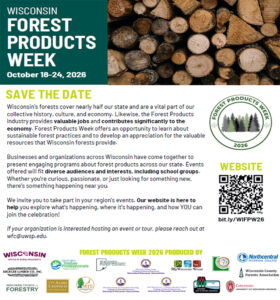
Wisconsin’s forests cover nearly half of our state and are a vital part of our collective history, culture and economy. Likewise, the Forest Products industry provides valuable jobs and contributes significantly to the economy. Forest Products Week offers an opportunity to learn about sustainable forest practices and to develop an appreciation for the valuable resources that Wisconsin forests provide.

Forest Product Week 2026 starts on Sunday, Oct. 18. Tours and special events will be hosted throughout the week at various locations, including logging sites, sawmills, paper manufacturers, secondary and urban wood manufacturers. Please save the date and join us at one of our events.

National Forest Products Week was established in 1960 with a proclamation brought forth from Congress and approved by President Kennedy, Public Law 86-753 (36 U.S.C. 123). The language in the proclamation cited the importance of forest products, dating back to the country’s founding and its ever-demanding growth cycles. A key sample from that first resolution states:

WHEREAS in order to reemphasize to each citizen in the United States the importance and heritage of our vast forest resources which are inseparably tied to our present and our future: Now, therefore, be it

Resolved by the Senate and House of Representatives of the United States of America in Congress assembled, That:

The seven-day period beginning on the third Sunday of October in each year is hereby designated as National Forest Products Week, and the President is requested to issue annually a proclamation calling upon the people of the United States to observe such week with appropriate ceremonies and activities.

From building materials and paper products to furniture and bioenergy, wood has a central tie to our daily lives. Today, decades after its launch, National Forest Products Week celebrates one of our nation’s most valuable resources and the people who transform trees into countless products that improve our lives.

For more information and to learn about events being held across the state, please visit the Wisconsin Forestry Center’s website.

Forest Products Highlighted At The Wisconsin State Fair

By Brian C. Cole, Wisconsin DNR Forest Product Specialist

person at the control of a piece of heavy equipment.

Photo Credit: Wisconsin Forestry Center

At this year’s Wisconsin State Fair, the Wisconsin Department of Natural Resources’ Forest Products Services program, in conjunction with the University of Wisconsin – Stevens Point Wisconsin Forestry Center, showcased the economic importance of Wisconsin’s forest products industry.

This included pulp and paper, lumber and non-timber forest products like maple syrup, as well as advanced forest products like biochar and sustainable aviation fuel. Wisconsin’s $27 billion forest products sector is leading the way in forest products development and sustainable forest management.

Along with forest products, fairgoers learned about forest health issues, invasive species, Wisconsin’s forest trees and tree identification. The big attraction was the Ponsse North America harvester simulator. Fairgoers had a chance to virtually operate a Ponsse Scorpion dangle head harvester and take part in a virtual, sustainable, cut-to-length harvest. Fairgoers learned about modern-day logging and why a sustainable harvest is needed for forest management.

Latest Timber Products Output Survey Results For Wisconsin Available

By Ryan Heiderman, Wisconsin DNR Forest Inventory Analyst

Recently, the United States Forest Service released updated data summaries from the Timber Products Output (TPO) survey, a component of the National Resource Use Monitoring (NRUM) program. This program falls under the larger Forest Inventory and Analysis (FIA) umbrella of programs. New data download, factsheets and other data products can be found on the NRUM webpage.

TPO is a survey on manufacturers who use harvested wood products that reports size of facilities, products manufactured, manufacturing capacity and other important indicators of the forest products industry. TPO data is reported for individual states based on an annual survey. The survey is administered by the Wisconsin DNR’s Forest Products Services team in partnership with the USFS. Annually, the team surveys approximately 85 primary wood processing facilities across Wisconsin. In addition to providing valuable industry data about roundwood production and wood residue generation, the survey offers an opportunity to connect with mills throughout the state, strengthening relationships and providing insight into current market conditions and trends within Wisconsin’s forest products industry.

chart

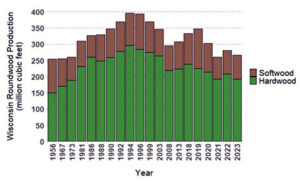
Figure 1: Annual hardwood and softwood roundwood production trends of Wisconsin’s primary wood-using mills. Data is sourced from various USFS publications reporting on the Wisconsin’s timber industry and wood product output. / Graphic Credit: Wisconsin DNR

The most recent TPO data is available for Wisconsin survey years 2022 and 2023. The most recent data shows 265 million cubic feet of roundwood production in Wisconsin mills, with about 75% of this production coming from hardwood species. Historic TPO data can be found in numerous reports published by the USFS dating back almost 100 years (Figure 1). Roundwood production ramped up in the 1980s as many of the cutover lands were becoming mature again and peaked in the 1990s. Wisconsin experienced a decline in large sawmills and paper mills from 1999 through 2008, with production subsequently declining during the 2008 financial crisis. Production rebounded slightly and again decreased during the COVID-19 years.

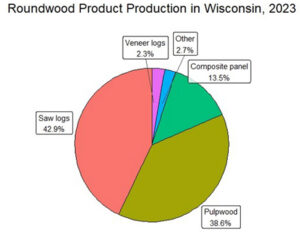
Roundwood is processed into different products depending on the species, tree size, market conditions, harvest site proximity to mills and a variety of other variables. In 2023, the majority of roundwood was processed into two major product categories accounting for over 80% of production: sawlogs and pulpwood (Figure 2).

chart

Figure 2: Roundwood product production by product class. / Graphic Credit: USDA Timber Products Output, Wisconsin, 2023

Sawlogs accounted for 43% of production and includes roundwood logs and bolts processed at sawmills into a variety of sawn products such as lumber, cants, squares and blanks. Red pine is the most commonly utilized species for sawlogs, accounting for approximately one-third of production. Red oak (18%) and sugar maple (11%) follow behind red pine in sawlog production.

Pulpwood accounted for 39% of production and includes roundwood logs, bolts and chips used in the manufacture of wood pulp for making paper and paperboard products. Many species are utilized for pulpwood including both soft (23%) and hard maple (15%), red (16%), white (6%) and jack (2%) pine, aspen (14%), and red (9%) and white (2%) oaks.

The third most common product made from roundwood are composite panels (13.5% of roundwood production), which include many different reconstituted wood products such as chip board, flake board, oriented strand board and various engineered lumber. The majority of composite panel roundwood is aspen (82%) with some basswood (14%) and other common hardwood species.

Forest Products Services Hosts Booth At Logging Expo

By Alex Anderson, Wisconsin DNR Forest Products Specialist

Heavy construction equipment at a site.

A log handling demonstration took place outside the venue. / Photo Credit: Wisconsin DNR

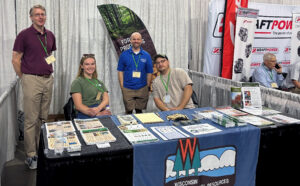
On Sept. 10 and 11, members of the Wisconsin DNR Forest Products Services (FPS) staff, along with Bill McNee from the Forest Health section, attended the Great Lakes Timber Professionals Association (GLTPA) Logging Expo at the Resch Center in Green Bay.

The event, which hosted over 300 exhibitors, held everything from logging equipment manufacturers to firewood production equipment companies to wood carvers. The annual event is hosted by GLTPA in Green Bay and Escanaba, Michigan on a rotating basis, so every other year, Wisconsin DNR FPS staff are able to host a booth and see what new and innovative products are hitting the market.

A group of workers at a convention booth

DNR representatives (left to right) Bill McNee, Elle Soderberg, Scott Lyon and Alex Anderson. / Photo Credit: Wisconsin DNR

In addition to connecting with industry stakeholders and seeing new products that have come to market in the past couple years, the booth provides DNR staff with an opportunity to address attendee questions and concerns regarding forest health and forest products. Scott Lyon, Ram Dahal, Elle Soderberg, Brian Cole and Alex Anderson all attended the event.

Wisconsin Projects Receive USDA Forest Service Wood Innovation Grants

By Scott Lyon, Wisconsin DNR Forest Products Team Leader

Wisconsin’s forest products industry will benefit from new federal investments through the U.S. Department of Agriculture Forest Service’s 2026 Wood Innovations Grant program. The Forest Service recently announced $105.5 million in grants nationwide to support wood products manufacturing, expand markets for wood and wood energy, strengthen rural economies and encourage innovative uses of America’s forest resources.

The Wood Innovations Program is designed to stimulate and expand markets for wood products and wood energy while supporting sustainable forest management. National priorities include mass timber, renewable wood energy, innovative wood products and technologies that can help reduce hazardous fuels and the costs of forest management.

Wisconsin recipients of the 2026 Wood Innovations awards include:

  • Cooper & Sons Timber, LLC, Blue River, Wisconsin: Upgrade sawmill processing technologies to increase production capacity in Wisconsin. $194,699
  • Timber Professionals Cooperative Enterprises, Tilleda, Wisconsin: Upgrade a chip mill to increase market access for low-value and small diameter timber to replace markets lost by papermill closures. $1,000,000
  • Bookends North, LLC, Milwaukee, Wisconsin: Develop tools to increase domestic mass timber market adoption in student housing and provide markets for small-diameter timber. $157,875

The Great Lakes Mass Timber Collaborative also received funding through a partnership with Dovetail Partners in Minnesota. The collaborative works across the Great Lakes region to advance mass timber markets, manufacturing and building opportunities, helping strengthen the regional forest products economy.

Wisconsin is represented in this regional effort by DNR forest products specialist Alex Anderson, who serves as a member of the Great Lakes Mass Timber Collaborative. His participation provides a connection between Wisconsin’s forest products industry and regional efforts to expand mass timber markets, share expertise and identify opportunities for collaboration.

Together, these investments and partnerships demonstrate the importance of collaboration at the state, regional and federal levels to strengthen wood markets, support forest products businesses and increase the utilization of Wisconsin’s forest resources.

The Wisconsin DNR’s Forest Products Services team played a supporting role in the grant process. Drawing on the team’s extensive experience in forest products utilization, markets and manufacturing, DNR staff assisted Wisconsin applicants with proposal reviews and provided letters of support for their applications.

Following the announcement of the Wisconsin awards, the DNR Forest Products Services team will continue to support the recipients by providing technical assistance related to mill upgrades and other project improvements. This assistance will help Wisconsin businesses successfully implement their projects and maximize the benefits of these federal investments.

Through these efforts, the DNR is helping connect federal investment with Wisconsin’s forest products industry and ensuring that projects are supported by technical expertise in wood utilization, markets and manufacturing.

This collaboration between the US Forest Service and the DNR helps connect federal investments with local knowledge and technical expertise. The resulting projects have the potential to strengthen Wisconsin’s forest products infrastructure, improve the utilization of Wisconsin-grown wood and create new opportunities for the state’s forest economy.

The 2026 awards demonstrate the continued potential for innovation across Wisconsin’s forest products sector. By connecting forest resources with new products, technologies and markets, these projects can help strengthen the state’s forest products economy while contributing to healthy and sustainably managed forests.

If you have a potential future project idea, please feel free to connect with the Wisconsin DNR. For more information and the complete list of 2026 Wood Innovations recipients, visit the USDA Forest Service Wood Innovations Program.

New Report Series Tracks Post-Pandemic Footprint Of Northeast-Midwest Forest Products Industry

By Ram Dahal, Wisconsin DNR Forest Economist

The Department of Forestry at Michigan State University, on behalf of the Northeast-Midwest State Foresters Alliance Forest Markets & Utilization Committee, has released a new, USDA-supported report series detailing the economic contributions of the forest products sector. This project consists of one comprehensive regional report and 20 state-specific reports.

The study utilized 2023 IMPLAN (Impact Analysis for Planning) data, the latest data available at the time of the analysis and compared it to the previous benchmark study completed in 2020 which relied on 2017 data. Looking at these timelines side by side, the reports show how the forest products sector reacted to COVID-19 supply chain issues and give us an updated look at its current post-pandemic health.

By assessing core economic indicators including employment, output, labor income and value-added, this series provides metrics that state agencies and industry leaders can use to monitor forest resource economic health, justify strategic capacity-building investments, target local workforce development, and shape regional forest management policies to actively strengthen the sector.

In the Northeast-Midwest region, the forest products industry acts as a $203 billion industry, directly supporting over 514,000 jobs. When accounting for the ripple effects throughout supply chains and household spending, the sector’s total footprint grows to a massive $387 billion and over 1.28 million jobs. This shows a substantial increase from the 2017 report, which recorded a $327 billion total footprint, highlighting the sector’s long-term growth and its powerful ability to support wider employment.

Compared to 2017, the Northeast-Midwest region’s forest products sector saw a 5.1% decline in direct employment and a 2.9% drop in gross output. Despite this, the industry showed resilience with a 1.7% net gain in value-added wealth, reaching $63 billion, while individual worker productivity increased to $395.27 thousand in output per job.

The report also reveals distinct manufacturing and labor patterns across individual states. Pennsylvania leads the region in direct employment, followed by Wisconsin, Ohio, Indiana, and Michigan. However, when measuring value of production, Wisconsin takes the top spot, followed by Pennsylvania, Ohio, Michigan and Indiana. Ultimately, these rankings demonstrate that while some states serve as major labor hubs, others excel in high-value, high-output production, providing each state agency with targeted insights to strengthen their specific local advantages.

These state and regional reports provide a clear, reliable guide for anyone looking to support the regional forest economy. This analysis helps state agencies, industry groups, and investors track sector health and create better workforce and marketing strategies. The complete series of state and regional reports is now available through the Michigan State University FERM Lab Forest Product Industry portal.

Wisconsin Forest Products Industry Navigates Challenging Market Conditions

By Elle Soderberg, Wisconsin DNR Forest Products Specialist

Wisconsin’s forest products industry continues to navigate a challenging market environment as mills, loggers and other industry partners respond to changing demand, limited pulpwood markets and broader economic uncertainty.

The Wisconsin DNR Forest Products Services team regularly connects with forest industry partners throughout the state to better understand regional and statewide market conditions. Recent conversations indicate that while portions of the industry remain stable, pressure continues across several key markets.

One of the most significant challenges remains Wisconsin’s pulp and paper sector. Recent mill closures have reduced available outlets for pulpwood and disrupted traditional fiber flows. The Ahlstrom mill in Kaukauna has resumed purchasing wood, but volumes remain limited as the market continues to adjust following the closure of Ahlstrom’s pulp mill in Mosinee. Suppliers with established contracts have generally experienced typical seasonal fluctuations, while those displaced by mill closures have faced greater difficulty finding new markets.

Conditions in the hardwood lumber market also remain difficult. Timber is generally available, but mills report that log costs remain high relative to finished lumber prices. Weak housing and construction activity has further reduced demand for hardwood products traditionally used in flooring, cabinetry and trim. White oak has been particularly affected, with green 4/4 FAS white oak prices falling nearly 24% over the past year and approximately 30% compared with two years ago.

Logging operations continue to feel the effects of these market conditions. Limited pulpwood outlets, changing weather patterns, increased fuel prices, and workforce availability remain persistent concerns. Wisconsin has ample harvestable timber, but some landowners are finding it increasingly difficult to secure logging contractors, while reduced demand is limiting economically viable markets for harvested material.

There are, however, some positive market signals. Industry contacts reported stronger demand for hickory, cherry and hard maple, while some Wisconsin and Lake States producers have experienced improved export opportunities. Strong demand from European and Asian markets has helped certain producers offset weakness elsewhere in the market.

Other wood markets remain mixed. Hardwood pallet production continues to lose market share to softwood, creating concern about the stability of low-grade markets. Railroad tie demand is also expected to soften, with the Railroad Tie Association forecasting demand of approximately 19.7 million ties in 2026 and 19.2 million in 2027.

Looking ahead, Wisconsin’s forest products industry is expected to remain cautious. While some sectors are showing signs of stability or growth, overall activity remains below full capacity. Future conditions will depend heavily on pulpwood market adjustments, housing and construction activity, broader economic conditions and the industry’s ability to adapt to changing markets.

Calendar of Events

  • Forest Products Week: Statewide in Wisconsin. Oct. 18-24, 2026. Tours and special events will be hosted throughout the week at various locations, including logging sites, sawmills, paper manufacturers, secondary and urban wood manufacturers. Learn about events being held across the state.
  • The Great Lakes Kiln Drying Association Fall Meeting: Appleton, Wisconsin, Nov. 12-13, 2026. Attendees will have the opportunity to tour local secondary wood manufacturing facilities. Additionally, Friday’s sessions will feature several informative presentations on the lumber industry. Learn more about this opportunity and register.
  • The Lakes States Lumber Association’s Annual Winter Meeting: Sheboygan, Wisconsin, Jan. 20-21, 2027. Find more information and register.

Extending The Health Benefits Of Urban Trees

By Dwayne Sperber, President, Wudeward Urban Forest Products & Founding Member, Urban Wood Network

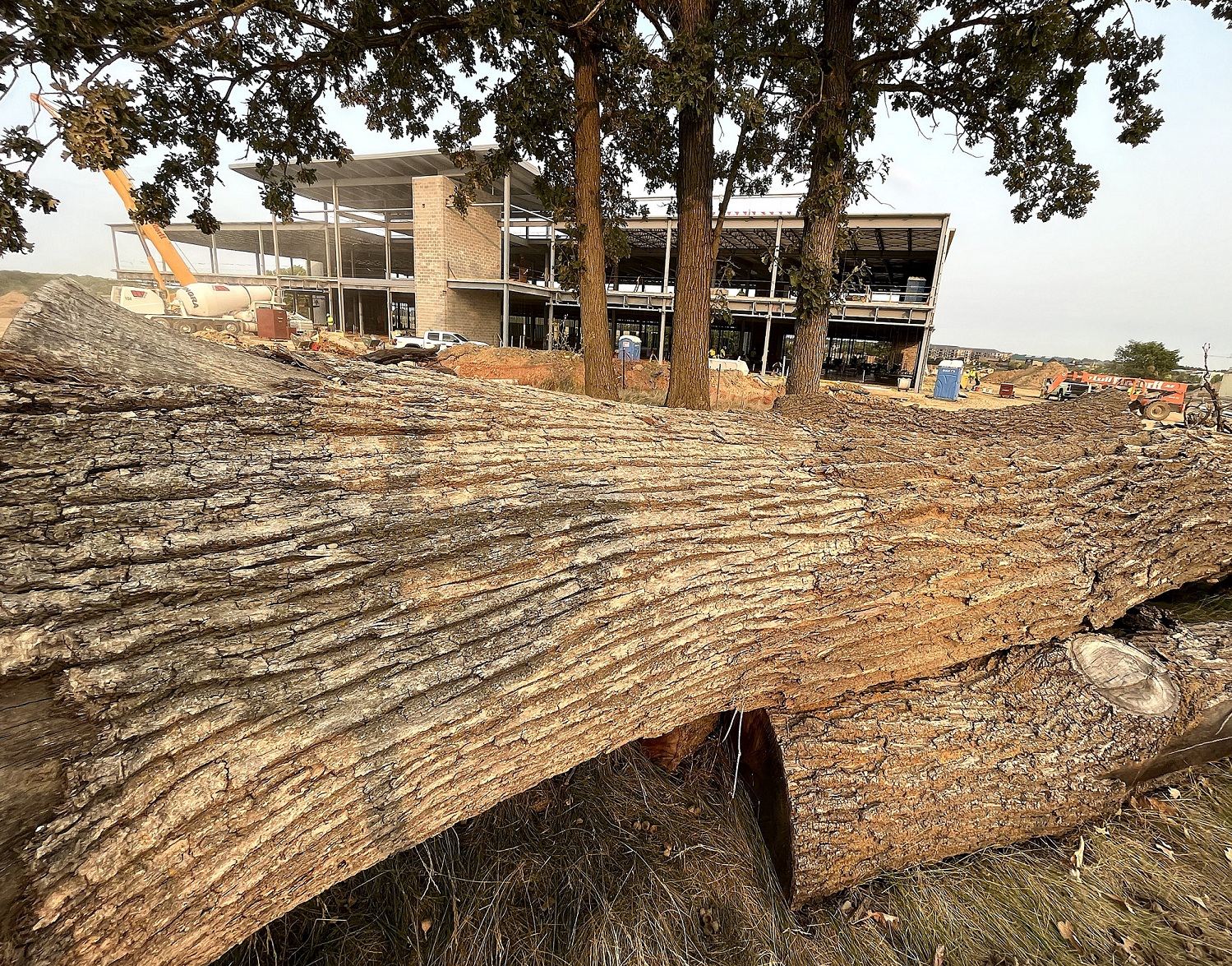
felled trees near a construction site

Photo Credit: Dwayne Sperber

Wisconsin’s 2020 Statewide Forest Action Plan recognizes urban and community forests as essential tools for achieving economic, environmental, social and public health goals. To advance those goals, the plan encourages multi-sector partnerships, engagement with new audiences and the use of urban wood. A recent project at the Medical College of Wisconsin illustrates how these priorities can be realized when those who manage urban and community forests are connected with established higher-use utilization pathways and the professionals committed to recognized industry standards who support them.

During site preparation for new student housing at the Medical College of Wisconsin, trees designated for removal were evaluated to determine their highest and best use. Logs suitable for higher-use applications were preserved and directed into a standardized urban wood utilization pathway where they can ultimately become durable wood products. Continue reading “Extending The Health Benefits Of Urban Trees” →

New Publication Highlights Perception Of Urban Wood Product Markets

LOGOA new U.S. Forest Service publication, Urban Residential Landowner Interest in Emerging Urban Wood Product Markets: Results from a Multi-City Survey, provides new insight into how homeowners across the United States engage with and perceive urban wood products and markets. The study highlights both the scale of urban wood resources and the opportunities to better utilize material that is often discarded as waste.

The research examined responses from residential landowners in six U.S. cities to better understand participation in urban wood systems and interest in urban wood products. Findings showed that approximately 15% of respondents had previously purchased or acquired urban wood products, demonstrating that a meaningful segment of urban residents is already participating in these emerging markets.

Interest was strongest for lower-value products such as mulch, wood chips, and compost, while products such as lumber and furniture generated lower—but still notable—levels of interest. The study also found that homeowners rely heavily on private-sector professionals, including landscaping and tree care companies, as well as friends and family, for trusted information related to tree care and wood utilization. Government agencies and nonprofit organizations were viewed as less influential information sources.

The publication underscores the significant opportunity to expand urban wood utilization efforts nationwide. Over the past two decades, urban tree removals have generated volumes of wood that exceed annual harvests from the U.S. National Forest System, yet much of this material continues to enter the waste stream. Strengthening local urban wood economies could support landfill diversion, create new business opportunities, encourage sustainable material use, and increase public awareness of the value of urban forests.

As one of the largest surveys of urban wood perceptions and practices conducted to date, the publication establishes an important baseline for future research, outreach, and market development efforts aimed at increasing participation in urban wood economies.

For more information on this study please visit: Urban Residential Landowner Interest in Emerging Urban Wood Product Markets: Results from a Multi-City Survey | US Forest Service Research and Development