Events

Markets Matter Convening Highlights

By Elle Soderberg, Wisconsin DNR Forest Products Specialist

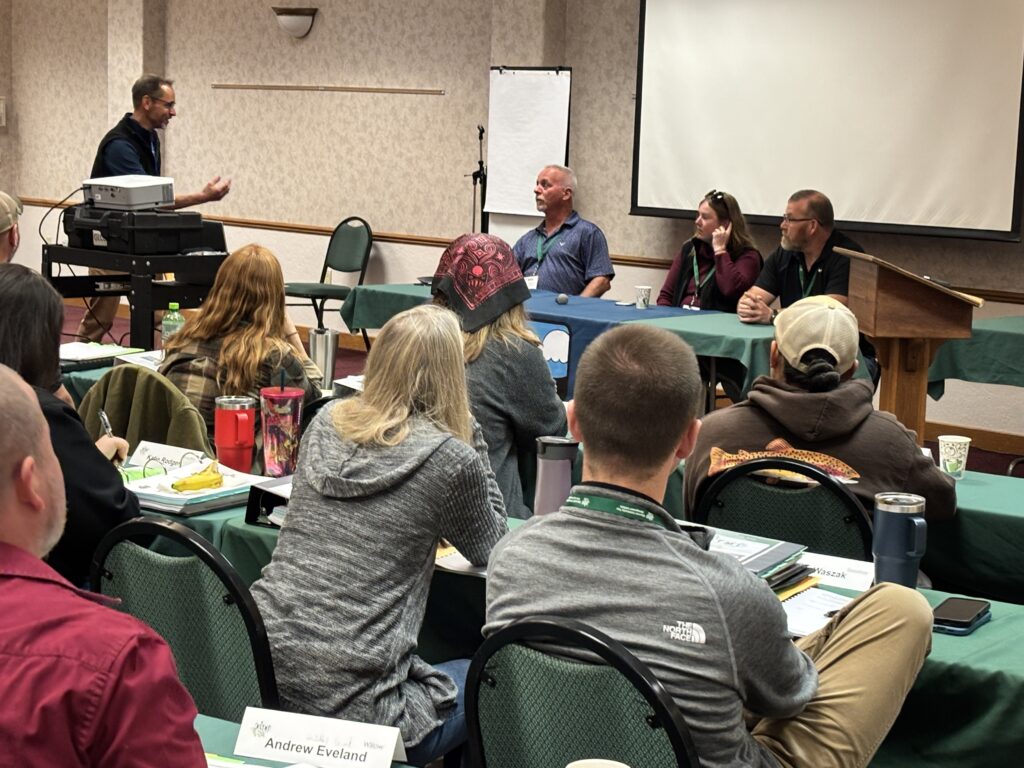
Leaders from across the forest products industry, government agencies, research institutions and economic development organizations recently gathered in Madison for the U.S. Endowment’s Markets Matter Convening. The event focused on the central challenge facing the forest sector today: Developing sustainable markets for low-value wood fiber, including small-diameter timber and mill residues.

Throughout the convening, participants emphasized that while the forest products industry continues to face significant economic and market pressures, there are also growing opportunities for innovation, collaboration and investment.

Current Market Conditions And Industry Challenges

Presentations from consulting groups across the country highlighted the broader economic realities impacting the forest sector. Speakers noted continued uncertainty surrounding economic policy, low consumer confidence and ongoing challenges within the housing market, including elevated mortgage and inflation rates. Notes from the convening also pointed to a rising median age of first-time homebuyers, now around 40 years old, further impacting housing demand and construction activity.

The pulp and paper sector continues to undergo significant transformation. According to discussions during the event, U.S. pulp and paper capacity has declined substantially over the past decade, while aging infrastructure and global competition continue to pressure domestic facilities. Participants noted that many pulp mill closures have been tied to high operational costs and changing market conditions.

A recurring theme throughout the convening was that the issue is not necessarily a lack of available wood fiber, but rather a lack of markets capable of economically utilizing low-value material. Roy Anderson with the Beck group shared that millions of bone-dry tons of wood fiber remain underutilized annually despite existing infrastructure theoretically being capable of consuming significantly more material if fully utilized.

Supporting Existing Infrastructure While Expanding New Markets

Several speakers emphasized the importance of maintaining and supporting existing forest products infrastructure, particularly sawmills and pulp and paper mills, which were repeatedly referred to as “system anchors” for rural economies. These facilities not only provide direct employment, but also support logging contractors, trucking, land management and secondary manufacturing industries.

At the same time, participants discussed the need to diversify market opportunities for wood fiber. Increased interest in biomass energy, biochar, wood-based building materials and emerging carbon-focused products were highlighted as potential growth areas. Discussions also explored opportunities to expand wood use in non-residential construction and affordable housing initiatives.

Elvy Barton with the Salt River Project discussed what the company has done in terms of biomass utilization strategies in the western United States, highlighting efforts to diversify biomass markets through biochar production. Benefits discussed included scalability, environmental co-benefits and lower capital costs compared to some other technologies. Challenges, however, remain in developing supply chains, end-user markets and large-scale applications.

Learning From Successful State-Level Efforts

South Carolina’s Forestry Recovery Task Force was presented as an example of how states can respond proactively to market disruptions. After losing a significant portion of its fiber supply markets over a short period, the state focused on stabilizing remaining companies while pursuing innovation and new product opportunities. Participants stressed the importance of bringing together industry leaders, researchers, economic development organizations and elected officials to focus on realistic, actionable solutions.

Not only in this presentation but across the whole convening, a common theme seemed to be the importance of partnerships with universities, design professionals and organizations promoting wood utilization and mass timber construction.

Policy, Investment And Research Priorities

Breakout sessions on research, investment and policy generated extensive discussion around how to better align funding, innovation and market development efforts. Participants discussed the need for stronger commercialization pathways to help move new technologies and research “out of the lab” and into practical application.

There was also significant conversation around potential policy tools and funding mechanisms to support forest product markets. Ideas included loan guarantee programs, reinvestment of softwood tariff revenues into forest product infrastructure, incentives for domestic wood utilization and potential subsidies designed to reduce barriers for wood products in construction and energy markets.

Participants emphasized the importance of developing durable, long-term policies capable of supporting both existing infrastructure and emerging technologies. Several discussions also focused on the need for greater collaboration between public agencies, private industry, investors and research institutions. It was discussed throughout the convening that one clear message needs to be formed and backed by the industry as a whole.

 A Shared Message Moving Forward

One of the key messages throughout the convening was that maintaining healthy forests and strong forest product markets are closely connected. Speakers emphasized that conservation and production are not opposing ideas, but rather complementary goals that depend on sustainable management and active markets for forest products.

Participants also stressed the importance of broadening conversations beyond traditional industry stakeholders and continuing to bring new voices into discussions around forest management, biomass utilization and wood innovation. A lack of understanding and negative public perception were also often brought up and the need to reframe the education around forestry and wood-based products.

As the convening concluded, attendees and closer Chief Tom Shultz of the USFS reinforced the idea that supporting existing infrastructure while investing in innovation, collaboration and market diversification will be essential to strengthening the long-term resilience of the forest products industry. The event served as both a reflection on current market realities and a call to action for developing practical, collaborative solutions for the future of low-value wood fiber markets.

International Mass Timber Conference

A booth made entirely of mass plywood is displayed at an expo.

Freres, an Oregon-based mass plywood producer, created this unique booth entirely from mass plywood. / Photo Credit: Wisconsin DNR

By Alex Anderson, Wisconsin DNR Forest Products Specialist

For the last 10 years, stakeholders in the mass timber industry have gathered in Portland, Oregon, for the annual International Mass Timber Conference (IMTC).

The 2026 IMTC was well-attended by a variety of businesses showing off their wares: mass timber fastener manufacturers, mass plywood and cross-laminated timber (CLT) producers and fabricators, engineering and building firms specializing in mass timber applications, and many others from a host of different sectors came to network and show off new, unique products. More than 3,000 attendees from 28 different countries attended the 2026 IMTC, which was about six times the size of the inaugural event, held in 2016, and nearly twice the size of the event five years ago.

The DNR Forest Products Services team hasn’t been able to attend the conference since 2021. Since then, the event has continued to expand in popularity. This year, there were three keynote speakers at the event, which took place from Tuesday, March 31 through Thursday, April 2. On day one, the keynote address was a series of live pitchers from several developers to a group of investors from different agencies. This offered a rare glimpse into the nuances of financial discussions surrounding mass timber development. Day two of the event had Kengo Kuma as the keynote speaker. Kuma is a famed Japanese architect who was responsible for designing the primary stadium for the 2020 Summer Olympics when Japan hosted the events. He has also done a myriad of fascinating designs utilizing mass timber and other timber elements for both structure and appearance. Finally, day three’s keynote involved mass timber specialists from Amazon and Meta, who described their respective businesses’ interest and commitment to building with sustainable materials.

In addition to meeting many new folks and reconnecting with others, the IMTC provided a unique opportunity for the launch of the Great Lakes Mass Timber Collaborative’s (GLMTC) Regional Vision document, which spells out the long-term goals of the group and creates some hierarchical clarity for future funding. This event, hosted after the conclusion of the main IMTC presentations on the final day of the conference, involved each of the GLMTC state leads presenting for a few minutes on each leads’ respective state’s strengths, weaknesses and opportunities surrounding wider mass timber adoption. Alex Anderson, Wisconsin DNR Forest Products Specialist and Wisconsin’s state lead, gave a short presentation on Wisconsin’s forest products and forestry industries and how they might work in the larger Great Lakes mass timber ecosystem.

A couple of the many interesting products on display at this year’s IMTC:

A modular learning environment made of mass timber is displayed at an expo.

Kalesnikoff, a Canadian mass timber manufacturer, unveiled modular mass timber classrooms at this year’s IMTC. / Photo Credit: Wisconsin DNR

A curving arch made of Canadian mass timber displayed at an expo.

Art Massif, another Canadian mass timber company, showed off their “aspen pure” line of glulams, which are made entirely of quaking aspen (Populus tremuloides). Their testing showed these beams to be similar in strength and stiffness values to Spruce-Pine-Fir (SPF) products. / Photo Credit: Wisconsin DNR

Calendar Of Events

LSLA Hardwood Lumber Grading Class – July 27-29, 2026

LSLA Education will offer a Hardwood Lumber Grading Short Course in Antigo, Wisconsin, from July 27-29, 2026. The course is open to everyone interested in lumber grading. This class is targeted at beginners and therefore will be ideal for sawyers, edgermen, trimmermen, grading trainees, salespeople, managers and supervisors. This course will cover topics such as clear vs. sound cuttings, wood characteristics and defects, hardwood lumber manufacturing standards, species, kiln dried lumber and hands-on lumber grading. For complete details, including the topics that will be covered in the course, list of area hotels and registration link, see the brochure.

Kiln Drying Short Course: Drying Quality Lumber – Aug. 11-13, 2026

Great Lakes Kiln Drying Association offers a Kiln Drying Short Course in Antigo, Wisconsin, from Aug. 11-13, 2026. The workshop is packed with valuable information for kiln operators and managers. The variety and quality of the information make this a must-attend event. The workshop will focus on drying systems, controlling lumber quality, species specific drying, wood structure and drying science. More than 20 breakout topics will be covered to help you maintain a successful kiln operation. Find more information and register on their website.

Sawing, Edging And Trimming Class – July 30, 2026

LSLA Education offers a one-day workshop on sawing, edging and trimming on Thursday, July 30, 2026, in Antigo, Wisconsin. This course will cover the basics of NHLA grading rules, sawing for recovery and edging and trimming requirements. Bottom-dollar issues of upgrade and increased recovery will be emphasized. For complete details, including the topics that will be covered, a list of area hotels and registration link, see their brochure.

GLTPA Logging Congress – Sept. 10-11, 2026

The Great Lakes Logging and Heavy Equipment Expo will take place from Sept. 8-10 in Green Bay, Wisconsin. More than 300 indoor and outdoor exhibitors attend each year to showcase the best of the best when it comes to log splitters, portable sawmills, compact tractors and logging equipment, chainsaw carving, wood/pellet stove dealers and more. Find more information on their website.

Spring Weather Damages Trees

Red pine damaged by the April 2nd, 2026, ice storm in central Wisconsin. / Photo Credit: Wisconsin DNR

By Michael Hillstrom, DNR Invasive Forest Pest Coordinator, Fitchburg
Michael.Hillstrom@wisconsin.gov or 608-513-7690

Spring 2026 has seen a variety of tree stress events. Wisconsin trees have experienced snow and ice damage, severe storms that resulted in wind, hail and flood damage and swings in temperatures that brought leaf out and subsequent frost damage.

Continue reading “Spring Weather Damages Trees”

Invasive Species Action Month: Action Awards, Awareness Weekend

The 2025 winners of the Invasive Species Action Awards. / Photo Credit: Wisconsin DNR

By Mackenzie Manicki, DNR Invasive Plant Specialist, Madison

In Wisconsin, June is Invasive Species Action Month (ISAM), and plenty of activities are planned to educate and motivate residents and visitors into action.

Invasive species are defined as nonnative organisms whose introduction can cause harm to the environment, the economy, or pose threats to human health.

Continue reading “Invasive Species Action Month: Action Awards, Awareness Weekend”

Forest Health Staffers Plan Appearances

A worker in the woods, holding a young tree to be planted.

Wisconsin DNR Forest Insect Pest Specialist Mike Hillstrom gives a presentation during a New Forester Training session in Marinette County in 2024. / Photo Credit: Bill McNee, Wisconsin DNR

By Art Kabelowsky, DNR Outreach and Communications, Fitchburg Arthur.Kabelowsky@wisconsin.gov or 608-335-0167

Mike Hillstrom, the Wisconsin Department of Natural Resources Invasive Forest Pest Coordinator, will give a public presentation on forest invasive species from 10 a.m. to noon Saturday, June 20, at Lake Kegonsa State Park in Stoughton.

The talk will be part of the informational and educational events sponsored as part of the DNR’s Invasive Species Awareness Weekend.

Continue reading “Forest Health Staffers Plan Appearances”

Upcoming Training & Events

group of people learning to plant a tree* These training opportunities are provided as an information service only and do not constitute endorsement by the Wisconsin Department of Natural Resources (DNR).

See below for information on training topics and events including i-Tree, American elm research, oak health issues, invasives and private equity. Continue reading “Upcoming Training & Events”

Governor Plants Seeds Of Celebration For Wisconsin’s Forests

Wisconsin Gov. Tony Evers (second from right) joins educators working with the Lodi School Forest during a tree planting event on Arbor Day 2026.

By Art Kabelowsky, DNR Forest Health Outreach and Communications
Arthur.Kabelowsky@wisconsin.gov; 608-335-0167

Wisconsin Governor Tony Evers didn’t have to go out on a limb to make this announcement.

By issuing a Governor’s Proclamation last month, Gov. Evers has shined a spotlight on Wisconsin’s 17 million acres of forestland. His announcement officially recognized Wisconsin’s participation in Forest Appreciation Week and Arbor Day.

Continue reading “Governor Plants Seeds Of Celebration For Wisconsin’s Forests”

Forest Health Specialist Paul Cigan Spreads The News

Paul Cigan (in black hat) discusses the health of a tree with fellow Wisconsin Department of Natural Resources Forest Health specialists Bill McNee and Linda Williams in Cambridge. / Photo Credit: Wisconsin DNR

By Art Kabelowsky, DNR Outreach and Communications, Fitchburg
Arthur.Kabelowsky@wisconsin.gov or 608-335-0167

Paul Cigan, the Wisconsin Department of Natural Resources Forest Health specialist for Northwest Wisconsin, has planned a public discussion for Tuesday, June 30, in Ashland.

Cigan will give a presentation on “Invasive Insects and Diseases” and take questions from those in attendance at the event, set for 6 p.m. June 30 at the Northern Great Lakes Visitors Center, 29270 County Hwy. G, Ashland.

Continue reading “Forest Health Specialist Paul Cigan Spreads The News”

Call For Urban Forestry Presentations: Due July 1, 2026

Wisconsin Arborist Association LogoThe Wisconsin Arborist Association (WAA) is accepting presentations for the 2027 Annual Conference to be held in Green Bay, WI on Feb. 14-16, 2027. This three-day event attracts approximately 950 attendees including professional arborists, community foresters, nursery professionals, utility workers, park/recreation staff, other green industry professionals, educators and students.

If you are interested in speaking at this conference, please complete the online form. Please make sure that the form is filled out completely to be considered. Continue reading “Call For Urban Forestry Presentations: Due July 1, 2026”