Care for your woods

Pitch Borer Mass On White Pine

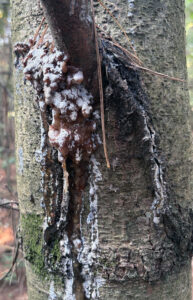
A pitch mass on a tree's main stem.

A pitch “glob”, with oozing pitch running down the trunk of a young white pine infected with pitch mass borer. / Photo Credit: Wisconsin DNR

By Linda Williams, Forest Health Specialist, Woodruff
Linda.Williams@wisconsin.gov, 920-360-0665

Have you seen big globs of gooey pitch on the main stems of eastern white pine trees?  Or maybe you’ve seen them on spruce?

For those with an adventurous side, grab a stick and scrape off some of that gooey glob. You might be rewarded with the sight of large larvae feeding beneath all of that goo. This is the larvae of our native pitch mass borer. Adults are clearwing moths that look a bit like wasps.
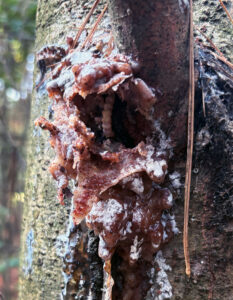
Peeling reveals a pitch borer "goo" mass on a damaged tree.

Using a stick to pry away some of the gooey pitch on a tree exposes a pitch mass borer larva underneath. / Photo Credit: Wisconsin DNR

Adults lay eggs on the bark. When eggs hatch, the tiny larvae chew into the bark and begin feeding on the inner bark. They feed enough to irritate the tree, causing more sap and pitch to be produced, which the larvae feed on.

Pitch mass borer can take two to three years to complete development, remaining in that same location throughout their life and continuously irritating the inner bark to promote continued pitch production. Pupation occurs under the glob of pitch and adults then chew their way out. Old pitch globs will harden and darken over time, remaining on the tree for a year or more before finally weathering off.

Hosts include pines (eastern white, jack, scotch and Austrian) and spruces (blue and Norway).

Management on forest trees is not necessary. Severely damaged and deformed trees can be removed during the first thinning. Management on yard trees includes maintaining healthy trees (which are less attractive to the adults), watering during droughts, avoiding pruning during mid-summer (which can attract adults to lay eggs near the fresh wounds), destroying any larvae under the globs of pitch and removing and disposing of severely infested trees.
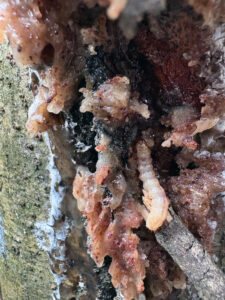
A pitch mass borer larva on a tree.

Scraping more pitch off a tree’s main stem shows a pitch mass borer larva on the end of the stick. / Photo Credit: Wisconsin DNR
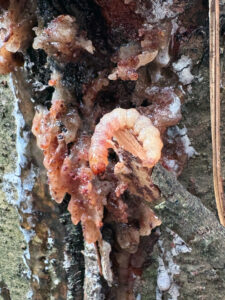
A photo showing the whitish color of some pitch mass borer larvae.

Pitch mass borer larvae can be shades of white to pink, depending on the host. / Photo Credit: Wisconsin DNR
Forest Health Staffers Plan Public Appearances

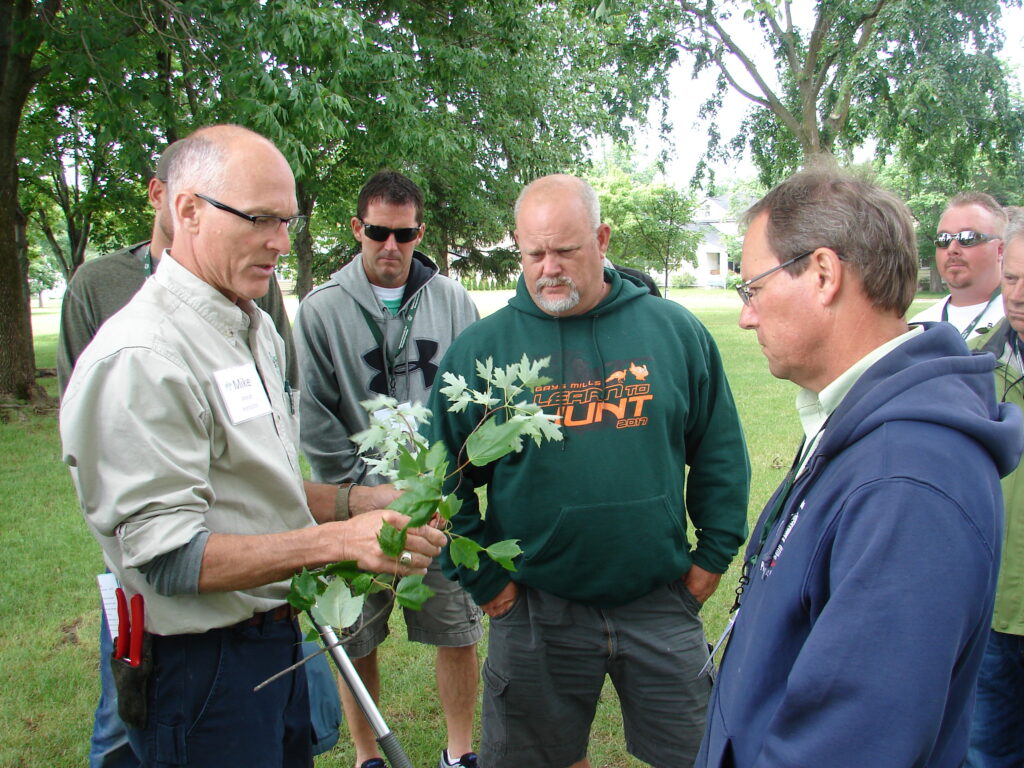
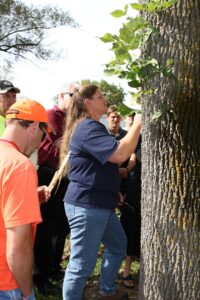
Workers inspect a tree's health.

Linda Williams, DNR Forest Health specialist for Northeast Wisconsin, inspects a tree during a training session. / Photo Credit: Wisconsin DNR

By Art Kabelowsky, DNR Forest Health Communications, Fitchburg;
Arthur.Kabelowsky@wisconsin.gov or 608-335-0167

Linda Williams, Wisconsin Department of Natural Resources Forest Health specialist for Northeast Wisconsin, will speak at multiple “Learn About Your Land” teaching events scheduled in September.

Continue reading “Forest Health Staffers Plan Public Appearances” →

Urban Forestry Fall Workshop: Tree Resilience: Planting, Pruning And Care

pruners

Photo Credit: Wisconsin DNR

This Urban Forestry workshop is brought to you by UW-Madison Division of Extension and the Wisconsin Department of Natural Resources (DNR).

Join us to learn about tree biology and the standards of care that have been developed by the American National Standards Institute to help get trees off to a great start. Led by Rich Hauer, Director of Urban Forestry at Eocene Environmental Group, we will build on tree biology to discuss pruning and planting methods to optimize tree health.

This day-long workshop begins with a morning classroom session covering:

  • Biological Basis of Tree Action
  • Terms, Technology and Standards of Care Best Management Practices
  • Tree Planting, Growth and Longevity Proper Tree Pruning

Continue reading “Urban Forestry Fall Workshop: Tree Resilience: Planting, Pruning And Care” →

Hydrate Your Trees As Well As Your Body!

By: Kevin Sayers, sayersk@michigan.gov or 517-582-3209 or Lawrence Law, LawL1@michigan.gov or  313-316-4137

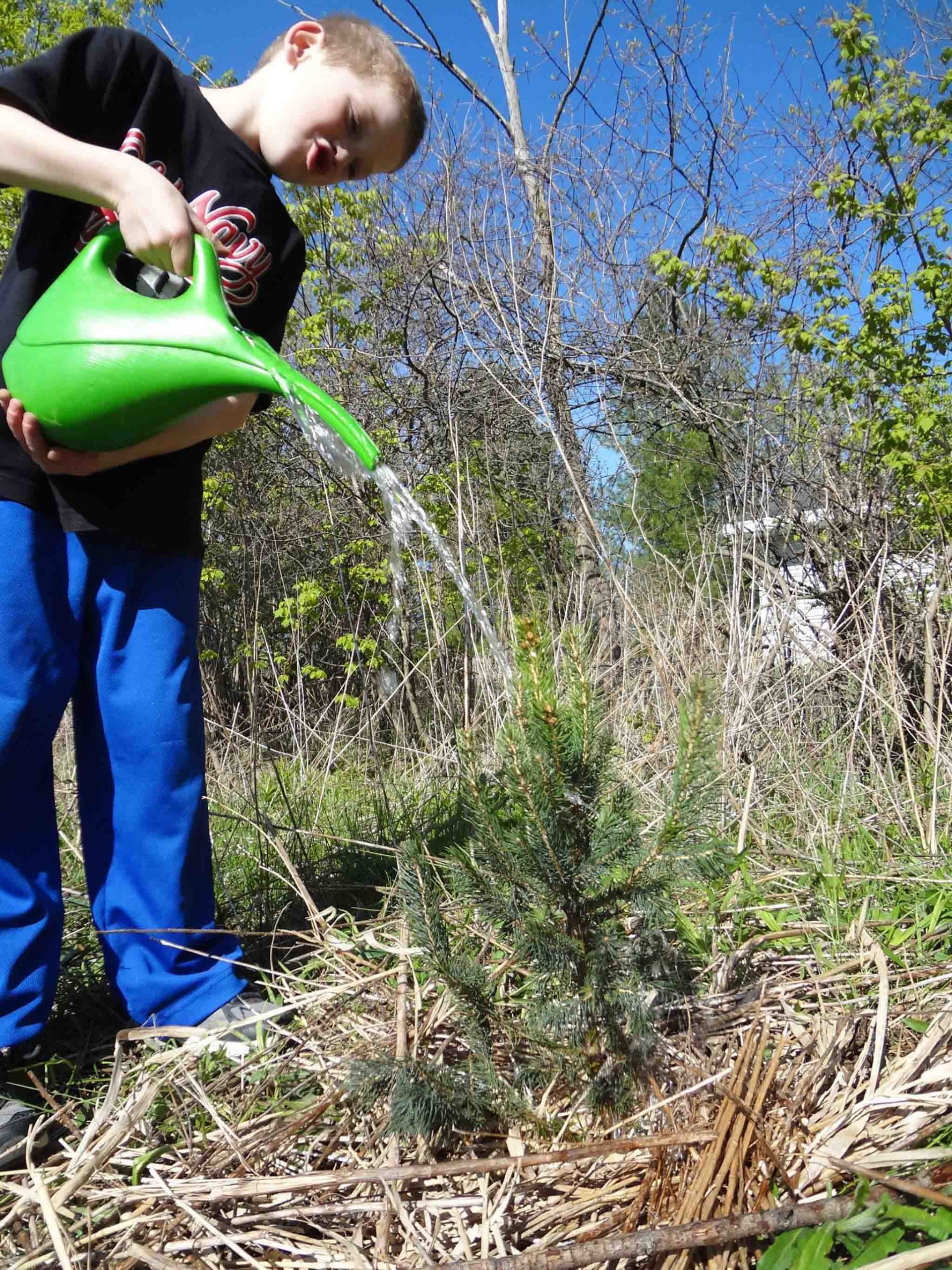
boy watering a spruce tree

Photo Credit: Wisconsin DNR

You don’t go anywhere in summer without your water bottle, right? In hot weather, your trees may need a drink, too, especially if they’re recently planted.

“When it’s hot and dry outside, your trees may suffer if they are not getting at least an inch of rain each week,” said Kevin Sayers, Urban and Community Forestry Program manager with the Michigan Department of Natural Resources. “Watering your trees during hot, dry spells can go a long way toward keeping them healthy.”

Deciduous trees – those that lose their leaves in fall – show drought stress through curling or drooping leaves. Leaves may “scorch,” or turn brown at the edges, fall off early or exhibit early fall color. Evergreen needles may turn yellow, then red or brown. Continue reading “Hydrate Your Trees As Well As Your Body!” →

DNR Participates In Beech Leaf Disease Detection Survey

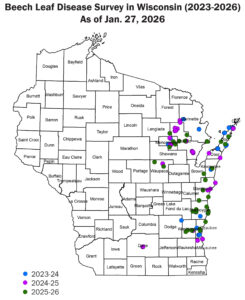
Map of Wisconsin

A Wisconsin map showing results of a beech leaf disease survey that ran from 2023 to 2026. / Graphic Credit: Wisconsin DNR

By Art Kabelowsky, DNR Forest Health Communications, Fitchburg;
Arthur.Kabelowsky@wisconsin.gov; 608-335-0167

To date, there have been no confirmed discoveries of beech leaf disease (BLD) in Wisconsin landscape, and we are on the lookout for this disease.

The disease is primarily found on American beech (Fagus grandifolia) but can also be found on ornamental species like European, Oriental, and Chinese beech (F. sylvatica, F. orientalis, and F. engleriana). Although it has not yet been found in Wisconsin, recent discoveries of the disease in Michigan and other states highlight the continued importance of monitoring BLD’s expansion.

Continue reading “DNR Participates In Beech Leaf Disease Detection Survey” →

Forest Health Staffers Plan Public Appearances

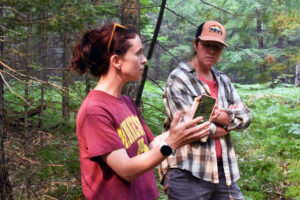
Two DNR workers discuss tree issues in the forest.

Alex Hornung, Wisconsin DNR Forest Health specialist for Central Wisconsin, discusses the tree disease phomopsis with Chief Forester Heather Berklund during a site visit near Minocqua in July 2026. / Photo Credit: Wisconsin DNR

By Art Kabelowsky, DNR Forest Health Communications, Fitchburg;
Arthur.Kabelowsky@wisconsin.gov or 608-335-0167

Alex Hornung, the Wisconsin Department of Natural Resources Forest Health Specialist for Central Wisconsin, will discuss oak wilt biology at a workshop this month.

Hornung will take part in a Wisconsin Forestry Center/Wisconsin Natural Resources Foundation workshop on oak wilt biology and management, focused on information for landowners and the public. The discussion will take place from 1 to 3:30 p.m. Tuesday, Aug. 18, at Schmeeckle Reserve, 2419 N. Point Drive, Stevens Point. She will be joined by Dr. Holly Petrillo, Professor of Forestry at the University of Wisconsin-Stevens Point.

Continue reading “Forest Health Staffers Plan Public Appearances” →

2027 Urban Forestry Grants Now Open

By Nicolle Spafford, DNR Urban Forestry Grant Manager
Nicolle.Spafford@wisconsin.gov or 715-896-7099

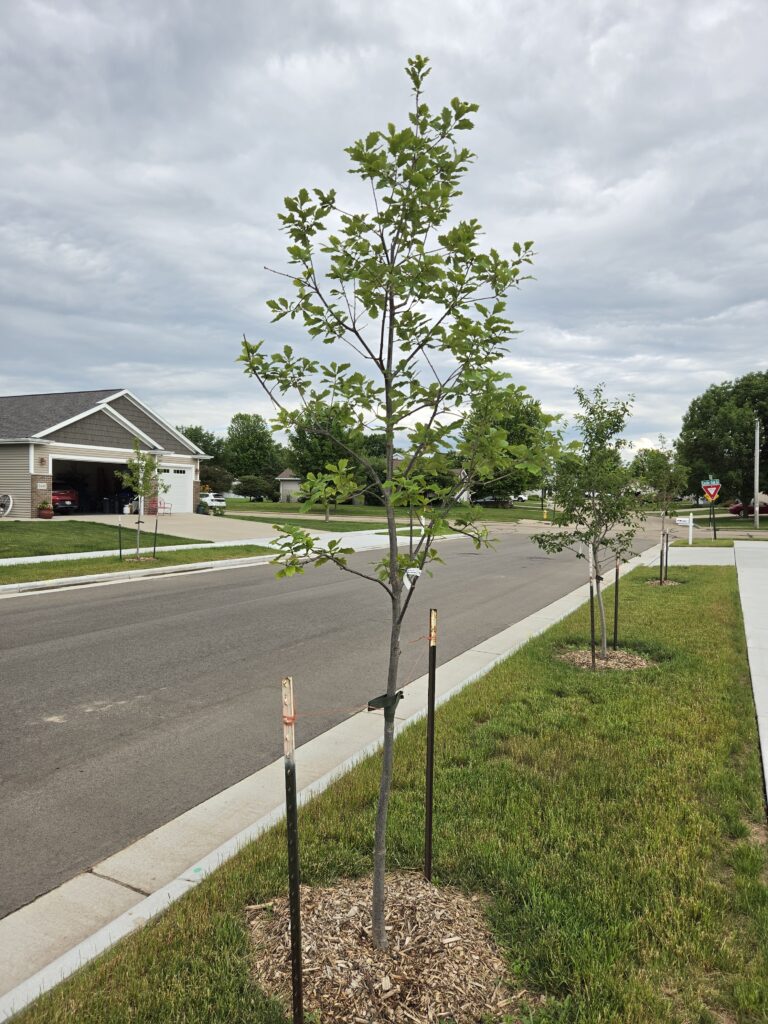
newly planted trees

Photo Credit: Wisconsin DNR

As of July 1, 2026, cities, villages, towns, counties, tribes and 501(c)(3) nonprofit organizations in – or conducting their projects in – Wisconsin can apply for a regular or startup 2027 Wisconsin Department of Natural Resources (DNR) Urban Forestry grant.

Regular Urban Forestry grants range from $1,000 to $25,000 and grant recipients must match each grant dollar for dollar. These grants fund projects that improve a community’s capacity to manage its trees (e.g., management plans, ordinances, staff training, tree board development, inventories and public education) and projects that help conserve, protect, expand or improve the urban forest resource (e.g., planting, hazard tree removal, pest control). Continue reading “2027 Urban Forestry Grants Now Open” →

When Can I Prune That Elm Tree?

By Elton Rogers, DNR Urban Forestry Coordinator
Elton.Rogers@wisconsin.gov or 414-294-8675

Most urban foresters and arborists are aware of the historical significance of Dutch elm disease (DED). Introduced to the United States in the 1930s, this deadly fungus wreaked havoc on urban and rural forests throughout the United States. In many ways, DED was the impetus for many of the best practices of urban forestry we see today, such as species diversification and modern plant health care practices.

Likewise, most urban forest practitioners understand DED is still very much prevalent today, and if they are managing any lingering American elms, they know they can help decrease their susceptibility to the disease by not actively pruning or wounding them during the growing season. Pruning these elms during the growing season attracts bark beetles, which can carry thousands of DED fungal spores on their bodies. But elm is a complex genus; there are over 30 different species of elm and hundreds (if not thousands) of hybrids and cultivars in the landscape. So, which of these species and cultivars can you prune during the growing season, and which shall you not? Continue reading “When Can I Prune That Elm Tree?” →

Upcoming Training & Events

group of adult learning to identify trees

Photo Credit: Wisconsin DNR

* These training opportunities are provided as an information service only and do not constitute endorsement by the Wisconsin Department of Natural Resources (DNR).

See below for information on training topics and events, including biopesticides, invasives, urban trees and fire, tree diseases, ecological restoration, safety and woodland trees and management. Continue reading “Upcoming Training & Events” →

First Populations Of Invasive Pale Swallow-wort Confirmed In Wisconsin

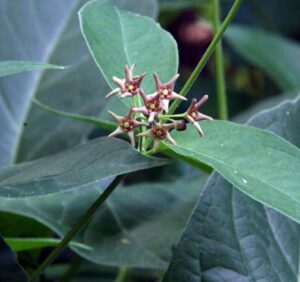
Closeup of pale swallow-wort flower cluster.

Pale swallow-wort flowers along the stem at the leaf axils. / Photo Credit: Chris Evans, University of Illinois, Bugwood.org

By Mackenzie Manicki, DNR Natural Resources Research Scientist

The Wisconsin Department of Natural Resources has confirmed that the state’s first populations of the invasive vine pale swallow-wort (Vincetoxicum rossicum) have been found.

The populations were first detected in Oconto and Shawano counties, within the outskirts of Krakow along the shared county line.

These are the first known populations in the state, making rapid response efforts critical in preventing the establishment of this species in Wisconsin.

Continue reading “First Populations Of Invasive Pale Swallow-wort Confirmed In Wisconsin” →