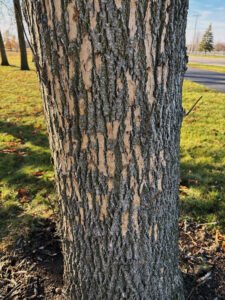
Woodpecker flecking on the bark of a dying ash tree is visible at Winnebago County Community Park in Oshkosh. Flecking occurs when the birds peck away at the trees to feed on emerald ash borer larvae beneath the bark. / Photo Credit: Wisconsin DNR
By Bill McNee, DNR Forest Health Specialist
Bill.McNee@wisconsin.gov
The Wisconsin Department of Natural Resources (DNR) encourages property owners to watch for woodpecker damage to their ash trees this winter.
Woodpecker damage, often called “flecking,” happens when birds peck away some of a tree’s bark to access the larvae underneath. Flecking is a common early sign that an ash tree might be infested with emerald ash borer (EAB), an invasive insect. EAB is the most damaging threat to Wisconsin trees, killing more than 99% of the untreated ash trees it infests.
EAB has now been identified in all 72 of Wisconsin’s counties, although the southern part of the state is more heavily infested than most northern counties. If you’re noticing flecking on your ash trees for the first time, it’s probably a sign that EAB has finally spread to your property.
Landowners who spot woodpecker damage in their woodlot ash trees are encouraged to consult a DNR or consulting forester for management advice. EAB management options will vary considerably depending on forest type, location and local wood markets. Insecticide treatments are seldom practical for woodlot ash trees, but can be used to protect high-value trees.
Please report a suspected infestation to your area’s DNR Forest Health specialist if it is present in a community (town, village or city) that does not have a confirmed detection on this map.
Consider Protecting High-value Ash Trees
Property owners who detect an EAB infestation in its early stages – often by looking for woodpecker damage – can take steps to protect their high-value ash trees by treating them with insecticide between mid-April and mid-May. Insecticide treatment of valuable ash trees is more likely to succeed if the trees have low or moderate levels of woodpecker damage. Now is a good time to make plans for insecticide protection this spring.
Treatments are worth considering statewide. The highest risk of infestation is in communities already known to be infested. More information on EAB protection can be found on the Wisconsin EAB website.
Treatments are applied every one or two years, depending on the product. Homeowners can apply some types of insecticide products, but a certified professional must apply others. Review the available options before selecting an insecticide and treatment method. Visit the Wisconsin EAB and EAB Information Network websites for more insecticide information.
Property owners should consider a tree’s benefits – including shade, view, wildlife habitat, reduced air conditioner use and increased property value – along with the financial cost of the treatments. Some ash trees are not worth treating due to pre-existing health or structural problems. For those trees, removal and replacement may be better options.
You can search for a certified arborist on the Wisconsin Arborist Association website and the International Society of Arboriculture website. Other businesses that conduct EAB treatments may be found online. Property owners are encouraged to arrange for treatments well in advance.
Other Signs And Symptoms Of Infestation

Emerald ash borer larvae carve S-shaped grooves in wood, just below the bark, restricting the movement of water and nutrients throughout the tree. / Photo Credit: Wisconsin DNR
Flecking usually starts in a tree’s canopy and progresses down the tree over the next few years if the tree is not treated. Other signs and symptoms of EAB infestation include:
- Sprouts growing from the base or trunk of the tree
- A thinning canopy with smaller, pale leaves
- Small (one-eighth of an inch), D-shaped exit holes in the bark
- Green beetles crawling on the trunk of ash trees during the summer
Visit the DNR’s EAB webpage for more information.