
By Tim Shively, DNR Forest Health Specialist
Timothy.Shively@wisconsin.gov or 608-772-6974
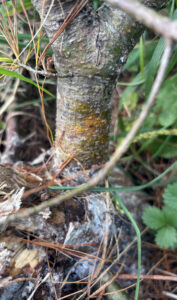
A white pine blister rust canker as seen on a young white pine tree. / Photo Credit: Wisconsin DNR
Eastern white pine (Pinus strobus) has historically held great ecological, cultural and economic value throughout Wisconsin, a tradition which continues today. For more than 100 years, however, it has been threatened by a non-native, invasive fungal pathogen called Cronartium ribicola, or white pine blister rust (WPBR).
History And Disease Cycle
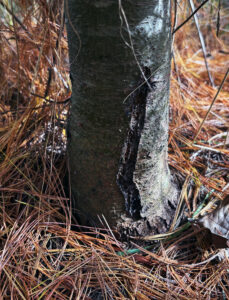
White pine blister rust causes a split in the main stem of a white pine tree. / Photo Credit: Wisconsin DNR
WPBR is native to Asia and first infected eastern white pine trees that were exported to Europe and planted there. Eventually, infected nursery stock made its way back to North America around the turn of the 20th century.
Like many other rust diseases, WPBR has a complicated life cycle involving several stages that are split between two host plants throughout the year. The second host plant is a gooseberry or currant shrub (Ribes spp.), several species of which are native to Wisconsin.
When temperatures rise in the spring and the weather is sufficiently wet, spores develop on white pines and are dispersed to gooseberries for the summer. Under appropriate conditions, the fungus often multiplies in great numbers during this stage. In autumn, another type of spore is produced that returns to white pines and infects the trees through their needles.
Over the ensuing months and years, the fungus travels throughout the tree and causes cankers, or dead areas on the branches or stems, which cause extensive damage and mortality.
WPBR Symptoms Differ Based On Tree Size
A white pine blister rust canker as seen on a young white pine tree. / Photo Credit: Wisconsin DNR
On mature trees, a telltale sign of WPBR infection is flagging, or the death of individual branches. This appears as patches of yellowing or brown needles in the canopy. Pruning out the branches and properly disposing of infected material can save the tree. However, WPBR can manifest quite differently on younger trees simply because of their small size.
Cankers quickly girdle the smaller diameter branches and stems, rather than taking several years to spread around a larger tree. On seedlings, needles can grow directly out of the stem, and their branches will remain quite short for several years. Simply put, there is a shorter distance between the infection site at the needles and the stem, which is the most vulnerable part of the tree. The pathogen spreads quickly from the former to the latter and causes lethal girdling cankers.
Because branches on younger trees are also closer to the ground, stem cankers tend to be lower as well, meaning that a single canker can completely cut off the flow of water and nutrients and induce whole-tree mortality.
Symptoms on young white pine often progress rapidly. Entire trees will turn off-green or yellow in early fall, appearing much like a serious nutrient deficiency or some other abiotic condition. Cankers may also be difficult to detect by the untrained eye, requiring close inspection of the branches and stems. Sticky, orange and off-white spore masses that appear in the spring may be obvious, but they are elusively transient. For much of the year, cankers appear as cracked bark or dark, sunken areas on the branches or stems.
Many landowners and forest managers are aware of how WPBR appears on larger trees (i.e., flagging and visible cankers that drain resin) and are confused when their younger trees succumb to WPBR after showing markedly different symptoms.
Management Options For WPBR In Young Stands

A 10-year white pine plantation has trees that show symptoms of white pine blister rust. / Photo Credit: Wisconsin DNR
Managing WPBR infections on young stands begins prior to planting. It is crucial to select a low-risk site, or one that will not collect cool, moist air during the spring and fall. High-risk areas include low-lying sites or depressions. Open areas also tend to collect more dew, so a thin overstory may help reduce moisture and mitigate conditions that are conducive to infection. This strategy has the added benefit of reducing white pine weevil infestations. In naturally regenerating stands, this logic can be extended by managing for white pine in appropriate areas or simply allowing WPBR to shape the stand’s spatial composition.
Planting or maintaining stands at higher densities permits a degree of mortality which may be unavoidable yet tolerable, because the number of surviving residual trees will meet management goals. Where possible, pruning up to 50% of tree height until the pruned area is 30 feet high will reduce potential infection sites close to the ground, where moisture exacerbates WPBR infections and cankers tend to be more lethal.
Reducing gooseberry plants by mechanical and/or chemical treatment is another potential strategy, but it is not often recommended because of the difficulty in achieving and maintaining local eradication of the shrubs. Most infections occur less than 1,000 feet from the other host plant, so it may be feasible in some areas. However, it’s important to consider the ecological impacts of removing native shrubs.
Finally, sanitation by removal of infected white pines could be an effective treatment during the winter months. Once infected individuals are identified in the fall, no more trees will become infected because WPBR cannot spread between trees. Their removal might help prevent the pathogen from spreading back to gooseberries in the spring.