By Dan Buckler, DNR Urban Forest Assessment Specialist
Daniel.Buckler@wisconsin.gov or 608-445-4578
Especially in the wake of emerald ash borer, urban foresters have stressed species diversity as an important goal in the management of local trees. Now there is a new, intuitive way of tracking species diversity by simply counting how many species it takes to make up half of your community’s trees.
This metric is called the top diversity index, or TD-50 index, and was proposed in a 2022 article in Urban Forestry and Urban Greening by Natalie Love and others. The index is deceptively simple — by counting the minimum number of species it takes to comprise 50% of your trees, you have an easy benchmark to improve upon to reduce your reliance on a few species.
Take the City of Platteville, for example. Its eight most common tree species are in the table below. The species percentage column shows what percentage of the city’s entire inventory is composed of that tree, while the total percentage is the accumulating percentage as you add the next common species. You see it takes a little over seven species to account for 50% of the city’s tree population. The TD-50 of Platteville is thus 7.3.
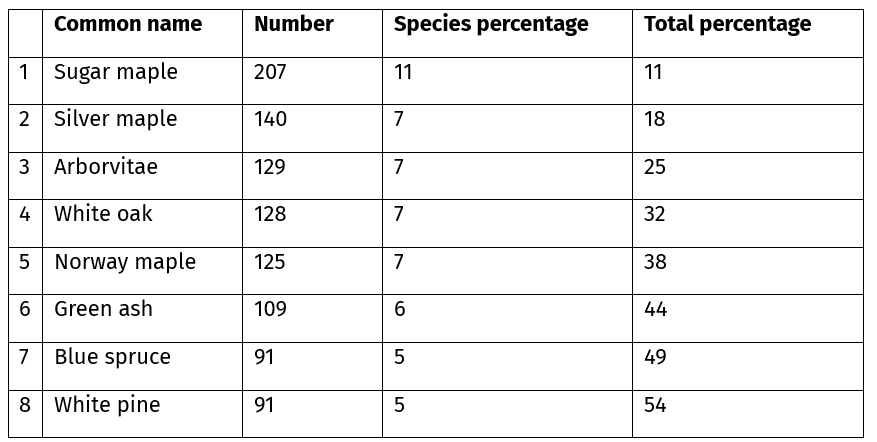
The City of Platteville’s eight most common tree species.
This intuitive measure could be used to track progress over time. Generally, the higher the TD-50, the more diverse and resilient the urban forest could be to environmental change or disturbance. The measure can be easily incorporated into community plans or goals, just like other diversity benchmarks, like the 30/20/10 rule or the Wisconsin DNR’s stricter 20/10/5 rule.
Wisconsin Results
See the list of results for every community with an inventory in the Wisconsin Community Tree Map.*
Leading the field in Wisconsin is Cambridge with a TD-50 of 17.7, followed by Fitchburg (13), Greenfield (12.4), Stoughton (11.8) and Monona (11.5). To place your community’s TD-50 results in the wider state context, see the graph below.
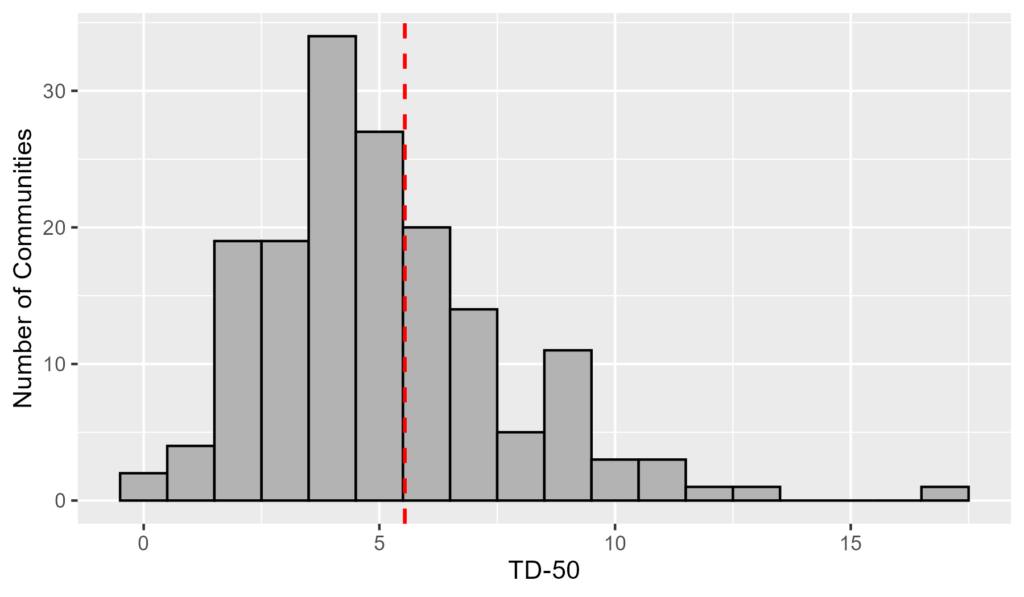
TD-50 on the x axis and number of communities on the y axis. The red dotted line shows the average TD-50 (5.53) across all 164 communities.
We encourage you to consider using the TD-50 index to set and measure diversity targets.
*Note that results are only available for communities with inventories in the Wisconsin Community Tree Map and that some data may be out of date. Furthermore, this metric is just looking at species and not incorporating cultivars or varieties. Many elm hybrids, for example, are identified as one species — Ulmus x. Some places also have park trees as well as street trees, which complicates comparison between some communities.