
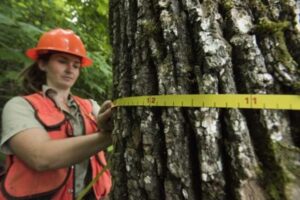
A USDA Forest Service timber cruiser measures a tree. The TPEP is a cooperative effort with the USDA Forest Service and USDA Rural Development. / Photo Credit: Lance Cheung, USDA
By United States Department of Agriculture Forest Service
Note: The Timber Production Expansion Guaranteed Loan Program (TPEP) provides funding to eligible applicants to establish, reopen, expand, or improve a sawmill or other wood-processing facility that processes ecosystem restoration byproducts from National Forest System lands.
The reopening last year of a sawmill in Tilleda, Wisconsin, one of the many recently shuttered sawmills in rural Wisconsin, is a signal of hope for the challenged forest products industry everywhere. The U.S. Department of Agriculture (USDA) Rural Development (RD) would like to see more mills brought back to life here with funding through its Timber Production Expansion Guaranteed Loan Program (TPEP).

A USDA Forest Service timber cruiser uses a Spiegel Relaskop to assess trees. The TPEP is a cooperative effort with the USDA Forest Service and USDA Rural Development. / Photo Credit: Lance Cheung, USDA
“The timber industry is an important part of Wisconsin’s history and economy,” said Andrew C. Iverson, USDA RD State Director for Wisconsin. “TPEP’s goal is to support rural communities, support forestry health, and provide American-made products.”
In 2025, the year the United Nations (UN) General Assembly declared the “International Year of Cooperatives,” a logging cooperative, Timber Professionals Cooperative Enterprises (TPCE), purchased the shuttered sawmill in Tilleda with a guaranteed loan of $800,000 through the TPEP. It was the first time ever that a cooperative purchased a chip mill in the U.S.
Cooperatives like the TPCE are businesses owned and managed by their members in order to serve the shared needs of their members. Some 56 loggers from Wisconsin and Michigan formed the TPCE about five years ago to help create places where loggers can have a vested interest in where they take their product for processing.
“Timber has historically played a vital role in the development of Michigan and continues to be hugely relevant in the rural economy,” said USDA Rural Development State Director for Michigan Dominic Restuccia. “From housing to furniture, timber supports everyday American life, and TPEP can be a powerful tool to help strengthen and revitalize the industry.”
TPCE goals align with the UN theme for the year of cooperatives, which is “Cooperatives Build a Better World.” For many, the reopening of the mill in Tilleda marks a positive turning point for the struggling timber industry in rural Wisconsin, where more paper continues to be produced each year than in any other state and more mills it waiting to be run again.
On a warm day last October, a celebratory group gathered to cut a ribbon officializing the restart of the mill, which had sat quietly idle for one year. The mill is on 49 acres located about 12 miles west of Shawano and two miles north of bustling State Trunk Highway 29.
The mill will increase capacity for processing timber from throughout the region.
“We wanted to create more places for loggers to go for processing,” said TPCE President Dennis Schoeneck.
In addition to purchasing the real estate, TPCE will also purchase equipment to help improve the efficiency of manufacturing wood chips. The project also includes plans to expand the capabilities of the site to manufacture new, higher-value products from the same raw materials. TPCE plans to implement a detailed process to improve productivity involving processes in the wood yard, chip mill, and maintenance department to improve productivity. Installation of an automatic log feed deck and more updates will help increase production from 2,500 to 4,000 tons per month.
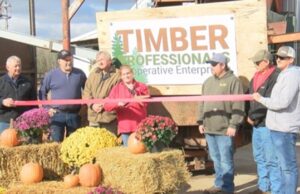
Members of the Timber Professionals Cooperative Enterprises cut a ribbon, celebrating the reopening of a sawmill in Tilleda, Wisconsin.
“We want to move forward, as a cooperative, in producing different things here than just chips for the pulp mill,” said TPCE Liaison Laura Delaney.
At the peak of the logging boom in the late 1800s there were over 1,000 active mills in Wisconsin. Today there are less than three dozen mills.
As the number of mills has diminished, the number of jobs for people in rural Wisconsin has declined. The reopening of the mill in Tilleda will create six jobs, with additional staffing added as the sawmill expands.
“With the restart of the mill in Tilleda, we are moving in the direction of creating even more jobs for people to engage in meaningful work and take part in revitalizing the forest products industry,” Iverson said.
The TPEP provides financial support to qualified lenders whose loan applicants want to establish, reopen, expand, or improve a sawmill or other wood processing facility that processes ecosystem restoration byproducts from USDA Forest Service (FS) National Forest System lands. There is a 90 percent guarantee with no origination or servicing fees. There is ability to work with any lender.
The program is operated in partnership with the USDA FS and USDA RD.
“The TPEP connects people with opportunities, and we are pleased to be able to partner with one of our fellow USDA agencies, the USDA Forest Service, to help more people achieve their goals in rural Wisconsin,” Iverson said. “It is important that we lift up the people-centered businesses at the heart of our communities and economies. We are proud to support the Tilleda project and projects like it that help sustain rural prosperity.”
The hope is that, with the reopening of the mill in Tilleda, and hopefully more sawmills in the future, the forest product industry will continue to re-grow.
More information about the TPEP is available online.