
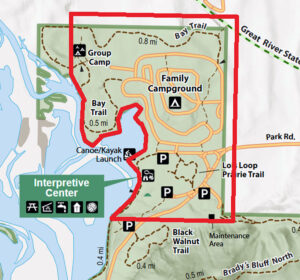
A map showing the 2026 spongy moth caterpillar aerial spraying area planned for Perrot State Park in Trempealeau County. / Map Credit: Wisconsin Department of Agriculture, Trade and Consumer Protection.
By Bill McNee, DNR Forest Health Specialist
Bill.McNee@wisconsin.gov
This spring, a portion of Perrot State Park in Trempealeau County will be aerially treated for spongy moth with “Foray” bacterial insecticide, containing Bacillus thuringiensis var. kurstaki.
A reproducing population of the leaf-eating caterpillar was detected in the park last fall, leading to the decision to conduct aerial spraying in 2026.
This spraying is being done as part of the Wisconsin Department of Agriculture, Trade and Consumer Protection’s (DATCP) participation in the national “Slow the Spread” program. The program was created to slow the westward spread of spongy moths by treating newly established, low-level populations. At high populations, spongy moth caterpillars feed on many tree and shrub species, stripping trees of their leaves and potentially killing them.
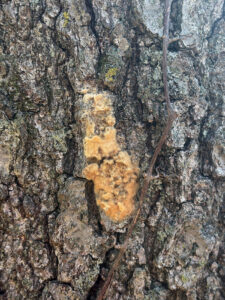
A spongy moth egg mass at Perrot State Park in November 2025, showing damage from birds or squirrels. / Photo Credit: Wisconsin DNR
The Perrot State Park spray will be funded by the DNR, using spongy moth funding provided in the current biennial budget.
The area to be treated is in the northwest corner of the park and includes the family and group campgrounds, Interpretive Center and day-use areas around the Lois Loop Prairie Loop Trail. Approximately 600 linear feet of the Great River State Trail adjacent to the state park, as well as other privately owned lands, are also included within the proposed treatment area. There are 161 acres within the treatment boundaries. Insecticide will not be applied to wetlands or open water.
Aerial spraying will occur between early May and early June, with exact dates and times dependent upon caterpillar development and weather conditions. Two aerial treatments will occur, approximately 5-7 days apart. The agencies intend to avoid spraying at the park during the extended Memorial Day weekend.
DATCP’s 2026 Slow the Spread treatment sites have been selected, and treatment area book maps are available online. Several sites include rural DNR-owned land that is infrequently used by the public during the spring and summer.
Aerial treatments usually occur in the morning, when weather conditions are more likely to be optimal for aerial spraying (high humidity and low winds), but planes may fly later into the day if weather conditions remain favorable. Small yellow planes will be heard and seen flying very low to treat treetops where the caterpillars are feeding.
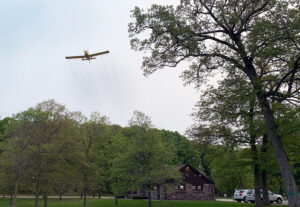
An airplane sprays pesticide over trees at Devils Lake State Park in Sauk County to help in the control of spongy moth caterpillars. / Photo Credit: Sue Johansen, Wisconsin DNR
For up-to-date information, visit the Wisconsin Spongy Moth Resource Center and subscribe to email updates that will provide notice when spraying dates are determined. Also, the toll-free Spongy Moth Hotline, 800-642-MOTH (800-642-6684), has a recording of up-to-date spraying plans. Law enforcement, local governments, schools, nearby medical facilities and campground users will be notified before spraying occurs.
No other state park is being aerially sprayed this spring, as the spongy moth population collapsed in 2024 and 2025, and overall populations remain low. For more information about spongy moth and management options, visit the Wisconsin Spongy Moth Resource Center.