By Art Kabelowsky, DNR Outreach and Communications
Arthur.Kabelowsky@wisconsin.gov or 608-335-0167
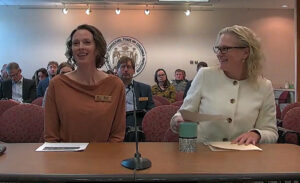
Wisconsin Department of Natural Resources Forest Health team leader Becky Gray (left) and Department of Agriculture, Trade and Consumer Protection Pest Survey and Control Section manager Renee Pinski appear before the Natural Resources Board to discuss tree and forest health issues on Nov. 13, 2025. / Photo Credit: Wisconsin DNR
The spirit of interagency communication was on display during a joint meeting of the Wisconsin Natural Resources Board (NRB) and the Wisconsin Board of Agriculture, Trade and Consumer Protection (Ag Board) on Nov. 13.
The seven-member NRB is the governing body of the Wisconsin Department of Natural Resources (DNR); the nine-member Ag Board governs the Wisconsin Department of Agriculture, Trade and Consumer Protection (DATCP). Each board sets policies and rules to be followed and enforced by its respective agencies. Members of both boards are appointed by the governor and confirmed by the Wisconsin State Senate.
The first presentation of the daylong event was given by DNR Forest Health team leader Becky Gray and Renee Pinski, Pest Survey and Control Section manager within the DATCP Plant Industry Bureau.
The presentation, titled “DNR and DATCP: Working Together to Protect Wisconsin’s Forest Resource,” covered how the agencies use both collaboration and independent processes to identify and address forest health concerns in all their various forms.
Both Gray and Pinski have first-hand knowledge of how their sibling agencies operate. Gray has worked with Forest Health for almost 13 years, following seven years with DATCP; Pinski has spent 12 years with DATCP after working for the DNR for nine years.
Gray’s team oversees protecting the health of 17 million acres of forestland, covering 46 percent of Wisconsin’s geography. Seventy percent of that forestland is privately owned, 10 percent is federally owned and 20 percent is owned by state, local and tribal governments.
The Forest Health team focuses on battling the insects, diseases and invasive plants that affect Wisconsin forests. The work includes identification, management recommendations, applied management research, and outreach, education and training.
Pinski’s DATCP Plant Industry Bureau has two sections: one to handle plant inspection (to prevent the spread of invasive pests and diseases) and interstate commerce involving trees and plants; the other to deal with export certification, quarantine, surveying and pest/disease control.
Gray noted for the NRB that in addition to the 17 million acres of forestland, Wisconsin also is home to 132 million urban trees, a Christmas tree industry that leads the nation and a nursery industry that contributes $2.85 billion per year to the state economy. What’s more, trees and parks are a big draw for Wisconsin’s tourism industry, which generates $23.7 billion in total economic impact.
A large percentage of the time spent by the DNR’s Forest Health team involves fighting invasive forest pests – non-native species that can cause economic, environmental and/or human health harm.
A 2017 study showed that 455 invasive forest pests have been introduced to the United States from other countries, largely through global trade.
These pests and the damage they bring create costs that are largely borne by local governments and landowners, and there is a substantial loss of revenue for the timber industry. Local governments pay about $1.7 billion per year for damage control, and about $830 million in tree value is lost each year due to the mitigation of insect infestations.
Pinski said DATCP’s survey detection and monitoring responsibilities ensure statewide data reporting and sharing through early detection and monitoring surveys that promote rapid response, regulation and management activities.
An example of the collaborative nature of the agencies came during the recent spongy moth outbreak. DNR conducted aerial sprays on state parks and other state properties to protect high-value trees; DATCP administered the “Slow the Spread” suppression program that fights the westward spread of the invasive pest.
Benefits coming from the collaboration included efficiencies with planning, contract sharing and staff time; the DNR’s aeronautics resource; consistent public messaging; and a high level of safety.
Gray and Pinski also discussed collaboration on control efforts against emerald ash borer and the potential coming threat of hemlock woolly adelgid, as well as the importance of messaging to educate Wisconsinites about the dangers of moving firewood that might contain pests and fungal infestations.