By Tom Jerow, Rhinelander City Forester
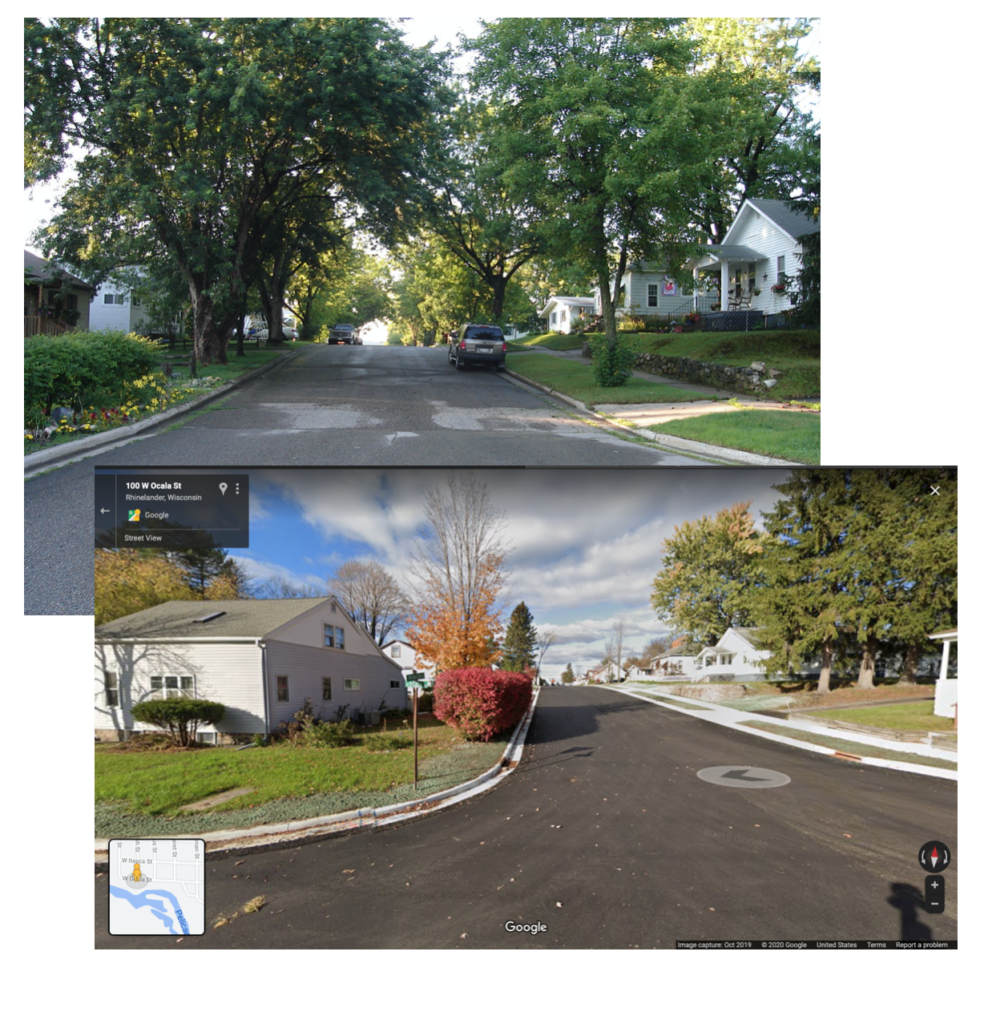
View of the same street before and after urban forestry efforts.
The City of Rhinelander, like many communities with populations under 10,000, has struggled to maintain a vibrant urban forestry program. Funding and staffing are its main challenges. The city also faces a variety of urban forestry issues, including pests and diseases, species diversity, community engagement, catastrophic ice storms and aging sewer and water infrastructure. The latter is one of the most significant challenges.
In 2019, after a major street project removed all the mature trees with little or no thought of replacement, a group of citizens came together. With the support of the mayor and city council, they formed a tree board to advocate for urban forestry in the community. Their first priority was updating the city’s inventory and management plan, utilizing a DNR Urban Forestry Grant. When the tree board reviewed the recommendations and proposed budget, it was an eye-opener. It became clear they lacked the financial resources to carry out the plan. While the city council and citizens supported managing the urban forest, their priority was to fix and maintain street infrastructure first. The tree board quickly realized they needed to educate decision-makers and help them recognize that trees are an important part of the infrastructure — a shift they are actively working to achieve.
One tree board member, a realtor who understands the value of trees, suggested they open an account at the local community foundation, where the tree board could receive 501(c)(3) tax-deductible donations. A meeting with the foundation’s executive director outlined the steps to open an account. She recommended a non-endowed fund because it offered the most flexibility in accessing funds for projects. The only obstacle was that the minimum to open an account was $10,000 — a significant amount for our small community. Undeterred, they created a brochure and started raising funds. The city’s finance director assisted in segregating and tracking donations.
Tree board members also got on the speaker circuit and spoke with all the civic organizations in town about supporting our efforts. Gradually, with small donations of $100 or $200, they raised the necessary $10,000 to open an account with the foundation. After opening the account, they started receiving larger donations, mostly from retirement accounts with required minimum distributions. By distributing funds directly to a qualified 501(c)(3) charity, the donor can avoid some of the tax liability on their retirement savings. The current balance is approximately $65,000 and increasing.
One additional unique aspect of Rhinelander’s urban forestry program is its forester, Tom Jerow. He is retired from the Wisconsin Department of Natural Resources and volunteers to help manage the city’s urban forestry efforts, saving the city thousands of dollars. He has been officially appointed by the city council and oversees the urban forestry grants. He collaborates with staff, city officials and the public to answer questions and offer technical support. Although not specifically trained in Urban Forestry, he is a valuable asset and works effectively with the community. Patricia Lindquist, DNR Urban Forestry Coordinator, emphasized how fortunate the community is to have such an ardent volunteer, “Tom is an exceptionally dedicated and innovative urban forester, and the recent growth of Rhinelander’s urban forestry program is directly due to his efforts.”
This goes to show that a small community without a big budget or municipal urban forestry staff can still have a measurable and long-lasting impact on its canopy. It just takes a few dedicated individuals with a passion for trees to make an urban forestry program flourish.
For more information on tree boards and other resources to jumpstart your urban forestry program, see the DNR Urban Forestry website.