
By Elton Rogers, DNR Urban Forestry Coordinator
Elton.Rogers@wisconsin.gov or 414-294-8675
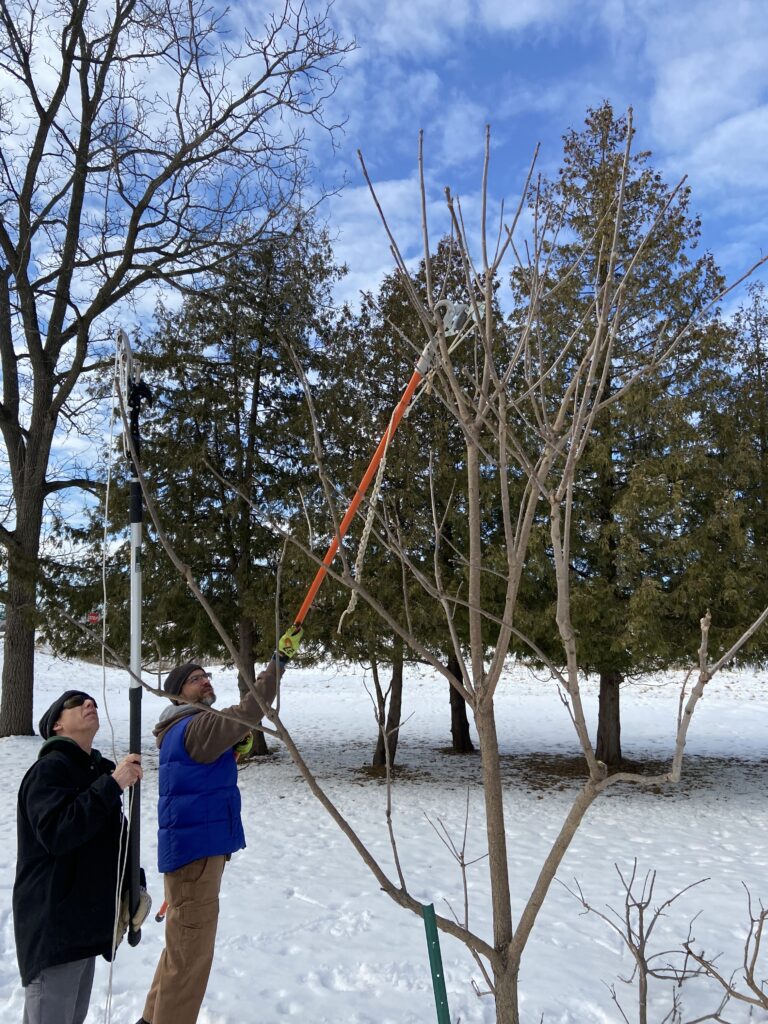 To best answer the titular question, I like to start by flipping the question on its head: When is the worst time to prune trees?
To answer this reworded question, we first need to acknowledge that “pruning is wounding.” Anytime you cut off a living portion of a tree, you are doing two main things:
- Removing photosynthetic material.
- Creating a potential entry point for decay.
So, in essence, there are two main measurables we can look at post-pruning. The first being the speed at which the tree can close the pruning wound using sugars produced via photosynthesis (which we just reduced the tree’s ability to do by removing leaves). The second is the extent of discoloration within the branch caused by invading pathogens and the tree’s own chemical responses.
Worst Times To Prune Trees And Why
Fall is typically seen as the worst time to prune deciduous trees. During this time, the tree is shifting to dormancy. Photosynthesis slows down, and the tree expends energy to senesce and drop its leaves. Removing live tissue at this time can necessitate the tree to tap into energy reserves to try and close the wound and stop invading pathogens. Depleting its energy reserves right before a period of dormancy without any way to replenish said reserves is not ideal. Additionally, pruning in the fall can trigger a new flush of epicormic growth (water sprouts) around the pruning wound. This new growth is fragile and may be easily injured during the coming winter months.
Spring during bud break is also seen as a poor time to prune trees. Similar in concept to the fall pruning example, at this time of year, the tree is expending great amounts of energy to “wake up” and push new growth out. Without any active photosynthesizing leaves, the tree is relying on stored starch energy reserves to perform this work. If you introduce additional stressors such as the need to contain pathogens and close wounds, the tree can become overwhelmed.
Best Times To Prune Trees And Why
Logically that leaves two remaining seasons, winter and summer. So, which is the best? Well, that jury is still out. Recent research has highlighted various advantages and disadvantages to both winter and summer pruning, with most concluding that it is highly dependent on tree species. Some species showed much less discoloration and faster wound closure when pruned in summer, others in winter and some have shown absolutely no difference between the seasons. In fact, contrary to my prior statement, some species (ex. Norway maple) seemingly showed no differences whether you pruned them in spring, summer, fall or winter.
It is important to note that outside of what was discussed in this article, there are other factors to consider when selecting pruning timing. For example, some tree species (ex. oaks, our native elms) should only be pruned outside of the spring/summer months due to certain pests and pathogens. Other considerations can range from being able to easily identify dead wood in summer to limiting landscape disturbance when working on frozen ground in winter.
When it is all said and done, most trees can be safely pruned any time of the year if done properly. Pruning guidelines should be established in accordance with the American National Standards Institute (ANSI) A300 and customized by evaluating factors such as health, age and species. By following this criteria, pruning becomes a tool for life-cycle management and promotes long-term stability.