
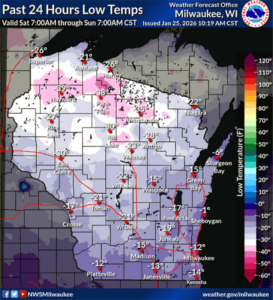
Cold temperatures across the state of Wisconsin on Jan. 25, 2026. / Graphic Credit: National Weather Service
By River Mathieu, DNR Forest Health Specialist, Fitchburg
River.Mathieu@wisconsin.gov or 608-772-2758
Wisconsin experienced a polar vortex in late January 2026, and temperatures got chilly throughout the state, even reaching close to -40⁰ F in some places! Although it has warmed up, the cold weather is still fresh in everyone’s minds, leaving insect and forest lovers alike wondering how insects survive temperatures that cold.
The Wisconsin Department of Natural Resources Forest Health staff has received several questions over the past month about how insects survive cold weather in winter and whether the January temperatures were cold enough to kill insect pests.
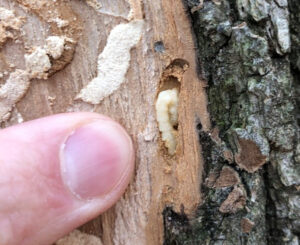
Emerald ash borer larvae overwinter in ash trees as J-shaped larvae. / Photo Credit: Wisconsin DNR
The answer varies by species, as many insects that call Wisconsin home are adapted to our bitter winters. Some insects, such as monarch butterflies, migrate south to warmer regions of the country; others find their way into our homes and other buildings to avoid the cold. Some insects even spend the winter underground or in leaf litter, where temperatures remain warmer than the air.
Many species of insects survive winter by producing cryoprotectant chemicals (similar to antifreeze) in their blood. By the time temperatures get cold in mid-winter, most insects are prepared to deal with extreme cold weather. Less dramatic cold snaps in spring or fall can have a greater impact on insect survival than extreme cold weather in mid-winter, because insects are less prepared for low temperatures during those times of year.
Different insect species have different cold tolerances. Here are a few examples of insect cold tolerances and their winter survival strategies:
- Emerald ash borer (EAB) larvae overwinter inside ash trees, where the bark provides additional protection. Still, EAB mortality may increase to 50% at temperatures colder than -20⁰ F. Unfortunately, the coldest temperatures during the recent polar vortex occurred in areas with the lowest EAB populations, so it is unlikely we will see a large impact on EAB populations.
- Similarly, spongy moth egg masses can survive -20⁰ F in fur-protected egg masses, often hidden in bark crevices. Egg masses scraped off trees should be disposed of and not dropped into the snow, because eggs insulated under snow may still hatch in the spring.
- The invasive hemlock woolly adelgid, not yet detected in Wisconsin, is not a very cold-hardy species. In northeastern states where HWA is prevalent, researchers have observed some mortality at -4⁰ F, and over 90% mortality when temperatures drop below -22⁰ F.
- Pine engraver beetle adults avoid the cold winter air by burrowing into the soil and forest litter. When in the forest litter and covered by a blanket of snow, these beetles can stay quite warm, surviving temperatures colder than -50⁰ F.
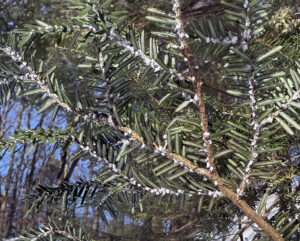
Hemlock woolly adelgid feed on hemlock in western Michigan. / Photo Credit: Wisconsin DNR
Because cold weather is generally not effective at significantly reducing populations of insects, it’s unlikely that the extreme cold weather in January will have a significant impact on the populations of Wisconsin’s most notorious forest insects.