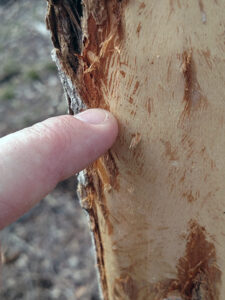
Squirrel tooth marks are small and look like narrow scratches from which the animals have removed the tree’s bark. / Photo Credit: Wisconsin DNR
By Linda Williams, DNR Forest Health Specialist, Woodruff
Linda.Williams@wisconsin.gov or 920-360-0665
As winter transitions into spring, you may notice patches of tree bark that have been removed. But what did the damage?
Several animals, including squirrels and porcupines, can chew or strip bark from trees. This can occur on hardwoods and conifers, older trees and young saplings. Damage can be enough to kill branches or even the entire tree.
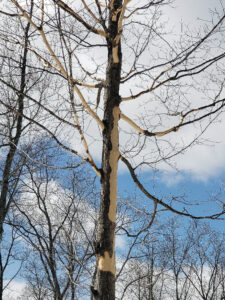
Squirrels have removed significant amounts of bark from a maple to get at the tasty cambium layer beneath. / Photo Credit: Wisconsin DNR
When damage first occurs, and bark is removed, it exposes the light-colored wood underneath, making the damage obvious in late winter and spring.
As the months pass, the wood will turn a grey-black color and blend in with the bark again. By summer, it can be difficult to easily locate the damage, but the damage is still present.
Once you notice the damage, how do you know what type of critter caused the problem?
Squirrels
Squirrels can be fun to feed and watch, but when they start damaging or killing your trees … that’s not so cute.
In late winter, when daytime temperatures climb and sap starts moving, squirrels may start to feed in maple trees. Sugar maple and red maple are squirrel favorites.
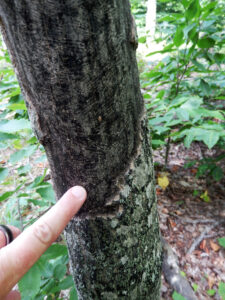
Squirrel damage weathers and darkens as it ages; it may be difficult to spot when damage occurred the previous winter. / Photo Credit: Wisconsin DNR
Once grey squirrels find a bit of sweet sap, they will begin to remove more and more bark from the branches and the main stem so that they can eat the tasty cambium layer just under the bark, where the sweet sap is flowing. As they repeatedly visit these trees and remove extensive amounts of bark, the white wood underneath becomes visible. Small chips of bark may accumulate at the base of the tree.
Damage to the bark can kill branches or girdle the tree. In the spring, damaged branches may start to leaf out, but leaves will rapidly wilt and die because the tree can no longer move food and water through that damaged branch to the leaves. If the damage is severe, the entire tree can be killed.
If the squirrel damage only partially girdles a branch, that branch may leaf out normally in the spring. Unfortunately, later in the summer, when it’s hot and dry, those damaged branches may not be able to move as much water as needed, and leaves can wilt and die.
Damage can be localized to a few trees or scattered across the landscape. Over the past decade, squirrel damage seems to have become more prevalent around the state.
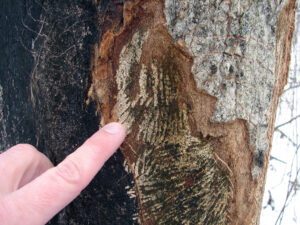
Porcupine teeth are larger than squirrel teeth, and they leave larger scrape marks as they remove tree bark. / Photo Credit: Wisconsin DNR
Porcupines
Porcupines can also strip bark from branches and the main stem of trees.
Porcupines can feed on many species of trees, but they have a slight preference for conifers. As they remove bark to get at the cambium layer, they can drop large chunks of bark that accumulate at the base of the tree.
To determine whether the damage was due to porcupines or squirrels, look closely at the scrape marks left by the teeth. Porcupine teeth leave a larger scrape mark, about 1/8-inch wide, compared to squirrels that leave tiny tooth marks that are just 1/16-inch wide.
You might also see porcupine droppings/pellets below the trees that they’re feeding on, while squirrel droppings are small enough that you are unlikely to see them.
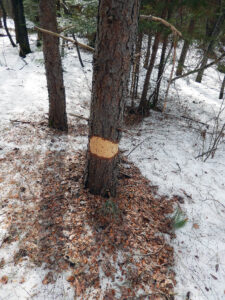
Porcupines remove large chunks of bark and drop them to the ground as they feed, as shown on a red pine tree. / Photo Credit: Wisconsin DNR
What Can You Do?
Controlling squirrel or porcupine populations is one of the few options for stopping extensive or ongoing damage. In certain situations, it may be possible to fence trees or wrap tree trunks with smooth metal sheeting that critters can’t climb. The University of Wisconsin-Madison Extension offers a document on squirrels that includes additional control options for urban or yard trees.
Girdled branches can be pruned to improve the tree’s appearance. Trees with extensive damage may die.
If you choose to hunt any of the species that are damaging your trees, be sure to check local hunting regulations for season dates, bag limits or nuisance permits.