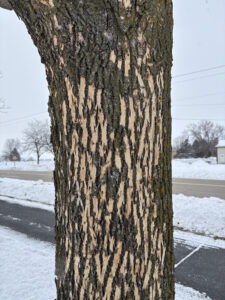
An ash tree next to a walking trail in Oshkosh has been damaged by woodpeckers feeding on emerald ash borer larvae beneath the bark. / Photo Credit: Wisconsin DNR
By Bill McNee, DNR Forest Health Specialist, Oshkosh
Bill.McNee@wisconsin.gov or 920-360-0942
Property owners with healthy, valuable ash trees are encouraged to treat them with insecticide this spring to protect against emerald ash borer (EAB).
The invasive pest is currently the most damaging threat to trees in Wisconsin, killing more than 99% of the ash trees it infests.
Woodpecker damage during the winter is often the first sign that an ash tree is infested. The birds remove pieces of bark while feeding on EAB larvae inside the tree. Insecticide treatment of infested ash trees is more likely to be successful if the trees have low or moderate levels of woodpecker damage.
Now is a good time to consider insecticide protection, as treatments typically occur between mid-April and mid-May. Ash (in the genus Fraxinus) is the only type of tree that needs protection against EAB. Mountain ash and prickly ash do not need protection because the insect does not attack them.
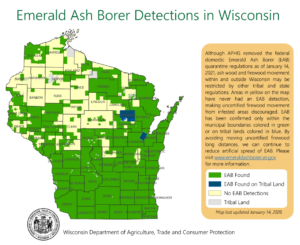
Municipal emerald ash borer detections as of Jan. 14, 2026, are shown in green. / Map Credit: Wisconsin Department of Agriculture, Trade and Consumer Protection
EAB has now been detected in all 72 counties in Wisconsin, and treatments are worth considering across the state.
The southern half of Wisconsin is heavily infested, and the vast majority of large ash trees there have already died. In northern counties, EAB is being found at an increasing number of locations, and tree mortality is not as widespread. Additional undetected infestations are very likely present in the northern half of the state.
Location is one of several considerations when making a decision about insecticide treatments. The financial expense of the treatments is another consideration, as treatments need to be repeated every one to three years or the trees will become heavily infested and die. The treatments are not economically practical for woodlot ash trees.
What You Should Do
Some insecticide products can be applied by homeowners, and others must be applied by a certified professional. Review the available options before selecting an insecticide and treatment method. Visit the UW-Madison Extension EAB website and EAB Information Network website for more information about insecticides.
Arranging insecticide treatments in advance can make it easier to secure an applicator, avoiding a last-minute rush when pest control businesses may already be very busy. Resources for finding a qualified pesticide applicator include the Wisconsin Arborist Association, the International Society of Arboriculture and a local phone book or online directory.
Consider the following:
- Determine whether the tree is worth treating. Some ash trees are too heavily infested to save or have structural or health problems that make them unlikely candidates for insecticide treatment. Property owners may save money by removing an untreated ash tree before it becomes heavily infested.
- Trees with abundant woodpecker damage may be too infested for successful insecticide protection. Consult an arborist for a professional opinion.
- Landscape trees can improve views, increase property values, provide shade and cooling and contribute to the quality of life in a neighborhood. Weigh these benefits against the expense of insecticide treatments.
- Consider the cost of removing or replacing trees. You will often be able to treat your ash tree for a decade and spend less money than it would cost to remove that tree. Meanwhile, you get the benefits the tree provides.
- The cost of an insecticide treatment will depend on the tree size, the product used and whether a professional is hired. Some products are applied annually; others are applied every two or three years.
- Check the credentials and pesticide applicator certification of any business you hire to treat your ash trees.
- Unprotected ash that are dead or declining from EAB are often structurally weakened, presenting a safety hazard. These trees are also more hazardous to remove. Consult a tree care professional.
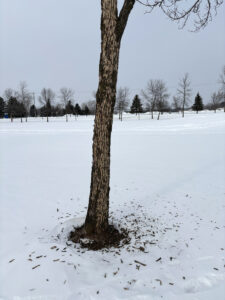
Recently removed bark lies on top of two-day old snow beneath a heavily “flecked” ash tree at Winnebago County Park in December 2025. / Photo Credit: Wisconsin DNR
Signs And Symptoms Of Infestation
Stay informed and be on the lookout for EAB. Know where the pest has already been found and look for the signs and symptoms of EAB infestation. Watch ash trees for the following:
- Woodpecker damage, called “flecking,” where pieces of bark have been removed while feeding on EAB larvae beneath the bark. It usually starts up in the canopy and progresses down the tree over the next few years if the tree is not treated.
- Sprouts growing from the base or trunk of the tree.
- Thinning canopy with smaller, pale leaves.
- Small (1/8-inch), D-shaped exit holes in the bark.
- Green beetles crawling on the trunk of ash trees during the summer.
Visit the DNR EAB website for more information.