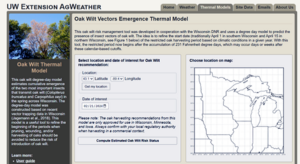
A University of Wisconsin-Madison Extension online tool provides users localized information about the estimated emergence status of the two most important insects that transmit oak wilt in Wisconsin. / Graphic Credit: University of Wisconsin-Madison Extension
By Kyoko Scanlon, DNR Forest Pathologist, Fitchburg
Kyoko.Scanlon@wisconsin.gov
In 2025, oak wilt was detected for the first time in Hughes Township, Bayfield County, a northern Wisconsin location where oak wilt remains uncommon. There were no new county finds in 2025.
Based on the findings in 2025, the maps in the Oak Harvesting Guidelines To Reduce The Risk Of Introduction And Spread Of Oak Wilt (the oak wilt guidelines), oak wilt fact sheet and were updated. The maps in the oak wilt guidelines are good through the end of 2026.
It is a good time to familiarize yourself with the oak wilt guidelines and updated maps. The oak wilt guidelines specify a harvesting restriction period due to oak wilt transmission from April 15 through July 15 in the North zone and April 1 through July 15 for the South zone, with flexibility for exceptions and modifications.
One of the modifications listed in the oak wilt guidelines is to adjust harvest timing in response to unusual early-spring weather. The online interface on the University of Wisconsin-Madison Extension Ag Weather website offers localized recommendations on the emergence status of the two most important insects that transmit oak wilt in Wisconsin.
The interface uses a degree-day model (Jagemann et al., 2018) constructed from insect-trapping and weather data, which helps refine the timing of periods when pruning, wounding, or harvesting oaks should be avoided.
Users can also sign up to receive a daily email notification of current and five-day forecasts, based on the average daily high temperatures from the previous week. Please be aware that this forecast could be off significantly if the temperatures of the upcoming week differ significantly from the prior week’s average, because it is not based on the predicted daily high temperature.
This tool intends to supplement, not replace, the calendar dates specified in the oak wilt guidelines. This interface provides degree-day-based information on the start of the oak wilt high-risk period, not its end.
If you have any questions about localized recommendations about the beginning of the oak wilt high-risk period, please contact the DNR Forest Health specialist for your region.