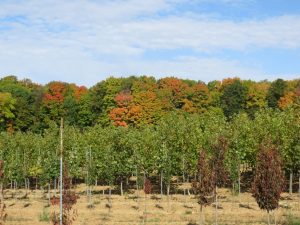
 “Plant a tree to thrive, not to simply survive.” Dan Traas, Ranger Service, echoes the sentiment of most arborists and urban foresters’. There are numerous crucial steps in the tree planting process, location, soil type and temperature must all be considered. However, the species of tree chosen may be the utmost central consideration. Continue reading “Innovative nurseries increase species selection”
Tree champions lauded for community service
Five individuals and organizations earned recognition from the Wisconsin Urban Forestry Council for their efforts to protect, preserve and increase the number of trees that line city streets, fill community parks and beautify neighborhoods throughout the state. Continue reading “Tree champions lauded for community service”
Collecting your local Arbor Day stories
Arbor Day has a long tradition in Wisconsin. This historic holiday has been celebrated in Wisconsin since 1883, and continues to be celebrated here and around the world. Many communities combine their Arbor Day celebrations with Tree City USA anniversaries and related achievements. Tree City USA, a program through the Arbor Day Foundation, acknowledges the commitment of a community to its urban trees. In addition to Tree City USA materials to help create a local celebration, Wisconsin DNR Division of Forestry offers materials, games, activities, facts and more to support your community in planning the perfect Arbor Day celebration. Arbor Day is an important part of Wisconsin’s history and has always been celebrated with zeal and enthusiasm. Continue reading “Collecting your local Arbor Day stories”
Spread the love: how to help your urban forests
Trees are vitally important to cities, villages and towns. Like electricity and water, an urban tree canopy is part of a community’s infrastructure, providing valuable environmental, economic and social benefits. Well-managed urban forests pay back nearly three times the cost to plant and maintain them. Continue reading “Spread the love: how to help your urban forests”
Make sure you are prepared for EAB
Recently, Iowa DNR conducted a survey of its community foresters to understand preparedness for ash mortality from EAB in their communities. EAB continues its spread, not just throughout Wisconsin, but other states, such as Iowa, as well. This survey displays some interesting data. Seemingly, despite the continued spread and the many cases studies on the effects of EAB in communities, no communities surveyed contain private land owners that are prepared for the increased ash mortality. View the survey to see other results and barriers to EAB preparedness. If you have any questions about EAB and how to prepare in your community contact your local Urban Forestry Coordinator.
For more information contact Ellen Clark (EllenA.Clark@Wisconsin.gov), Urban Forestry Communication Specialist, at 608-267-2774.
CTMI graduate workshop, young tree pruning
This fall Wisconsin DNR Urban Forestry program hosted the inaugural Wisconsin Community Tree Management Institute (WCTMI) graduate workshop. It was held over two days in mid-October at the Green Lake Conference Center. The workshop included presentations and mini-workshops on many topics. One of the topics was young tree pruning. Continue reading “CTMI graduate workshop, young tree pruning”
Accepting applicants for urban positions
The Wisconsin Department of Natural Resources Division of Forestry has two Limited Term Employment (LTE) positions open for applications. One position is an Urban Forest Assessment Outreach Specialist with the Urban Forestry team and the other is an Urban Forest Inventory Specialist with the Forest Products Services team. Each of these positions is a half-time appointment, and both are stationed out of Central Office in downtown Madison. Continue reading “Accepting applicants for urban positions”
2016 annual report issued
The Division of Forestry annual report highlights a few of our accomplishments in 2016 – including implementing the Good Neighbor Authority, expanding the urban forest inventory and analysis to include all census-defined urban places, rewriting the forest fire reporting system, and more. Photos in the report showcase Division employees at work. In his report introduction, State Forester Fred Souba thanked former State Forester Paul DeLong (who departed at the end of September for a leadership position with American Forest Foundation) and Deputy Darrell Zastrow (who retired at the end of the year) for their legacy of leadership. Find the link to the 2016 report from the Forestry topic page on the DNR Website.
For more information, contact Forestry Outreach Specialist Kirsten Held (Kirsten.Held@Wisconsin.gov) at 608-264-6036.
Urban Forestry supports health care research
The University of Illinois is taking the lead on a three-year research project exploring urban forestry’s effects on health care spending. The project will be the first to focus specifically on urban forestry’s economic return on investment. Health expenditures of over 4 million people will be analyzed with LiDAR (Light Detection and Ranging) canopy coverage. The project will also result in a free, online tool that can be used to estimate a community’s return on investment for their urban forest.
For more information contact Ellen Clark (EllenA.Clark@Wisconsin.gov), Urban Forestry Communication Specialist, at 608-267-2774.
DNR attends Partners in Community Forestry Conference
The DNR Urban Forestry program sent Laura Lorentz, UF Policy and Partnership Specialist, and Sara Minkoff, UF Specialist, to the annual Partners in Community Forestry Conference convened by the Arbor Day Foundation. Attending this national conference provided Laura and Sara a unique opportunity to meet other urban forestry professionals representing local, state and federal governments as well as non-profit organizations from across the country (and one from the UK!) and share ideas and resources with the goal of enhancing urban and community forestry initiatives in Wisconsin. Some of the sessions they attended included topics such as the role of urban forestry in green infrastructure, environmental justice and equity in urban forestry, development and diversification of the urban forestry workforce, the relationship between urban trees and health, and demonstrated uses of urban forest inventory data to make positive impacts on the ground. Click here to learn more about the Partners in Community Forestry Conference.
For more information contact Ellen Clark (EllenA.Clark@Wisconsin.gov), Urban Forestry Communication Specialist, at 608-267-2774.