invasive

Aerial Spraying For Spongy Moth Planned at Perrot State Park

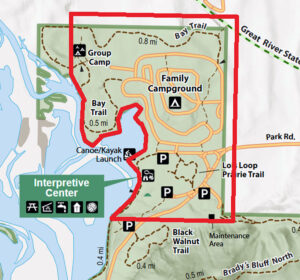
A map showing the area to be covered by a 2026 aerial spray for spongy moth caterpillar control at Perrot State Park.

A map showing the 2026 spongy moth caterpillar aerial spraying area planned for Perrot State Park in Trempealeau County. / Map Credit: Wisconsin Department of Agriculture, Trade and Consumer Protection.

By Bill McNee, DNR Forest Health Specialist
Bill.McNee@wisconsin.gov

This spring, a portion of Perrot State Park in Trempealeau County will be aerially treated for spongy moth with “Foray” bacterial insecticide, containing Bacillus thuringiensis var. kurstaki.

A reproducing population of the leaf-eating caterpillar was detected in the park last fall, leading to the decision to conduct aerial spraying in 2026.

Continue reading “Aerial Spraying For Spongy Moth Planned at Perrot State Park”
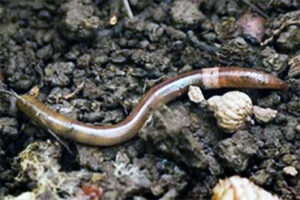
Jumping Worms A Threat To Gardens And Forests

Closeup of a jumping worm on soil.

Closeup of a jumping worm (Amynthas agrestis). / Photo Credit: Wisconsin DNR

By Art Kabelowsky, DNR Outreach and Communications, Fitchburg; Arthur.Kabelowsky@wisconsin.gov or 608-335-0167

Invasive jumping worms are worrisome for several reasons, but here’s one of the main ones: It can be difficult to tell you even have them until they’ve already done their damage.

That makes this time of year important, because the best way to avoid damage from jumping worms, which can be substantial and long-lasting, is to prevent them from getting into your garden, yard or forestland in the first place.

Continue reading “Jumping Worms A Threat To Gardens And Forests”

Watch For Woodpecker Damage On Ash Trees

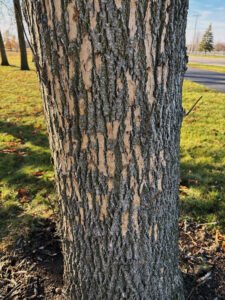
Woodpecker flecking on the bark of a dying ash tree is visible at Winnebago County Community Park in Oshkosh.

Woodpecker flecking on the bark of a dying ash tree is visible at Winnebago County Community Park in Oshkosh. Flecking occurs when the birds peck away at the trees to feed on emerald ash borer larvae beneath the bark. / Photo Credit: Wisconsin DNR

By Bill McNee, DNR Forest Health Specialist
Bill.McNee@wisconsin.gov

The Wisconsin Department of Natural Resources (DNR) encourages property owners to watch for woodpecker damage to their ash trees this winter.

Woodpecker damage, often called “flecking,” happens when birds peck away some of a tree’s bark to access the larvae underneath. Flecking is a common early sign that an ash tree might be infested with emerald ash borer (EAB), an invasive insect. EAB is the most damaging threat to Wisconsin trees, killing more than 99% of the untreated ash trees it infests.

Continue reading “Watch For Woodpecker Damage On Ash Trees”

Increased Tree Mortality Seen As Spongy Moth Outbreak Ends

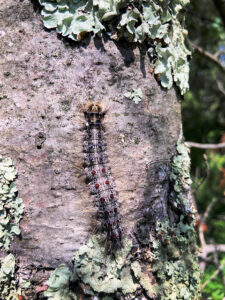
Mature spongy moth larva on a tree at Potawatomi State Park in Door County, July 2025.

Mature spongy moth larva on a tree at Potawatomi State Park in Door County, July 2025. / Photo Credit: Wisconsin DNR

By Bill McNee, DNR Forest Health Specialist, Oshkosh
Bill.McNee@wisconsin.gov  

Wisconsin’s recent period of high spongy moth populations (an “outbreak”) came to an end in 2025, as the remaining known hotspots were aerially sprayed or naturally collapsed. Only a handful of large larvae were observed or reported by property owners.

Spongy moth populations are likely to be low across the state for at least the next few years. However, it is possible that some sites may experience a population increase before then, if local weather conditions are favorable for the insect.

Continue reading “Increased Tree Mortality Seen As Spongy Moth Outbreak Ends”

Imported Willow Leaf Beetle Spotted

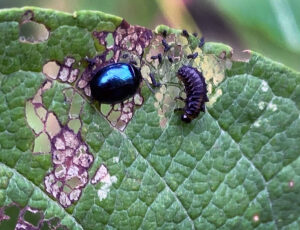
Closeup photo of an imported willow leaf beetle adult and larva.

An imported willow leaf beetle adult and larvae. / Photo Credit: Wisconsin DNR

By Linda Williams, DNR Forest Health Specialist, Woodruff
Linda.Williams@wisconsin.gov, 920-360-0665

Imported willow leaf beetle (Plagiodera versicolor) is a small, shiny, blue-black beetle as an adult, and the larvae are small, solid black and spikey. Both feed on the foliage of willow and poplar species. Two generations per year are possible.

The invasive pest was first detected in the United States in 1915, likely coming from eastern Europe.

Continue reading “Imported Willow Leaf Beetle Spotted”