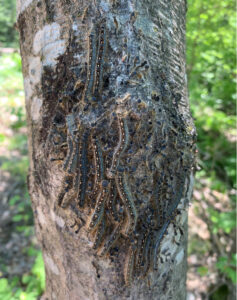
Northern WI Forest Health

Pine Root Collar Weevil Or Red Turpentine Beetle?

By Linda Williams, Forest Health Specialist, Woodruff
Linda.Williams@wisconsin.gov, 920-360-0665

Red turpentine beetle and pine root collar weevil both attack pines near ground level. So, how can you identify them and differentiate the damage?

If you prefer the abbreviated version, check out the table below. For more details, read further and be sure to check out the photos.

  Pine Root Collar Weevil Red Turpentine Beetle
Hosts Pines Pines, tamarack, spruce, fir


Tree size Younger pines (generally less than 8 inches diameter at breast height). Larger trees (generally greater than 8 inches diameter at breast height)


Location of damage Ground level and below Lower 1-3 feet of the trunk


Signs and symptoms Trees leaning heavily or broken over at the base. Black, pitchy soil at base of tree. Black, pitchy, sunken area at base of tree. Scattered trees in a stand decline and die. Pitch tubes near base of tree


Prevention Maintain stocking and crown closure to prevent grass and weeds around the base of trees. Keep trees healthy


Management Remove grass and weeds from base of trees. Prune lower branches to increase air flow. Insecticides may be an option. Salvage

Pine Root Collar Weevil

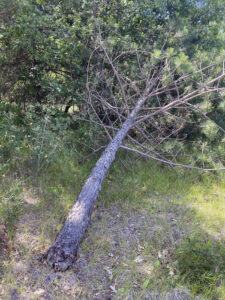
Damage at the base of young red pine, by pine root collar weevil can weaken it and trees with green needles can suddenly break over. / Photo Credit: Wisconsin DNR

Pine root collar weevil prefers younger pine stands that are open, with grasses or weeds near the bases of the trees to give the insects additional protection. Pine root collar weevil will attack red, jack, scotch and Austrian pine, but rarely white pine.

Pine root collar weevil damages roots and creates a weakened area of the tree at ground level. Damaged trees can break over at ground level if damage is on the trunk or may just lean heavily if roots are damaged and can no longer keep the tree upright.

To look for pine root collar weevil pull the weeds, duff and soil away from the base of the tree and away from the major roots. Infested trees will have black pitch-soaked soil around the base. Removing the bark from the root collar area and from the major roots, will show boring damage from pine root collar larvae just under the bark. The base of the tree may be slightly sunken where weevil larvae have been feeding under the bark.

Management options depend on the age and stocking of the stand when you notice the infestation. Planting at the proper depth and maintaining good crown closure to minimize the amount of grass and weeds around the base of trees can help prevent infestation. If you already have an infestation, eliminating weeds and grass around the base of trees and/or pruning lower branches can increase air flow to dry out the base of the trees and make them less attractive to the weevils.
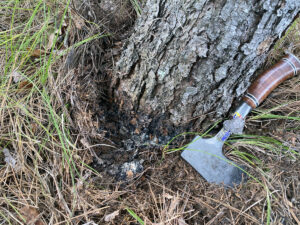
Looking closely at the base of a tree being attacked by pine root collar weevil shows blackened pitchy dirt around the base of the tree. / Photo Credit: Wisconsin DNR

Red Turpentine Beetle
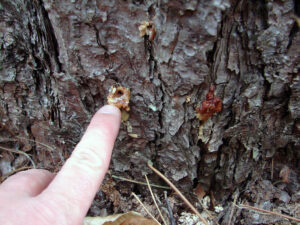
Pitch blobs near the base of a red pine indicate attack by red turpentine beetle. / Photo Credit: Wisconsin DNR

Red turpentine beetles generally prefer pine trees that are pole-sized and larger. They attack the lower 2-3 feet of the trunk of pines that are under stress, but can also attack stressed tamarack, spruce and fir. The original stressors could be abiotic, such as drought, flooding or fire, could be due to stress from thinning, or from trees being planted too deep or off-site.

Look for pitch tubes around the base of the tree. Adult beetles bore into the bark to lay eggs under the bark, and the tree will start to exude pitch, which the beetles push out to create a blob of pitch called a pitch tube. Pitch tubes will last for many months to years and are a noticeable clue indicating attack.

Larvae feed under the bark. The damage they do can girdle areas, which puts additional stress on the tree. If multiple pitch tubes are noticed at the base of a tree, the damage could be severe enough that Ips bark beetles could attack the tree and kill it.

Red turpentine beetle can also carry the spores of Leptographium root disease and, when introduced to a red pine, the disease can begin to spread through the roots and create expanding pockets of mortality, referred to as Red Pine Pocket Decline And Mortality.

Maintaining tree health is the best way to prevent attack by red turpentine beetles. When stress is severe, and attacks are numerous, salvage of trees may be necessary.

University of Minnesota Seeks Reports On Dying Black Locust Stands

Wide view of struggling black locust trees.

A stand of dead or dying black locust trees. / Photo Credit: Norbert Frank, Bugwood.org

By Ryan Franke, University of Minnesota

The Blanchette Forest Pathology Lab at the University of Minnesota is leading a project to study black locust in Minnesota and Wisconsin and requests the help of foresters and the public in locating stands of dying black locust (Robinio pseudoacacia) this summer.

The university plans to collect native pathogenic fungi from stands of dying black locust and testing them for their suitability to biologically control black locust clones.

Continue reading “University of Minnesota Seeks Reports On Dying Black Locust Stands”

Green, Sawyer Counties Added To Spongy Moth Quarantine

Map of Wisconsin showing counties in yellow quarantine for spongy moth.

The updated map of spongy moth quarantined counties in Wisconsin, showing the April 15 addition of Green and Sawyer counties to the quarantined list. / Map Credit: Wisconsin DNR

By Wisconsin DNR

Green and Sawyer counties have become the latest additions to Wisconsin’s spongy moth quarantine, joining most eastern and central Wisconsin counties already considered to be infested by the invasive insect.

The announcement was made April 15 by the Wisconsin Department of Agriculture, Trade and Consumer Protection (DATCP), based on trapping data collected last year.

Continue reading “Green, Sawyer Counties Added To Spongy Moth Quarantine”

Forest Health Specialist Paul Cigan Spreads The News

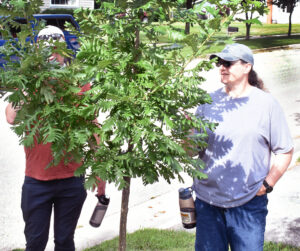
Paul Cigan (in black hat) discusses the health of a tree with fellow Wisconsin Department of Natural Resources Forest Health specialists Bill McNee and Linda Williams in Cambridge. / Photo Credit: Wisconsin DNR

By Art Kabelowsky, DNR Outreach and Communications, Fitchburg
Arthur.Kabelowsky@wisconsin.gov or 608-335-0167

Paul Cigan, the Wisconsin Department of Natural Resources Forest Health specialist for Northwest Wisconsin, has planned a public discussion for Tuesday, June 30, in Ashland.

Cigan will give a presentation on “Invasive Insects and Diseases” and take questions from those in attendance at the event, set for 6 p.m. June 30 at the Northern Great Lakes Visitors Center, 29270 County Hwy. G, Ashland.

Continue reading “Forest Health Specialist Paul Cigan Spreads The News”

‘Exploding Trees’ Face Long-term Impacts

A long vertical wound in a tree trunk caused by deep freezing.

Cracked bark and wood creates a long vertical wound typical of the phenomenon commonly called “exploding trees.” / Photo Credit: Wisconsin DNR

By Linda Williams, DNR Forest Health Specialist, Woodruff
Linda.Williams@wisconsin.gov or 920-360-0665

This past winter, “exploding trees” went viral on social media. Many news outlets followed up with a more realistic explanation of the dramatically named phenomenon, pointing out that while the bitter cold can cause sudden cracks to form on trees, the trees don’t truly explode.

But what happens to those damaged trees as we warm up and move into the growing season?

Continue reading “‘Exploding Trees’ Face Long-term Impacts”

Forest Health Specialists Plan Appearances

Tim Shively, Wisconsin DNR Forest Health specialist for the West Central zone.

Tim Shively, Wisconsin DNR Forest Health specialist for the West Central zone. / Photo Credit: Wisconsin DNR

By Wisconsin DNR

A list of public appearances planned by Wisconsin Department of Natural Resources (DNR) Forest Health specialists over the coming weeks:

  • Tim Shively, DNR Forest Health specialist for the West Central zone, will present a forest health overview tailored for landowners, land managers and volunteers at a meeting of the Chippewa County Land Conservancy, set for 6:30 p.m. Tuesday, April 14, at Lafayette Town Hall, 5765 197th Street, Chippewa Falls
  • Linda Williams, DNR Forest Health specialist for the Northeast zone, will present a forest health overview to loggers, truckers and foresters at the 21st annual Sustainable Forestry Conference, set for Wednesday, April 15, inside the ski lodge at the Keyes Park Recreation Area, 4960 County Hwy. 101, Florence. Registration is required. More event information can be found on the University of Wisconsin-Madison Extension website.
Linda Williams, DNR Forest Health Specialist for the Northeast Zone, addresses forestry workers.

Linda Williams (left), DNR Forest Health specialist for the Northeast zone, addresses workers during a forestry seminar. / Photo Credit: Wisconsin DNR

Look For Spongy Moth Egg Masses And Take Action

Closeup of a person scraping spongy moth egg masses into a cup.

A putty knife, plastic knife or similar object can be used to gently scrape spongy moth egg masses into a cup of soapy water. The water can be discarded after two days. / Photo Credit: Wisconsin DNR

By Bill McNee, DNR Forest Health Specialist, Oshkosh
Bill.McNee@wisconsin.gov

The Wisconsin Department of Natural Resources (DNR) encourages property owners to examine their trees for spongy moth egg masses and determine whether control measures are needed this spring.

Property owners who have oak, birch, crabapple, aspen, willow and linden (basswood) trees should be particularly watchful because the caterpillars of this invasive insect prefer these species. However, they will feed on many other kinds of trees and shrubs.

Continue reading “Look For Spongy Moth Egg Masses And Take Action”

Thanksgiving Blizzard And Tree Damage

Ice and snow weigh down trees in a forest after a 2025 blizzard.

Trees bent from the weight of heavy snow following a Thanksgiving-week blizzard in northern Wisconsin. / Photo Credit: Wisconsin DNR

By Paul Cigan, DNR Forest Health Specialist
Paul.Cigan@wisconsin.gov or 715-416-4920

This year’s Thanksgiving holiday brought with it not only a hearty meal and a few good hunting stories to tell around the family table, but also a heavy fixing of blizzard-like conditions. The storm caused a real stretch to the proverbial beltline of many trees that were left heavily bent over in its wake.

On the evening of Tuesday, Nov. 25, a potent winter storm moved across northwestern Wisconsin, bringing with it freezing rain that transitioned to heavy, wet snow as temperatures dipped overnight.

Then, on Nov. 28-29, southern Wisconsin experienced its own potent dose of early winter snow when a second large snowstorm moved through, bringing heavy snowfall but with more limited damage.

Continue reading “Thanksgiving Blizzard And Tree Damage”

Phomopsis, Black Knot Easily Found In Winter

Phomopsis galls are found on branches of a northern red oak.

This northern red oak has many large Phomopsis galls. / Photo Credit: Wisconsin DNR

By Linda Williams, DNR Forest Health Specialist
Linda.Williams@wisconsin.gov or 920-360-0665

Winter is a great time to admire the structure of trees. When they are without leaves, you can see how the branches are arranged, how large or small the branches are, and if they are fairly straight or contorted. You might also notice some swellings or growths on those branches.

Two types that can really make a statement are Phomopsis and black knot.

Continue reading “Phomopsis, Black Knot Easily Found In Winter”

Hemlock Borer Attacks Stressed Hemlock

Closeup photo of a hemlock borer larva feeding inside channels in a hemlock tree.

A hemlock borer larva inside channels in a hemlock tree. / Photo Credit: Steven Katovich, Bugwood.org

By Linda Williams, DNR Forest Health Specialist, Woodruff
Linda.Williams@wisconsin.gov or 920-360-0665

Woodpeckers are often the first to know that a hemlock tree is being attacked by hemlock borer.

Woodpeckers will flake off the outer layers of bark to get at the tasty hemlock borer larvae under the bark, leaving the tree with a reddish hue that, once you’ve seen it, is unmistakable. The woodpecker damage quickly makes it obvious that the tree was fully infested from top to bottom by hemlock borer.

Continue reading “Hemlock Borer Attacks Stressed Hemlock”