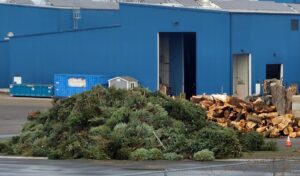
A stack of discarded Christmas trees awaits processing at a drop-off facility. / Photo Credit: Wisconsin DNR
By Wisconsin DNR
Invasive plants and insects don’t mind playing the long game. After all, they’re just trying to survive and thrive, like the rest of us.
They’ll hang out as part of your holiday decorations throughout the season, just on the chance humans might dispose of them improperly, giving them an opportunity to find a new home in your yard or neighborhood.
Their growth and feeding can often harm native trees, native plants and entire ecosystems over time. A little extra effort can prevent the spread of invasive insects, seeds and spores that can harm your trees and plants and potentially spread to cause problems elsewhere.
For that reason, the Wisconsin Department of Natural Resources (DNR) reminds people to dispose of all wreaths, trees, boughs and other holiday decorations using safe methods in accordance with state and local laws and regulations. Following established guidelines will help avoid the spread of invasives.
Wisconsin law generally prohibits landfill disposal of yard waste, including leaves, grass clippings, brush and pieces of wood (branches, sticks, etc.) less than six inches in diameter. The yard waste disposal law has been in place since 1993. The DNR recommends chipping or composting yard waste.
Instead, the DNR recommends a close inspection of holiday decorations that include plant matter or trees, to check for evidence of invasive insects, plants or fungal infections. If you find something that might be of concern, take close-up photos and send them to your local DNR Forest Health specialist along with your contact information.
If your municipality or a private service provider offers drop-off or curbside tree collection for residents, remove lights, decorations and wires before placing the tree on the curb or taking it to the drop-off center. If tree management is not offered in your area, check the Wisconsin Recycling Markets Directory for a list of licensed composting facilities.
Do not toss trees and greenery with signs of invasive insects, plants or fungal infections into backyard woods or your residential compost pile, which could make the problem worse. Crafters are advised to be mindful of using invasive greenery.
Many agricultural products are brought in from other parts of the country during the holidays, and some can carry invasive insects, plants and pathogens that can spread through one of three ways:
- Improper disposal of holiday greenery.
- Moving firewood and wood products.
- Transporting freight on vehicles and on recreational equipment.
Plants such as round-leaf bittersweet (Celastrus orbiculatus), multiflora rose (Rosa multiflora) and various types of teasel (Dipsacus sp.) can often be found in holiday wreaths or decorations. Insects such as hemlock woolly adelgid (Adelges tsugae) and elongated hemlock scale (Fiorinia externa) pose a risk to Christmas tree fields as well as native and ornamental coniferous trees common to Wisconsin.
The Wisconsin Department of Agriculture, Trade and Consumer Protection (DATCP) has established quarantines for the import of trees and plants to prevent the introduction of invasive insects and plant pathogens. The Wisconsin state legislature has also created Chapter NR 40, a rule categorizing invasive species as prohibited or restricted. It is unlawful to transport, transfer or introduce any species listed under ch. NR 40. Prohibited species have an additional restriction on possession.
The DNR offers more information on invasive species and forest pests. DATCP offers more information on its quarantine regulations.