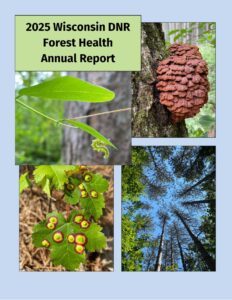
The cover of the 2025 Wisconsin Department of Natural Resources Forest Health Annual Report. / Graphic Credit: Wisconsin DNR
By Art Kabelowsky, DNR Outreach and Communications, Fitchburg
Arthur.Kabelowsky@wisconsin.gov or 608-335-0167
The Wisconsin Department of Natural Resources (DNR) has made its 2025 Forest Health Annual Report ready to view and download.
This year’s edition contains 55 pages of reporting on forest health issues throughout Wisconsin, detailing methods employed by the DNR and other agencies to control pests, diseases and invasive plants.
Among the highlights:
- The spongy moth outbreak, which peaked in 2023, collapsed in summer 2024. No defoliation was observed in 2025; however, moderate to severe oak mortality is now occurring in many areas that experienced severe defoliation during the outbreak.
- The DNR is developing a response plan for the invasive pest hemlock woolly adelgid, which has not yet become established in Wisconsin but is moving westward and has reached the western lakeshore of Michigan.
- Work continues to focus on biological control of emerald ash borer to aid in the protection of ash regeneration.
- Beech bark disease was confirmed at a site in northern Menominee County, making it the second Wisconsin county (Door County was the first) in which the disease is known to occur. The insect beech scale, a contributing factor in beech bark disease, was found in several new locations in four northeastern Wisconsin counties, bringing the total to 13.
- Invasive Japanese stilt grass, previously only known in La Crosse County in Wisconsin, was discovered in four new counties in 2025: Rock, Walworth, Dane and Grant.
Updates are provided on many other forest health issues, covering all regions of the state.
The DNR’s Forest Health webpages contain a page with links to previous years’ annual reports.