
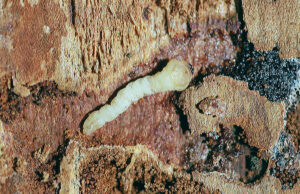
A hemlock borer larva inside channels in a hemlock tree. / Photo Credit: Steven Katovich, Bugwood.org
By Linda Williams, DNR Forest Health Specialist, Woodruff
Linda.Williams@wisconsin.gov or 920-360-0665
Woodpeckers are often the first to know that a hemlock tree is being attacked by hemlock borer.
Woodpeckers will flake off the outer layers of bark to get at the tasty hemlock borer larvae under the bark, leaving the tree with a reddish hue that, once you’ve seen it, is unmistakable. The woodpecker damage quickly makes it obvious that the tree was fully infested from top to bottom by hemlock borer.
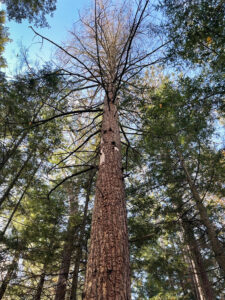
A single hemlock that was killed by hemlock borer, surrounded by other hemlock that are healthy. / Photo Credit: Wisconsin DNR
Often, when woodpecker activity begins to appear, the tree still has some green needles in its crown. But they quickly turn off-color green, then yellow, and then drop as the tree dies.
In recent decades, it has become increasingly common to see a single tree attacked and killed, indicating that only that tree was under significant stress. But following significant blowdown from storms in the 1930s and again in the 1950s, large populations of hemlock borer developed and killed many trees across the landscape. Hemlock is the most common host observed in northern Wisconsin, but the literature also lists white pine, tamarack, balsam fir and spruce as possible hosts for hemlock borer.
Hemlock borer is a small, buprestid beetle that attacks stressed trees. Adult buprestid beetles are generally referred to as metallic wood borers; their larvae are commonly called flatheaded wood borers.
Hemlock borer larvae are about 1 inch long, feed under the bark and are flattened and resemble lollipops. They typically have a greatly enlarged area near the head, with the rest of the body being narrow.
Some larvae can complete development in a single growing season, while others may take two growing seasons.
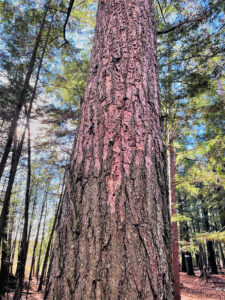
Woodpeckers have flaked off outer layers of bark on this hemlock main stem, leaving the tree with a reddish cast. / Photo Credit: Wisconsin DNR
Maintaining healthy trees is the best way to prevent issues with hemlock borer. Natural enemies, including egg and larval parasitoids, help to keep the borer population in check. In areas with storm damage, where many hemlock trees are stressed and beetle populations could build up, salvaging the timber can help reduce the population of borers in that area.