By Art Kabelowsky, DNR Outreach and Communications
Arthur.Kabelowsky@wisconsin.gov or 608-335-0167
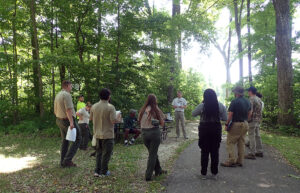
Wisconsin DNR Forest Health specialist Bill McNee presents a hazard tree training talk to other DNR workers at Lizard Mound State Park in 2023. / Photo Credit: Wisconsin DNR
Did any of your trees explode during the recent cold snap? Likely not.
Social media — and some traditional news outlets — grabbed hits and headlines by warning folks that the January cold snap could spark a phenomenon they called “exploding trees.”
But Bill McNee, an Oshkosh-based Forest Health specialist for the Wisconsin Department of Natural Resources (DNR), was there to prune the branches of the fast-growing viral story.
In an interview on National Public Radio’s Weekend Edition, and a newspaper interview with the Milwaukee Journal Sentinel that was picked up nationally by USA Today, McNee explained that the phenomenon is more commonly called “cracking trees.”
Sap inside a tree will expand as it freezes, and the resulting pressure on the inside of the tree can lead to a vertical crack in the tree’s mainstem — sometimes running the full height of the tree. Having a tree actually explode from frost is extremely rare, McNee said.
The cracking can create a loud bang, perhaps even resembling a gunshot. Trees can drop branches from cracking, and the results of a cracking mainstem could cause a safety hazard, McNee said. Most of the time, though, the tree survives despite the crack.
If any of the trees in your yard suffered from cracking — or, worse yet, exploded — McNee urges you to consult an arborist to discuss next steps.
Paul Cigan Discusses Winter Tree Health
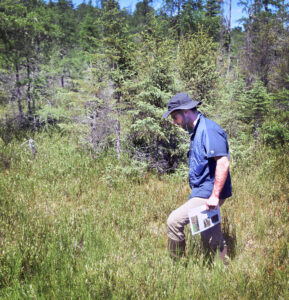
Paul Cigan looks for various species of invasive plants during a visit to a bog at the Wisconsin Department of Natural Resources’ Kemp Research Station on Tuesday, June 25, 2024. / Photo Credit: Wisconsin DNR
Paul Cigan, the DNR’s Forest Health specialist for Northwest Wisconsin, made an appearance on Wisconsin Public Radio with Garden Talk host Larry Meiller to discuss methods for protecting trees in winter.
The discussion also touched on winter pruning to prevent oak wilt, making plans for spring tree planting and ways to dispose of holiday trees.
Forest Health Staffers Plan Presentations
DNR Forest Health staff members are scheduled to appear at public events in February to discuss forest health. The schedule includes:
- Bill McNee will present a Forest Health update at the Fox Valley Woodland Landowner Conference, set for 7:30 a.m. to 1:30 p.m. Saturday, Feb. 7, at LaSure’s Banquet Hall, 3125 S. Washburn St., Oshkosh. McNee’s talk will begin at 8:30 a.m. The public is welcome. Pre-registration is requested at a cost of $45 per person.
- Tim Shively, the DNR’s Forest Health specialist for Western Wisconsin, will give a presentation titled “Forest Health for Everyone” at 5:30 p.m. Wednesday, Feb. 11, at the Cardinal Community Learning Center, 140 W. Elm St., Chippewa Falls. The public is welcome.
- Bill McNee will present a Forest Health update on Tuesday, Feb. 17, at the Wisconsin Arborist Association (WAA) and DNR Urban Forestry’s annual conference at the KI Convention Center, 333 W. Main St., Green Bay. The entire event will run from Sunday through Tuesday, Feb. 15 to 17. The cost to attend the convention is $300 for WAA members or $325 for non-members.