
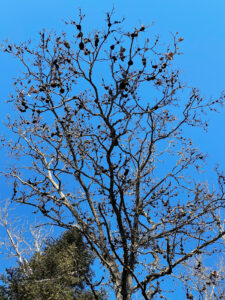
This northern red oak has many large Phomopsis galls. / Photo Credit: Wisconsin DNR
By Linda Williams, DNR Forest Health Specialist
Linda.Williams@wisconsin.gov or 920-360-0665
Winter is a great time to admire the structure of trees. When they are without leaves, you can see how the branches are arranged, how large or small the branches are, and if they are fairly straight or contorted. You might also notice some swellings or growths on those branches.
Two types that can really make a statement are Phomopsis and black knot.
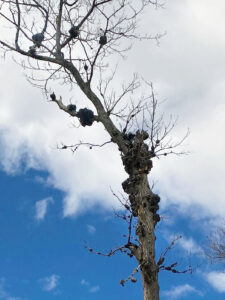
Phomopsis galls on northern red oak can get very large on the trunk or branches. / Photo Credit: Wisconsin DNR
Phomopsis
In Wisconsin, you will occasionally see a northern red oak, hickory or cherry with lots of lumpy growths on the branches, and even on the main trunk of the tree.
Phomopsis is a fungus that causes galls, sometimes large, to form on some oaks and hickories.
Not all trees will get them. In fact, it is common to see one tree with many galls evident throughout the top of the tree growing right next to other trees with no galls. If you’ve never seen a heavily galled tree, don’t despair — they can be rare in some areas of the state.
Large numbers of Phomopsis galls on a tree don’t mean that the tree will die quickly. Trees often live for many years, or even decades, with Phomopsis galls before they finally fade away and die, and then often only after a stress such as drought or defoliation by insects.
Phomopsis galls are most noticeable on bigger trees, because the galls have had time to grow quite large either in size or in numbers, but smaller trees can get them as well. Pruning out the galls can be done when the trees are young, but on trees in the forest, they are usually just left to grow.
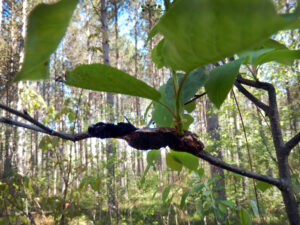
A black knot on the branch of a wild black cherry. / Photo Credit: Wisconsin DNR
Black Knot
Another woody gall you might notice during the winter is black knot on cherry. Our native black cherry can sometimes have large numbers of black knot galls on the branches, and occasionally, you can find larger galls growing on the trunks of the trees.
On our native wild black cherry trees, some black knot galls can cause branch-tip mortality, but the tree often just lives with many of these galls growing on the branches. Galls on the main stem rarely seem to cause mortality. On the other hand, black knot on cultivated stone fruits can cause significant dieback and mortality.
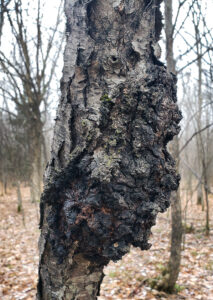
A large black knot gall on the trunk of a wild black cherry tree. / Photo Credit: Wisconsin DNR
To explore the question of whether black knot galls on the main stem could cause a high risk of failure, Wisconsin Department of Natural Resources staff monitored some mature black cherry trees with large black knot galls on the main stem from 2009 to 2023. At the end of the monitoring period, none of the monitored trees had broken where the galls were located, and none had died from the presence of the gall. Cross sections of some of those galls showed distorted wood grain, but it was solid wood without decay, and with minimal bark inclusions.
Management of galls on branches can include pruning out the affected area, if feasible. But that is usually not necessary if the branches affected are otherwise healthy and asymptomatic.
There are lots of other galls that you might spot on various tree species, but they are often much less common, or there are far fewer galls per tree compared to the two mentioned here.
If you spot some galls this winter while marveling over the branch structure of trees, make a mental note to go back and check the tree this summer to see if it appears healthy, because having many galls doesn’t always equate to declining tree health.
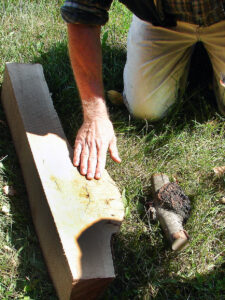
A cross-section of a large black knot gall on the trunk of a wild black cherry tree doesn’t have decay. / Photo Credit: Wisconsin DNR