
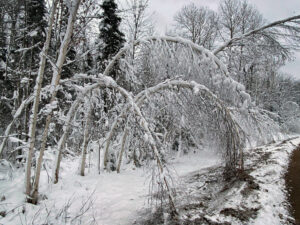
Trees bent from the weight of heavy snow following a Thanksgiving-week blizzard in northern Wisconsin. / Photo Credit: Wisconsin DNR
By Paul Cigan, DNR Forest Health Specialist
Paul.Cigan@wisconsin.gov or 715-416-4920
This year’s Thanksgiving holiday brought with it not only a hearty meal and a few good hunting stories to tell around the family table, but also a heavy fixing of blizzard-like conditions. The storm caused a real stretch to the proverbial beltline of many trees that were left heavily bent over in its wake.
On the evening of Tuesday, Nov. 25, a potent winter storm moved across northwestern Wisconsin, bringing with it freezing rain that transitioned to heavy, wet snow as temperatures dipped overnight.
Then, on Nov. 28-29, southern Wisconsin experienced its own potent dose of early winter snow when a second large snowstorm moved through, bringing heavy snowfall but with more limited damage.
Many trees were left bent to the ground by a heavy layer of ice and snow, causing branches to break and whole trees to snap. Aspen, birch and pine less than 6 inches in diameter were the most heavily affected tree species, while understory shrubs (such as hazelnut) and tag alder were commonly left completely bent over and buried by icy snow cover.
The storm was reminiscent of the “Blue Blizzard” of December 2022, but the recent storm resulted in comparatively minor tree damage. A brief but sharp warm-up, accompanied by gusty winds on Dec. 16 through 18, provided trees with much-needed relief. Higher temperatures caused the heavy layer of accumulated ice and snow to rapidly shed off trees, allowing most to spring back to an upright position.
Clean-up and tree care after winter storm damage is a good practice that can reduce tree health issues later in the spring. Corrective pruning on broken tree branches can promote a better growth habit and aesthetics following damage, such as the loss of large branches or main terminal leaders under the weight of ice and snow. Removing excessive downed material near structures can reduce wildfire risk.
If using pruning tools such as shears, hand saws or chainsaws, it’s important to keep the risk of oak wilt infections to a minimum by completing these activities by April 1 in southern Wisconsin, or by April 15 if working in northern Wisconsin.