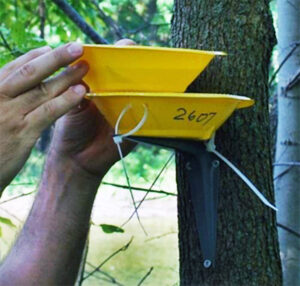
A yellow pan trap used for trapping Oobius agrili wasps. / Photo Credit: United States Department of Agriculture Animal and Plant Health Inspection Service
By River Mathieu, DNR Forest Health Specialist
River.Mathieu@wisconsin.gov or 608-772-2758
One small adult wasp collected by United States Department of Agriculture Animal and Plant Health Inspection Service (USDA APHIS) staff at Riedel Redmond Nature Preserve in Mosinee (Marathon County) was recently identified as Oobius agrili.
USDA APHIS staff collected several wasp specimens in yellow pan traps and sent them to a U.S. Forest Service expert for identification. This marks the first recovery of O. agrili in Wisconsin.
Oobius agrili is an emerald ash borer (EAB) parasitoid that was first released in Wisconsin in 2011 and has been released annually since then. O. agrili parasitizes EAB eggs on the bark of ash trees, consuming the EAB larvae inside the egg.
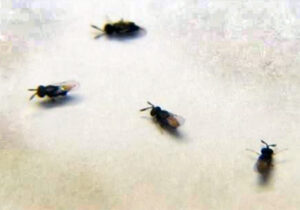
Adult Oobius agrili wasps. The actual size of these wasps is about 1 millimeter in length. / Photo Credit: Wisconsin DNR
In contrast to O. agili, other wasps used for EAB biocontrol parasitize EAB larvae rather than eggs. O. agrili also differs from other EAB parasitoids used for biocontrol in North America in that all individuals are female and are capable of laying eggs without mating.
Because of their small size (about the thickness of a sharp pencil tip), O. agrili adults are difficult to recover in the field. Additionally, it is difficult to recover EAB eggs parasitized by O. agrili, as EAB eggs are small and laid in bark crevices on ash trees. This cryptic nature makes it very likely that O. agrili has established in other Wisconsin release sites but has not yet been found in other recovery surveys.
Four species of EAB parasitoid have been released in Wisconsin: Tetrastichus planipennisi, Spathius galinae, Spathius agrili and Oobius agrili. However, Spathius agrili was released for only 2 years and has not been recovered subsequently in Wisconsin.
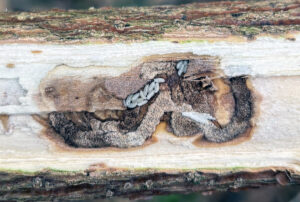
Tetrastichus planipennisi pupae are found in an emerald ash borer gallery at Aztalan State Park in Jefferson County. / Photo Credit: Wisconsin DNR
All three parasitoid species that have been consistently released since 2011 (Tetrastichus planipennisi, Spathius galinae and Oobius agrili) have now been recovered at least once, indicating that they are successfully reproducing and attacking EAB life stages. Parasitoid releases have now occurred in 38 counties; recoveries have been made in 19 counties.
Other recoveries in 2025 included: T. planipennisi in Green Lake, Jefferson, Marathon, and Shawano counties and recoveries of S. galinae in Green Lake and Shawano counties. T. planipennisi is the most frequently recovered parasitoid in Wisconsin.
The goal of EAB parasitoid releases is to establish a population of EAB natural enemies that will provide some level of EAB population control, allowing regenerating ash a chance to reach maturity, albeit as smaller trees.
Recovery efforts made by the Wisconsin Department of Natural Resources Forest Health staff and USDA APHIS are crucial for monitoring the establishment and dispersal of EAB parasitoids. Release and recovery efforts of parasitoids will continue in 2026, with most releases set to occur in northern Wisconsin.
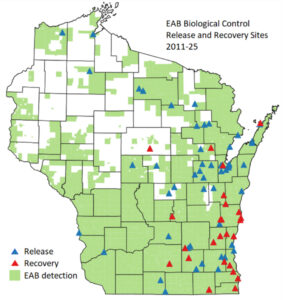
A Wisconsin map showing emerald ash borer biological control releases and recoveries as of November 2025. / Map Credit: Wisconsin DNR
EAB parasitoid wasps do not sting or bite, and it is unlikely that the public will see them.