Month: March 2026

Stilt Grass StoryMap Updated For 2026

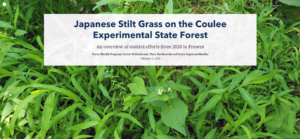
Main page of the Wisconsin DNR's StoryMap on Japanese stilt grass.

The main page of the Wisconsin Department of Natural Resources’ StoryMap titled “Japanese Stilt Grass on the Coulee Experimental State Forest.” / Graphic Credit: Wisconsin DNR

By Carter Hellenbrand, DNR Invasive Plant Field Specialist, Fitchburg
Carter.Hellenbrand@wisconsin.gov

The Wisconsin Department of Natural Resources (DNR) Forest Health program has updated the Japanese stilt grass StoryMap to reflect all the work completed in 2025. The StoryMap documents the history of this invasive species on the Coulee Experimental State Forest in La Crosse County.

A StoryMap is a web-based content creation and communication tool that allows creators to share maps, apps and multimedia in the context of a narrative. Users can see an overview of Japanese stilt grass, how to identify it and what control efforts have been implemented since the plant was first detected in Wisconsin in 2020.
Continue reading “Stilt Grass StoryMap Updated For 2026”

Oak Wilt High Risk Period Quickly Approaches

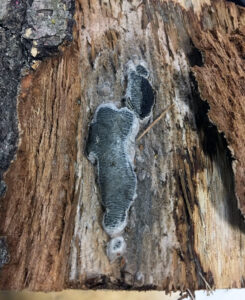
A closeup of a fungal pressure pad under the bark of an oak tree infected with oak wilt.

A fungal pressure pad formed on the outside of the sapwood underneath the bark of an infected tree. The pad will create cracks in the bark, where beetles can enter and visit the pad and become covered in spores. They will then leave and move on to infect new trees through open wounds. / Photo Credit: Wisconsin DNR

By Alex Hornung, DNR Forest Health Specialist, Plover
Alexandra.Hornung@wisconsin.gov or 715-340-3810

It is again that time of year to pause operating in oak stands or pruning oak trees during the high-risk period for oak wilt, which begins in April. The high-risk period begins April 1 in the South, April 15 in the North, and ends in both zones on July 15.

The high-risk period is determined by when the beetles that carry the fungus that causes oak wilt have emerged for the year and when they are carrying the highest number of fungal spores. When wounds are created by logging operations or other activities that expose sapwood, the beetles carry the fungus to the wounded tree, and the disease process begins.

Continue reading “Oak Wilt High Risk Period Quickly Approaches”

Watch For Squirrel, Porcupine Damage In Spring

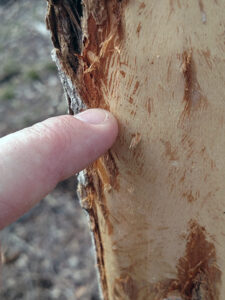
Closeup of small squirrel tooth marks on a tree's mainstem.

Squirrel tooth marks are small and look like narrow scratches from which the animals have removed the tree’s bark. / Photo Credit: Wisconsin DNR

By Linda Williams, DNR Forest Health Specialist, Woodruff
Linda.Williams@wisconsin.gov or 920-360-0665

As winter transitions into spring, you may notice patches of tree bark that have been removed. But what did the damage?

Several animals, including squirrels and porcupines, can chew or strip bark from trees. This can occur on hardwoods and conifers, older trees and young saplings. Damage can be enough to kill branches or even the entire tree.

Continue reading “Watch For Squirrel, Porcupine Damage In Spring”

Does Cold Weather Bug The Bugs?

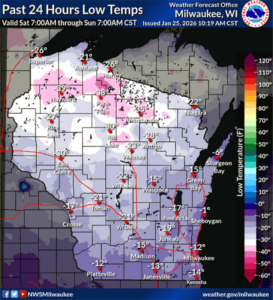
A map of Wisconsin showing cold temperatures on Jan. 25, 2026.

Cold temperatures across the state of Wisconsin on Jan. 25, 2026. / Graphic Credit: National Weather Service

By River Mathieu, DNR Forest Health Specialist, Fitchburg
River.Mathieu@wisconsin.gov or 608-772-2758

Wisconsin experienced a polar vortex in late January 2026, and temperatures got chilly throughout the state, even reaching close to -40⁰ F in some places! Although it has warmed up, the cold weather is still fresh in everyone’s minds, leaving insect and forest lovers alike wondering how insects survive temperatures that cold.

The Wisconsin Department of Natural Resources Forest Health staff has received several questions over the past month about how insects survive cold weather in winter and whether the January temperatures were cold enough to kill insect pests.

Continue reading “Does Cold Weather Bug The Bugs?”

Protect Valuable Ash Trees Against Emerald Ash Borer

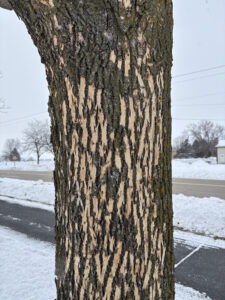
An ash tree in Oshkosh shows damage from woodpeckers feeding on emerald ash borer larvae beneath the bark.

An ash tree next to a walking trail in Oshkosh has been damaged by woodpeckers feeding on emerald ash borer larvae beneath the bark. / Photo Credit: Wisconsin DNR

By Bill McNee, DNR Forest Health Specialist, Oshkosh
Bill.McNee@wisconsin.gov or 920-360-0942

Property owners with healthy, valuable ash trees are encouraged to treat them with insecticide this spring to protect against emerald ash borer (EAB).

The invasive pest is currently the most damaging threat to trees in Wisconsin, killing more than 99% of the ash trees it infests.

Woodpecker damage during the winter is often the first sign that an ash tree is infested. The birds remove pieces of bark while feeding on EAB larvae inside the tree. Insecticide treatment of infested ash trees is more likely to be successful if the trees have low or moderate levels of woodpecker damage.

Continue reading “Protect Valuable Ash Trees Against Emerald Ash Borer”