By Abby Krause, DNR Urban Forestry Coordinator
Abigail.Krause@wisconsin.gov or 608-556-5690
 Trees are good. For those who hold trees in high esteem, this simple statement feels as much a universal truth as the sky being blue or the sun rising in the east. It can feel unfathomable that anyone might hold a contrasting opinion.
Luckily, if you are of the trees are good persuasion, there’s plenty of research out there to support your stance. Oxygen production, air pollutant removal, stormwater reduction and filtration, lower energy bills, increased property values, food sources, recreational opportunities, wildlife habitat and calming aesthetics are just a few oft-touted benefits provided by trees.
Tree appreciators tend to also have emotional connections with them. Sometimes, when I host meetings, I require people to participate in the dreaded icebreaker. (My sincerest apologies if even reading the phrase “ice breaker” just now triggered a wave of unease to befall you.) However, my go-to question for these instances has become, “What’s one memory you have with a tree?” Groans and apprehension melt into laughter and bemusement as people eagerly share childhood adventures climbing into canopies, plucking fruits from the backyard to bake a pie with grandma, tromping through the snowy forest to find the perfect holiday tree and watching songbirds visit the oak outside their window each morning. I have yet to have anyone share a bad memory.
Still, that doesn’t mean there aren’t experiences that cause people trepidation about trees. Branches break off and damage roofs during storms. Cracked pipes being exploited by roots or the removal of a dying tree can bring hefty maintenance price tags. Cleaning leaves out of gutters is a loathed chore. Acknowledging these very real concerns up front can help strengthen your message when educating audiences about trees.
While it may seem like old news to the self-proclaimed tree person (and I suspect you are one since you’re currently reading a government newsletter dedicated to urban forestry) that trees have vast benefits, not everyone has had the same life experiences. That’s why it’s important to keep getting the word out in different ways about how amazing trees are while conceding they’re not perfect. Below are a few outreach examples from communities in western Wisconsin on how they’ve been educating residents about their local urban forest.
Tree Walks
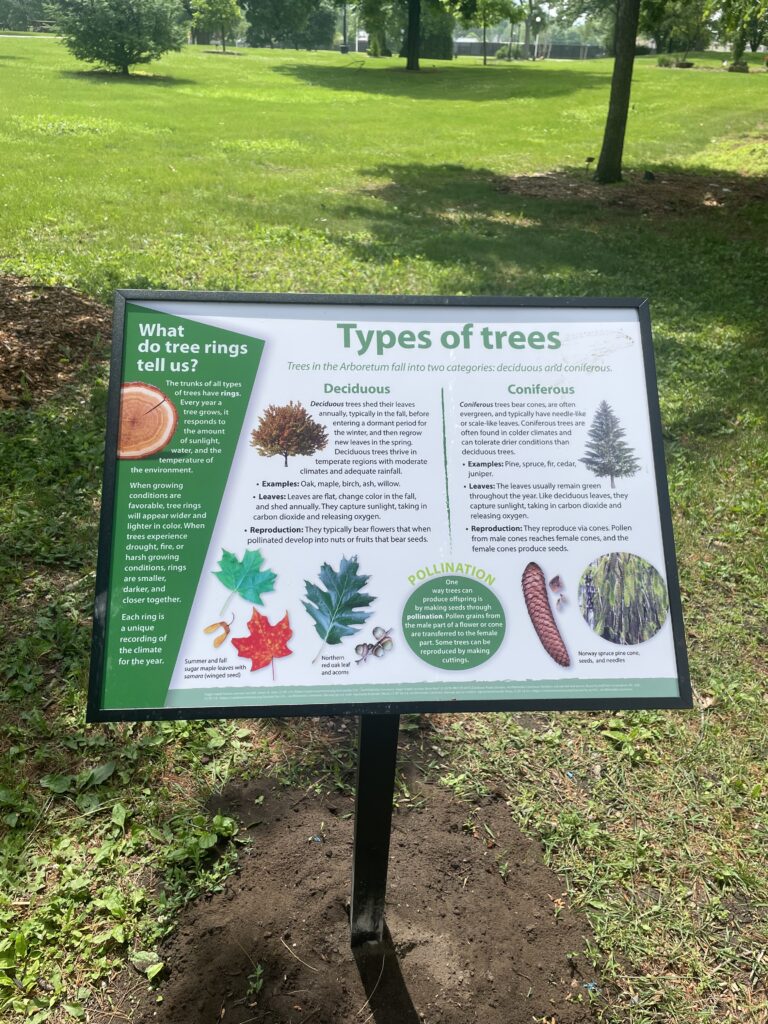 The Myrick Park Arboretum in La Crosse is nothing new; it’s actually been around for decades. In May 2024, it was officially accredited as a Level 1 Arboretum through ArbNet. Then, this last year, additional signage and educational materials were created for the arboretum, partially funded by a DNR Urban Forestry grant. Visitors can discover over 50 species of trees as they weave their way through the park.
Less than a mile south of the Myrick Park Arboretum, on the University of Wisconsin – La Crosse (UWL) campus, you’ll find the new Hįnųkwas Tree Trail created through a partnership between the Ho-Chunk Nation and UWL. Here, 24 native tree species are highlighted to inspire curiosity in passersby. Besides some of the usual information you might expect from a tree walk (i.e., common name, Latin name, identifying features, etc.), this trail also includes the Ho-Chunk name and cultural significance for each species.
Videos
One of the objectives for the Chippewa Valley Biodiversity Partnership (CVBP) is to landscape with native trees and plants. We often hear about the urban forest from the perspective of public street and park trees, but the majority of the urban forest is found on private property. The CVBP produced a series of short videos (“The City for the Trees,” “Trees Please,” “The New Green Deal”) created to inform residents about the urban forest and encourage planting in their own yards. “The City for the Trees” even scored a nomination for the creators, Story Time with Steve & Micah, at the 2025 Upper Midwest Chapter Emmy Awards.
Webpages
When the City of Menomonie started the grueling response to emerald ash borer (EAB), staff began receiving an uptick in angry phone calls. The disappearance of beloved trees felt careless and sudden to some residents, unaware these removals were strategically done to ensure their safety from ash starting to succumb to the invasive pest. A takeaway for staff from these interactions, though, was that they had residents who valued trees, and passionately so. Staff used the opportunity to update and expand the city’s forestry program webpages. Not only can residents be in the know about the response to EAB, but they can learn about all the other tree maintenance carried out by the Community Services Department, the city’s boulevard tree planting program and how to care for their yard trees.