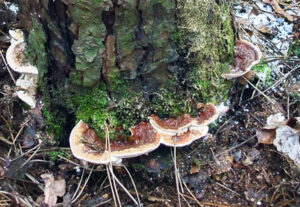
A tree shows fruiting bodies of Heterobasidion root disease at the base of its trunk. / Photo Credit: Wisconsin DNR
By Kyoko Scanlon, DNR Forest Pathologist
Kyoko.Scanlon@wisconsin.gov or 608-235-7532
In 2025, Heterobasidion root disease (HRD), a destructive fungal disease, continued to be found in Wisconsin counties where the disease had previously been detected. There were no new county finds in 2025.
Based on the findings in 2025, the maps in the HRD stump treatment guidelines and online viewer have been updated. The 6-mile and 25-mile buffer zone maps in the guidelines are updated annually and good through Dec. 31, 2026.
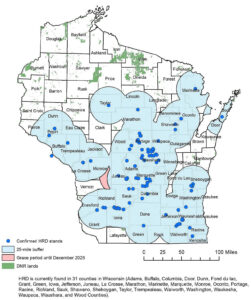
A map of Wisconsin shows the most up-to-date Heterobasidion root disease confirmed locations and the 25-mile buffer zones around them. / Map Credit: Wisconsin DNR
The maps in the HRD guidelines document should be consulted at the time of timber sale establishment. Winter is a good time to review the maps in the areas where you work. Please pay attention to buffer zones that are currently under grace period until the end of 2026. Newly included areas have a one-year grace period for implementing the guidelines on DNR lands.
HRD guidelines are used for forest management activities on state lands managed by the Wisconsin DNR and are recommended on county forests and private lands. Under certain conditions, as described in the guidelines, treatment of pine and/or spruce stumps of merchantable size within 25 miles of detection is recommended.
HRD was first observed in Wisconsin in 1993 and is now known to occur in 31 of the state’s 72 counties. In Wisconsin, HRD is known to infect and kill red, white and jack pine, white and Norway spruce, balsam fir and red cedar.
HRD-infected trees exhibit reduced height, shoot and diameter growth and thinner foliage. Symptoms progress over several years and result in mortality. Symptoms typically appear 3 to 8 years after a stand is thinned.
If you suspect HRD, please contact a DNR forest health specialist in your zone. The DNR maintains a database that tracks every infected stand in Wisconsin.