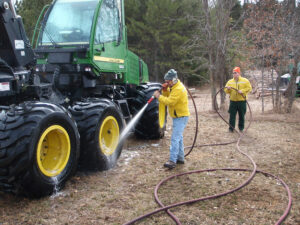
Workers follow the practice of pressure-washing the tires and frames of a tractor to rid the vehicle of possible invasive plants after a workday in the forest. / Photo Credit: Wisconsin DNR
By Art Kabelowsky, DNR Outreach and Communications
Arthur.Kabelowsky@wisconsin.gov or 608-335-0167
The North American Invasives Species Management Association (NAISMA) has organized a series of activities to take place as part of its National Invasive Species Awareness Week (NISAW), set for Feb. 23 through 27.
The Wisconsin Department of Natural Resources will participate by presenting a news release and daily social media posts in the days leading up to the start of NISAW’s 2026 activities.
The week’s motto is “Defending Our Health by Stopping the Spread.” The event — which has become international — is dedicated to raising awareness about invasive species, the threats they pose and the actions that can be taken to prevent their spread.
The goal of the event is to involve local, state, tribal, federal, regional and international organizations — both private and public — to increase awareness and action, promoting behaviors that curb the spread of invasives of all sorts.
The number and types of organisms that can be called “invasive species” is wide-ranging, including plants, animals, insects, fungi and pathogens. Each can threaten public health, food security, recreation, infrastructure and ecosystem stability across North America.
Invasive species, if left uncontrolled, can and will limit land and water use now and into the future. The longer the problem is ignored or pushed to the back burner, the harder and more expensive the battle for control will become.
“Invasive species impact every community. Whether through wildfire risk, agriculture losses, water shortages, vector-borne diseases or damage to critical infrastructure,” said Christie Trifone-Millhouse, executive director of NAISMA. “This year’s theme underscores a powerful truth: Protecting our environment is directly tied to protecting our health. NISAW 2026 is a rallying point for collaboration and solutions.”
Throughout the week of Feb. 23 through 27, invasive species experts will gather in Washington, D.C., and virtually across North America, to inform and educate elected officials, agency leaders and other decision-makers about best practices and priorities for prevention and management of invasives. Partners around the country may hold local events to advocate to decision-makers in their region.

The logo for National Invasive Species Awareness Week, sponsored by the North American Invasive Species Management Association. / Graphic Credit: NAISMA
NISAW 2026 will spotlight key issues such as:
- Public health impacts of invasives, including allergens, toxins and disease vectors.
- Aquatic invasive species threatening drinking water systems and fisheries.
- Forest pests and pathogens are increasing wildfire risk and reducing carbon storage.
- Agricultural and economic damages affecting food systems and rural communities.
- Best practices for prevention, including recreation-based spread prevention, clean equipment protocols and biosecurity principles.
Throughout the week, NAISMA will host free national webinars, policy discussions and a congressional briefing designed to educate and activate stakeholders at every level. Participants viewing the events virtually can expect:
- Daily educational webinars featuring leading scientists, land managers and policymakers.
- Toolkits, social media graphics and community engagement resources for partners.
- Calls to action encouraging individuals and organizations to stop the spread.
NISAW organizers offer a full schedule of events and information on how to join virtually.