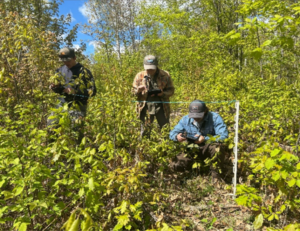
New hires familiarize themselves with FRM data collection. / Photo Credit: Wisconsin DNR
By Gabe Spangler, DNR Forest Regeneration Monitoring Coordinator
The Forest Regeneration Monitoring (FRM) program was initiated to better assess the status of naturally regenerating forests across the state and to provide data on forest regeneration success or failure in relation to deer herd population density across Wisconsin. Previous forest monitoring methods were not intensive enough to tell a precise, county-level story of the impacts of deer browse (herbivory) on forest regeneration or the quality of the forest habitat available to deer.
Monitoring is accomplished through random sampling of the harvested area of a timber stand, using 1/300th-acre plots, taking precise counts and thoughtful estimates of:
- Stems by species and height class
- Percent of stems browsed of a species
- Woody plant competition percentage
- Herbaceous plant competition percentage
- Canopy cover (shading) percentage
To date, more than 50,000 FRM plots have been collected during the program’s lifetime by seasonal technicians hired across the state during the growing season. Data collected from FRM program efforts have already provided important snapshots of current forest habitat conditions throughout Wisconsin for landowners and land managers. Sustainable forest management is a long-term endeavor deeply intertwined with wildlife habitat, and data collected from the FRM inventory will continue to be incredibly valuable for both short and long-term forest habitat management on public and private lands.
What And Where Do We Sample?
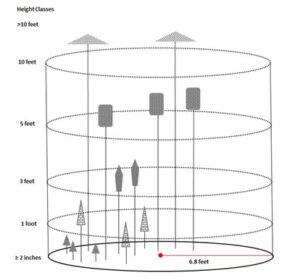
A drawing showing a 1/300th-acre FRM plot.
FRM data collection occurs throughout 45 of Wisconsin’s counties, meeting the threshold of at least 30% forest cover. Commonly harvested forest types within these counties are selected for data collection, private lands, usually in the Managed Forest Law (MFL) Program, to public lands in federal, state and county ownerships. Forest types commonly sampled include northern hardwoods, oak, pine and sometimes aspen.
To meet the criteria of an FRM-targeted timber stand, a recent regeneration harvest must have occurred to allow natural regeneration. This means that the program targets recent timber harvests that rely on locally available seeds and sprouts to establish a new generation of trees in canopy gaps; plantations are not sampled for the FRM program. Ideally, the first sample to collect from a stand may be 2-6 years from the harvest, depending on location and forest type.
What can we learn from FRM?
After the initial sample, the stand is resampled every 3 years, using the same methods. With time, FRM data on this 3-year cycle will allow us to track how Wisconsin forests are changing and could facilitate refinement of Wisconsin-specific regeneration guidelines. In May 2026, we will begin our 9th year of data collection, with the third cycle of FRM data collection ending in mid-October, where hundreds of stands will have been sampled three times.
FRM reports from a single stand can give landowners and land managers valuable insight into how one stand in particular may be faring. These reports include estimates on trees per acre by species and height class, as well as the severity of deer browse experienced by each species.
FRM data has begun to allow us to identify hotspot regions struggling with regeneration from high deer browse, and that relationship will only be better described over time. This data can also give us an early warning if forest habitat is changing in ways that may affect the future of wildlife and Wisconsin’s forest products industry.
Questions or comments? Email DNRFRRegenerationMonitoring@wisconsin.gov.