
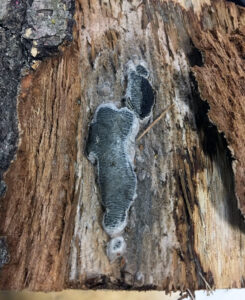
A fungal pressure pad formed on the outside of the sapwood underneath the bark of an infected tree. The pad will create cracks in the bark, where beetles can enter and visit the pad and become covered in spores. They will then leave and move on to infect new trees through open wounds. / Photo Credit: Wisconsin DNR
By Alex Hornung, DNR Forest Health Specialist, Plover
Alexandra.Hornung@wisconsin.gov or 715-340-3810
It is again that time of year to pause operating in oak stands or pruning oak trees during the high-risk period for oak wilt, which begins in April. The high-risk period begins April 1 in the South, April 15 in the North, and ends in both zones on July 15.
The high-risk period is determined by when the beetles that carry the fungus that causes oak wilt have emerged for the year and when they are carrying the highest number of fungal spores. When wounds are created by logging operations or other activities that expose sapwood, the beetles carry the fungus to the wounded tree, and the disease process begins.
Oak trees in the red oak group are the most susceptible to oak wilt, often dying in as little as 2-4 weeks after being infected. Oak in the white oak group are susceptible to a much lesser extent, but mortality can still occur, especially in bur oak trees.
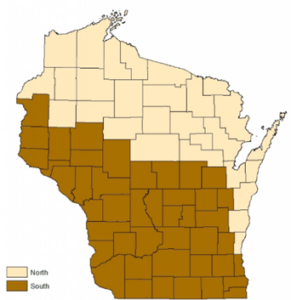
The South/North zones recommending that pruning and other work on oak trees should stop on April 1 (South zone) or April 15 (North zone). The no-damage recommendation runs through July 15. / Map Credit: Wisconsin DNR
Once the disease is introduced into a tree, it is transmitted to neighboring trees through interconnected root systems. Oak in the red oak group are known to commonly create functional root grafts with other red oaks, allowing the disease to rapidly expand within a stand.
Symptoms of infection start at the very top of the tree and work their way down. Leaves will begin to discolor around the margins, ranging from dingy dark green to dried, crunchy brown. From a distance, the top of the tree may look red. The leaves will begin to fall, starting around the end of June and into July.
The best way to manage oak wilt is to prevent its introduction. Operating outside of the high-risk period is an easy way to prevent the disease from entering uninfected stands. If wounds are made to oaks unintentionally during the high-risk period, the application of a wound paint as quickly as possible will help prevent beetles from dropping the fungus off. Wounds are susceptible for 72 hours.
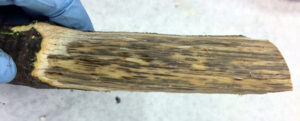
Sapwood of trees infected by oak wilt becomes discolored, a diagnostic clue called vascular streaking. The discoloration can range from light gray or blue all the way to dark gray. The fungus can make its way through the sapwood into the roots of neighboring trees. / Photo Credit: Wisconsin DNR
Once oak wilt has been identified on a property, work with your local forester or DNR Forest Health Specialist to create a management plan.