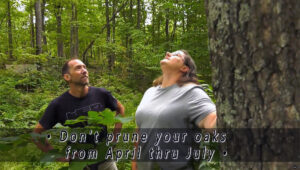
Landowner Montgomery Mouw and DNR Forest Health specialist Linda Williams inspect oaks as part of a DNR video explaining the disease oak wilt. / Photo Credit: Wisconsin DNR
By Art Kabelowsky, DNR Outreach and Communications; Arthur.Kabelowsky@wisconsin.gov or 608-335-0167
Owners of oak trees, the time for caution is now.
Your oaks are at risk of oak wilt infection if they undergo pruning work or are damaged —even inadvertently — between April and mid-July.
To bring landowners and managers up to speed on the impacts of oak wilt and the best ways to prevent it, the Wisconsin Department of Natural Resources (DNR) offers a video highlighting basic information on the danger that oak wilt poses to trees and forests.
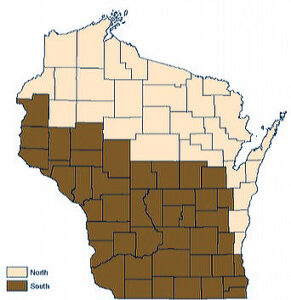
The South/North zone recommendations show that pruning and other work on oak trees should stop on April 1 (South zone) or April 15 (North zone). The no-damage recommendation runs through July 15. / Map Credit: Wisconsin DNR
The video is presented on the DNR’s main Oak Wilt webpage, which also contains links to additional information. Damage to oaks during the high-risk period, which begins April 1 in the South zone, and April 15 in the North zone, and ends in both zones on July 15, could lead to oak wilt infection.
The high-risk period is determined by when the beetles that carry oak wilt fungus have emerged and carry the highest number of fungal spores. These beetles carry the fungus to tree wounds where sapwood is exposed, starting the disease process.
Once infected, oaks in the red oak group will die within 2-4 weeks while oaks in the white oak group are less susceptible but can still die. After oak wilt is introduced into a tree, it spreads to neighboring trees through interconnected root systems, primarily amongst oaks in the red oak group which frequently form root grafts with other red oaks.
The best way to manage oak wilt is to prevent its introduction. If wounds are accidentally made to oaks during the high-risk period, wounds should be painted as soon as possible to prevent beetles from spreading the fungus.