
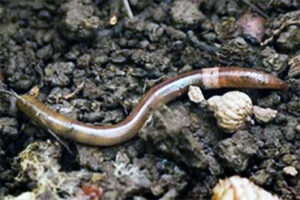
Closeup of a jumping worm (Amynthas agrestis). / Photo Credit: Wisconsin DNR
By Art Kabelowsky, DNR Outreach and Communications, Fitchburg; Arthur.Kabelowsky@wisconsin.gov or 608-335-0167
Invasive jumping worms are worrisome for several reasons, but here’s one of the main ones: It can be difficult to tell you even have them until they’ve already done their damage.
That makes this time of year important, because the best way to avoid damage from jumping worms, which can be substantial and long-lasting, is to prevent them from getting into your garden, yard or forestland in the first place.
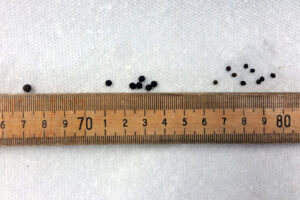
Closeup photo of cocoons containing jumping worm eggs, next to a ruler showing centimeters. / Photo Credit: Marie Johnston, University of Wisconsin Arboretum
The worms don’t become detectable until about late June. They reproduce in late August and September and their eggs, which are about the size of a mustard seed, overwinter in the top 2 inches of soil or leaf litter.
As a result, it’s easy to miss them hiding in your yard, garden and forest; in soil, mulch, compost and potted plants you may purchase. Eggs can even be stuck on vehicles, equipment or footwear when you visit infested areas.
When jumping worms (Amynthas agrestis) emerge from cocoons in April and May, they begin to feed on organic matter in the soil. As their population grows, jumping worms transform the soil into dry, granular clumps that resemble large coffee grounds.
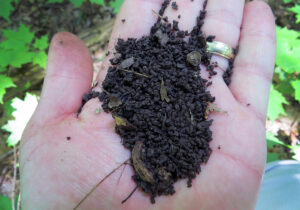
Soil infested with jumping worms often resembles coffee grounds. / Photo Credit: Wisconsin DNR
Soils impacted by jumping worms do not provide good growing conditions for native plants, lack important nutrients for plants and soil organisms, and may create good growing conditions for invasive plants. These changes can result in a less diverse ecosystem over time.
Jumping worms are parthenogenetic, producing eggs without the need for a mate. This means that just one worm introduced to a new area can lead to the development of a new population. With a life cycle of 90 to 120 days between hatching and reproduction, they can produce two generations per year.
Jumping worms, native to eastern Asia, were first detected in Wisconsin in 2013. They get their name from their behavior: when handled, they thrash violently, sometimes jumping into the air and shedding their tails. Jumping worm bodies are brown or gray and can grow up to 6 inches long and are smooth, firm and shiny. Their clitellum, the cloudy white to gray-colored fleshy band forming an enclosed ring around the worm’s body is not raised like on other earthworms, nor do jumping worms produce the familiar slimy substance like other earthworms.
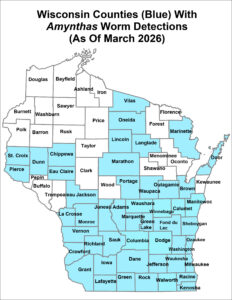
A map of Wisconsin showing counties (in blue) that have had jumping worm detections. / Map Credit: Wisconsin DNR
Jumping worms pose enough of a threat that Wisconsin, under Invasive Species Rule Ch. NR 40, has made it illegal to buy, sell, bring into the state or release jumping worms in water or on land.
Those who plant, sell, purchase and trade landscape and gardening plants should make sure they are free of jumping worms and their cocoons. One way to be sure is to sell, purchase and trade only soil, compost and mulch that you know was heated following appropriate temperature, time and procedural protocols to reduce pathogens, including jumping worms and their cocoons.
It’s also important for home gardeners and landscapers to avoid digging up and moving plants from one location to another.
More information is available online on a website hosted by the DNR that is a collaborative effort with the University of Wisconsin-Madison Division of Extension. Extension also offers a video explaining the threat of jumping worms.