
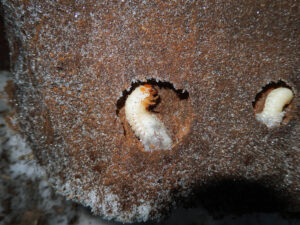
Large white grub larvae discovered while splitting firewood. The insects are living in a piece of firewood with a lot of decay. / Photo Credit: Wisconsin DNR
By Linda Williams, DNR Forest Health Specialist, Woodruff
Linda.Williams@wisconsin.gov or 920-360-0665
Hermit flower beetles (Osmoderma spp.) are very large scarab beetles, sometimes called leather beetles.
Three Osmoderma species can be found in Wisconsin, though none are common. Adult beetles look big and beefy but are harmless, eating a little pollen, feeding on ripe fruit and sipping nectar and tree sap during their adult life.
Eggs are laid in dead and decaying wood and larvae feed on that decaying wood. They avoid the solid wood of the trees.
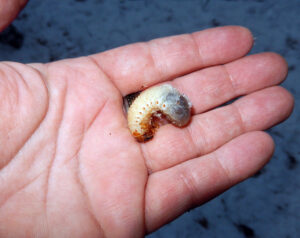
Large white grub larvae discovered while splitting firewood. The insects are living in a piece of firewood with a lot of decay. / Photo Credit: Wisconsin DNR
Usually, these beetles and their larvae are hard to find, with most discoveries made when firewood is being cut or processed. When wood is split, exposing a decayed core, occasionally large white grubs or pupal cases that look like small grenades will also be exposed. These large white grubs are very cold hardy, so even in winter the larvae will be alive, though moving very slowly.
There are reports that if you find these beetles, they can be hand-raised by feeding adults fruit, fruit juice and sugar water and by feeding the larvae decaying plant material, rotten wood and possibly some dog food. Pupal cases that are found can be kept with some of the decayed wood so that they don’t dry out or become damaged and adults may emerge.
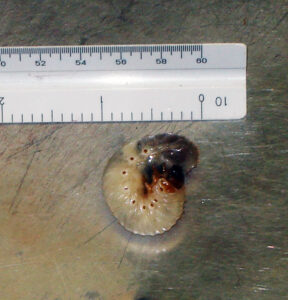
Osmoderma larvae are very large, “C”-shaped white grubs. / Photo Credit: Wisconsin DNR
None of the life stages of the hermit flower beetle are damaging to trees, even when found within a tree, because they only feed on decayed wood. Because of this, no control is necessary.