
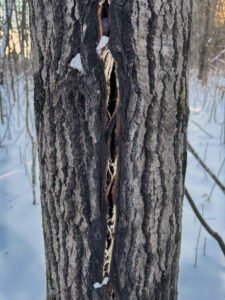
Cracked bark and wood creates a long vertical wound typical of the phenomenon commonly called “exploding trees.” / Photo Credit: Wisconsin DNR
By Linda Williams, DNR Forest Health Specialist, Woodruff
Linda.Williams@wisconsin.gov or 920-360-0665
This past winter, “exploding trees” went viral on social media. Many news outlets followed up with a more realistic explanation of the dramatically named phenomenon, pointing out that while the bitter cold can cause sudden cracks to form on trees, the trees don’t truly explode.
But what happens to those damaged trees as we warm up and move into the growing season?
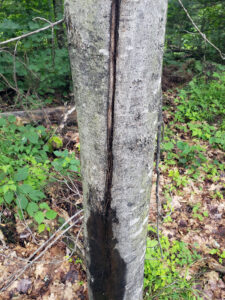
A vertical crack in a young maple has become infected with bacteria, causing an ooze called slime flux. / Photo Credit: Wisconsin DNR
Trees don’t heal wounds the same way that people heal wounds. Instead of repairing the damaged cells, trees compartmentalize the damaged area, serving to limit the ability of bacteria and fungi to invade. Trees then begin growing callus tissue over or around the wounded area.
How trees respond to wounds can vary based on the species of tree, its health, the location and extent of the wound and any further stress the tree might face during the upcoming growing season.
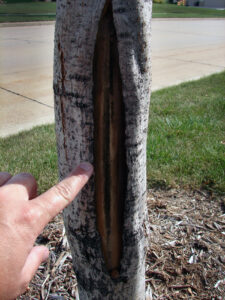
Thin bark that suffers cracking can dry out further, separating from the wood and creating a larger wound surface. / Photo Credit: Wisconsin DNR
Splits in the bark may expand as temperatures warm and the bark along the edges of the wounds dries out further. This will be more common in young trees or trees with thin, smooth bark. The splits will create a larger area that the tree needs to grow over.
Other trees will maintain just a thin crack and will try to grow over the split. The photos below are from past years, when winter cracking occurred, to show how they progressed after the cracks happened.
Callus tissue forming at the edge of the wound can create what appears to be a seam in the bark. Growing over and closing these wounds may or may not be successful over the next few years. Wounds that the trees are unable to completely grow over will remain an open crack, though only a very small crack may remain open.
Should you spray these cracks with wound paint? No. It is generally not necessary to use wound paint for wounds on trees, although there are some exceptions. For instance, wounds that occur on oak trees during the high-risk period for oak wilt transmission should be painted immediately (April 1 to July 15 in southern Wisconsin, or April 15 to July 15 in northern Wisconsin).
If the cracks that occurred during the winter compromise the structural integrity of trees near your home, garage or other areas of concern, you should have them evaluated by an arborist. Some trees may need to be removed for safety.
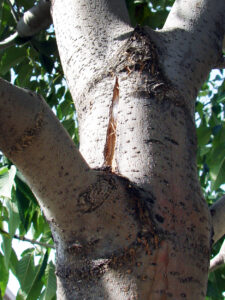
Cracked bark on a young tree opening wider as it dries. / Photo Credit: Wisconsin DNR
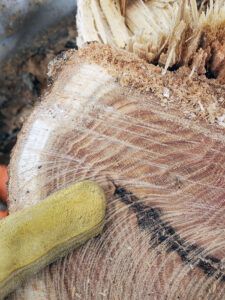
The stump of a tree that suffered a frost crack but was able to completely grow over and seal it off so that the crack was no longer open to the outside. / Photo Credit: Wisconsin DNR
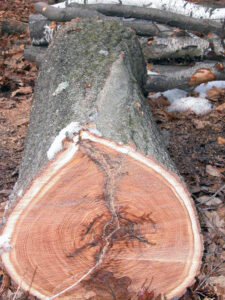
A tree cross-section shows that although a frost crack came all the way out of the tree, and even through it, it was attempting to grow over the wound that continued to remain open for many years. / Photo Credit: Wisconsin DNR