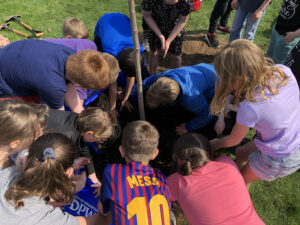
A group of children in Cedarburg gathers to plant a tree as part of an Arbor Day observance. / Photo Credit: Wisconsin DNR
By Art Kabelowsky, DNR Forest Health Outreach and Communications
Arthur.Kabelowsky@wisconsin.gov or 608-335-0167
It takes more than one celebration to pay tribute to Wisconsin’s 17 million acres of rich, diverse forestland.
So, the state has come up with multiple ways to acknowledge the value of trees to Wisconsin’s ecology, economy, health and way of life. Three of the biggest ones are taking place in April:
- Earth Day will be observed on Wednesday, April 22.
- Arbor Day is set for Friday, April 24.
- Forest Appreciation Week runs April 20-24 statewide, covering both of those dates.
The Wisconsin Department of Natural Resources (DNR) uses Forest Appreciation Week to observe multiple tree-related events and programs, and to get the word out about the myriad of benefits that residents and visitors receive from our public and private forests and trees.
“Everyone has a role in ensuring that forests continue to serve a vital role in the ecological, cultural and economic health of our state, our local communities and our individual lives,” said Carmen Hardin, DNR Applied Forestry bureau director.
Nearly half of Wisconsin’s land is covered by forests — 17 million acres’ worth. Those trees, along with the state’s millions of urban trees, augment Wisconsin residents and visitors’ lives in many ways:
- Safeguarding water resources
- Creating homes and food for wildlife
- Supporting the forest industry and local economies
- Offering a diverse set of outdoor recreation opportunities
- Reducing energy consumption and soil erosion
- Providing natural beauty for stress relief
- Supporting human health
- Providing shade
- Mitigating impacts of the changing climate by trapping and storing carbon dioxide
To maintain these many benefits, Wisconsinites need to practice good stewardship of the forest resource.
Trillion Tree Pledge On Track
In 2021, the State of Wisconsin made a tree planting and forest conservation pledge focusing on the stewardship of forests and trees in both rural and urban areas, addressing the equitable distribution of the urban tree canopy and committing to protect forest lands from development.
In 2024, Gov. Tony Evers and the DNR increased the state’s promise to the worldwide Trillion Tree Pledge initiative, boosting the state’s goal of planting 75 million trees by the end of 2030 to a new number: 100 million trees planted by the end of 2030.
Last year, Wisconsinites planted about 12 million trees across the state and conserved more than 7,000 acres of forestland in the process.
Participation in the Trillion Tree Pledge is open to agencies, organizations and individuals. Wisconsin residents can participate in the pledge by:
- Planting trees and recording them on the Wisconsin tree planting map
- Caring for trees in their neighborhood
Tree City USA Program A Success
Wisconsin’s urban communities also recognize the benefits of trees and forests. This point is illustrated by the fact that Wisconsin boasts the third-highest number of Tree City USA communities in the nation.
Currently, 196 Wisconsin communities have earned official Tree City USA status.
Youngsters Plant A New Generation
Students can also make a difference — not just now, but also by learning lessons that can last a lifetime:
- This year, the DNR donated more than 54,000 tree seedlings to fourth-grade classrooms across Wisconsin to celebrate Arbor Day, helping students learn about the importance of trees.
- The DNR also donated more than 500 seedlings to the Badgerland Council of the Girl Scouts of America to distribute at their Arbor Day event. Participants will receive credit toward badges by participating.
All told, the DNR’s Reforestation program has supplied Wisconsin landowners with more than 1.6 billion seedlings since 1911.
These investments in tree planting and forest stewardship by communities, forest landowners and residents of all ages are key to ensuring that Wisconsin continues to provide healthy and sustainable urban and rural forests that support strong and resilient communities.