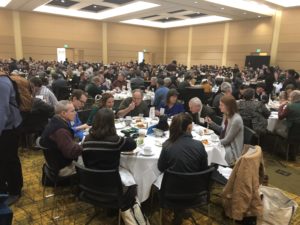
The Lynden Sculpture Garden is delighted to be partnering once again with Wisconsin Urban Wood to present Urban Forest Fest 2019. Urban Forest Fest brings together a range of individuals and organizations with an interest in sustainability–and particularly in the fate of the trees that surround us in our urban and suburban neighborhoods. Continue reading “September 21 – Urban Forest Fest”
Fall tree planting
Every wonder if you can successfully plant trees in the fall? Which species are suited to a fall planting and which aren’t? Check out this article from Iowa State University Extension and Outreach. Even though it originates from out of state, much of the information is applicable to the Midwest, including Wisconsin.
Arbor Day Foundation now accepting Tree City USA applications!
Wisconsin may be best known for our cheese, lakes and beer, but did you know that we are second in the country for number of Tree City USA communities?! Last year 195 Wisconsin communities achieved Tree City USA status, and those communities are home to nearly 60% of Wisconsinites. Wouldn’t it be something if we were number one in the country this year?! Well, here’s our chance – the application period for Arbor Day Foundation’s (ADF) recognition programs, including Tree City USA and Tree Campus USA, is now open! Continue reading “Arbor Day Foundation now accepting Tree City USA applications!”
Urban Forestry Council awards
The Council presents annual awards to outstanding individuals, organizations, communities and tribes that further urban forestry in Wisconsin. The awards are announced each year at the annual Wisconsin Urban Forestry Conference and presented to winners in their community. We are currently seeking nominations for the 2020 awards. Continue reading “Urban Forestry Council awards”
Madison College starts an arboriculture program
This fall, Madison College enters the arboriculture education arena, joining Gateway and Mid-State technical colleges in offering a 2-year associates degree in arboriculture. Continue reading “Madison College starts an arboriculture program”
Norway maple: a boon and bane to Wisconsin communities
By Dan Buckler, Urban Forestry Assessment Outreach Specialist, 608-445-4578
It wasn’t by chance that Norway maple made its way across the pond to our shores. It was, in fact, humble correspondence that invited it here. Continue reading “Norway maple: a boon and bane to Wisconsin communities”
October 16 – urban wood webinar: using local materials to enhance design & sustainability on projects
Do you have an interest in learning more about urban wood as a locally and sustainably sourced option for wood building materials? Is your community, organization or company planning for renovations or new construction projects? If you answered yes to either of the above, we invite you to check out an upcoming webinar from Wisconsin Urban Wood on this very topic. Continue reading “October 16 – urban wood webinar: using local materials to enhance design & sustainability on projects”
Storm recovery update
The Chequamegon-Nicolet National Forest and the Wisconsin DNR-Division of Forestry jointly produced a progress report on recovery efforts following the July 19-20, 2019 storms that damaged more than 285,000 acres in Barron, Polk, Langlade, Oconto and portions of Oneida, Wood and Portage Counties.
You are invited to read “After the Storm News” here.
For additional information, visit this DNR webpage about recovering from storm damage to forests.
If you have questions, contact:
Hilary Markin, Public Affairs Officer
Chequamegon-Nicolet National Forest
715-362-1354
hilary.r.markin@usda.gov
or
Kirsten Held, Forestry Outreach Specialist
Wisconsin DNR – Division of Forestry
608-219-9605
kirsten.held@wisconsin.gov
Tax Law Strategic Plan Released
The Wisconsin Department of Natural Resources – Division of Forestry’s Tax Law Section has released their strategic plan developed to further meet the Division of Forestry’s Strategic Direction 2017-2022 intent to “… continue to improve administration of the Tax Law programs, focusing on a new service model which will consolidate tax law work into fewer positions and develop expertise in staff.”
The new strategic plan focuses on five goals with associated objectives designed to guide section efforts to increase completion of sound forest management through landowner engagement, cooperator commitment and staff expertise.
This plan does not include the specific tactics that will be utilized to achieve the objectives and strategies. The Tax Law Section will be soliciting feedback from the Wisconsin Private Forestry Advisory Committee (WPFAC) and other key stakeholders to develop and finalize an implementation plan to be released later this fall. That plan will detail tactics and tools to achieve specific objectives affiliated with the five goals.
We are excited and ready to work collaboratively with our customers and partners to move the tax law program forward and better serve the people of Wisconsin and their resource. Please direct questions to R.J. Wickham, Tax Law Section Chief at Richard.Wickham@Wisconsin.gov or 920-369-6248
Salvaging Storm-Damaged Forest Products
By Alex Anderson, forest products specialist, Rhinelander
The devastation left behind in forested areas after a severe weather event can seem overwhelming. In order to further understanding of how storm-damaged forest and woodlot salvage harvests differ from traditional timber sales, we have compiled information that will, hopefully, help landowners affected by the recent rash of severe weather events in Wisconsin deal with their damaged woodlands more confidently.
Wood Degradation
Many of the downed trees from July’s severe weather are red pines (Pinus resinosa). Pines, particularly white pine (Pinus strobus) and red pine in the Lake States region, are susceptible to staining when they are harvested or killed during a weather event but are not processed quickly enough. The discoloration is a result of microscopic fungi that manifest as a pale, blueish stain in the wood often called “blue-stain” or “sap-stain.” Though there is a small, decorative market for blue-stained pine—sometimes referred to as “denim pine”—it is generally undesirable. Hardwood species are also susceptible to blue stain fungi. End coating logs with a wax barrier may reduce the risk of staining and end checking.

These logs show blue staining. Continue reading “Salvaging Storm-Damaged Forest Products”