Upcoming forest health events

CONFERENCES

OCTOBER 15-18, 2018. Mayo Civic Center, 30 Civic Center Drive SE, Rochester, MN
Upper Midwest Invasive Species Conference / North American Invasive Species Management Association
The Upper Midwest Invasive Species Conference (UMISC) is a biennial conference celebrating 10 years of connecting the invasive species management, research, and policy community. The Conference host organizations and organizing committees are pleased to join with the North American Invasive Species Management Association (NAISMA), celebrating its 25th year, to co-host the largest invasive species conference in North America at the Mayo Civic Center in Rochester, MN – October 15-18, 2018. The goal of UMISC is to strengthen management of invasive species, especially prevention, control, and containment. Invasive species research, prevention, and management has seen great strides but much work still must be done. The conference provides numerous opportunities to network with professionals, land managers, researchers, nonprofits, and others.   The conference is open to the general public. Registration with fees required.

TALKS

OCTOBER 13, 2018. Boerner Botanical Gardens, 9400 Boerner Drive, Hales Corner, WI.
10:00-11:30AM
“Invasive Plants”. Mary Bartkowiak, invasive plants specialist, WI DNR Forest Health Program.
Mary’s presentation will focus on invasives in the marketplace (aka Organisms in Trade) and an overview of the NR 40 invasive species rule. Open to SEWMG Master Gardeners. Registration required.

OCTOBER 15, 2018. Holiday Inn Convention Center, 1001 Amber Ave, Stevens Point, WI
71st Annual Wisconsin Towns Association meeting (October 14-16).
“Enemies of the Town – Insects, Diseases, Invasive Plants and Worms impacting Wisconsin in 2018”. Mike Hillstrom, forest health specialist, WI DNR Forest Health Program.
Talks begin at 8:30AM. The meeting is open to the general public. Registration with fees required.

Emerald ash borer detected in Kewaunee County

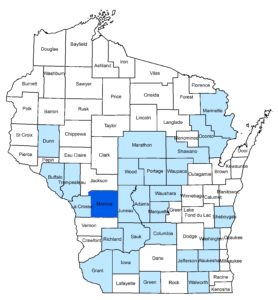
Communities known to have emerald ash borer as of September 2018 are shown in green, with Kewaunee County highlighted in red. Modified from a map by the Wisconsin Dept. of Agriculture, Trade and Consumer Protection (DATCP).

Communities known to have emerald ash borer as of September 2018 are shown in green, with Kewaunee County highlighted in red. Modified from a map by the Wisconsin Dept. of Agriculture, Trade and Consumer Protection (DATCP).

By Bill McNee, forest health specialist, Oshkosh. Bill.McNee@wisconsin.gov; 920-360-0942

In August, two separate infestations of emerald ash borer (EAB) were found in rural areas of Kewaunee County. EAB has spread through Wisconsin over the last few years, so these detections were expected. The first infestation spans the towns of Carlton and Franklin in the southern part of the county. A county resident reported the second infestation, located in the Town of Casco, in late August. The pest is likely present in other parts of the county as well.

Public comment period for EAB silviculture guidelines revision closes October 9

By Bill McNee, forest health specialist, Oshkosh. Bill.McNee@wisconsin.gov; 920-360-0942

Ash trees dying from an EAB infestation. Photo: Troy Kimoto, Bugwood.org

Ash trees dying from an EAB infestation. Photo: Troy Kimoto, Bugwood.org

The Wisconsin DNR is seeking public comments on a proposed revision to silviculture guidelines for emerald ash borer (EAB). Stand-level EAB silviculture guidelines were originally released in 2007, with periodic reviews and updates. A DNR technical team and stakeholder advisory committee prepared the current version using multiple sources of information, including recent research findings, identification and locations of new EAB infestations, economic considerations, and experience gained from implementing previous versions of the guidelines.

The draft document and information about the public comment process can be found at  https://dnr.wi.gov/news/input/Guidance.html#open through Tuesday, October 9, 2018. All comments must be submitted by that date.

Seedling sales begin October 1

The DNR’s reforestation program will be accepting orders starting October 1, 2018 from Wisconsin forest landowners for trees and shrubs to be planted in spring 2019. The high-quality seedlings are native species appropriate for planting throughout Wisconsin.

Seedlings grown at the state nurseries are used for reforestation and conservation plantings on private, industrial, and state/county forest lands. A minimum order consists of a packet of 300 trees or shrubs of the landowner’s choosing in increments of 100 of each species, or 500 shrubs or 1000 tree seedlings. Seedlings can also be purchased by youth groups and educational organizations for their reforestation and conservation planting projects.

Forest landowners may place orders starting October 1st using an online form found on the DNR website (keyword “tree planting”) or by printing the order form, completing it and mailing it in. Customers may contact the reforestation staff or the DNR forester who serves the area where their property is located for personal assistance. Printed copies of the order form are also available at local DNR offices.

In addition to the online form, customers can also find the following on the DNR website:  the current inventory, a seedling catalog, frequently asked questions, additional tree planting information and a listing of private nurseries.

Contact: Joe Vande Hey, Reforestation Team Leader, 608-574-4904, Joseph.VandeHey@Wisconsin.gov

Complete the Secondary Wood Manufacturer Survey

The Wisconsin Department of Natural Resources -Division of Forestry is conducting a survey on Wisconsin’s secondary wood manufacturing sector. This sector includes Wisconsin firms that purchase and produce products from lumber, blocks, wood components, fiberboard, plywood, veneer, and manufacturing residue.

The goals of this survey are to: 1.) update the Wisconsin Wood Using Industry Directory, 2.) determine the impact of the secondary wood industry on Wisconsin’s economy, 3.) determine residue availability, and 4.) develop an understanding of educational and training needs for the success of the wood industry. Continue reading “Complete the Secondary Wood Manufacturer Survey”

Wood Energy Webinar a Success

In July, the Wisconsin Statewide Wood Energy Team hosted a free webinar titled, “Wood Energy Systems and Forest Industry Companies: When Are They the Right Fit.” Thirty people attended the webinar. The webinar addressed why wood energy is a good fit for sawmills and other forest products manufacturers. The webinar presenters also covered topics such as the production of heat from wood, combined heat and power that produces heat and electrical power, how wood energy can help with residue management, and what tools are available to look at the feasibility of a project. Some example projects were also highlighted to show how wood energy is benefiting actual companies. For those of you who missed this webinar, please visit the Wisconsin State Wood Energy Team website for educational videos, case studies, tools, and other information to learn more about whether wood energy is the right fit for your home or business.

Celebrate Wisconsin Forest Products Week

Wisconsin has 17.1 million acres of forestland covering nearly half of the state and is home to more than 1,200 forest products companies producing a variety of products that we use daily. In recognition of the importance of forest products to Wisconsin, Governor Scott Walker proclaimed the third week of October (October 21-27, 2018) as Wisconsin Forest Products Week.

The proclamation encourages citizens to recognize the many products that come from forests and the people and businesses that work in and care for forests. Forest businesses and organizations are encouraged to host an event or open house to commemorate this event. For ideas or suggestions or to learn more about hosting an event, please contact a member of the DNR forest products team.

Let’s celebrate Wisconsin’s diverse forest products sector during Forest Products Week on October 21-27, 2018!

Mass Timber Proposed in Milwaukee Building

A Wisconsin-based real estate development firm, New Land Enterprises, plans to construct a seven-story mass timber office building on a vacant site in downtown Milwaukee. The building was designed by Korb + Associates Architects and would be the tallest of such structures in Wisconsin.

What is mass timber?
Mass timber is a category of structural framing styles typically characterized by the use of large, solid wood panels for wall, floor, and roof construction. Examples include: glued-laminated timber (glulam), nail-laminated timber (NLT), cross-laminated timber (CLT), and dowel-laminated timber (DLT).

Continue reading “Mass Timber Proposed in Milwaukee Building”

Foster student success with trees in your neighborhood

September is back to school month.  How do you get those kids to settle down and focus after three months off?  The answer is as simple as walking right outside your front door!  Exposure to nature has shown various impacts on students, from improved academic performance and focus, to reduced Attention Deficit Hyperactivity Disorder (ADHD) symptoms.  Research has shown exposure to nature during school hours is positively associated with academic performance, including standardized test scores, graduation rates, and plans to attend a four-year college.  Continue reading “Foster student success with trees in your neighborhood”

Video to help understand urban forestry grant reimbursement

The Urban Forestry grant reimbursement process can be challenging. All the time and energy that goes into creating a successful project can also create a lot of paperwork, and it is not an easy task to keep everything organized. A new video has been created to help grant recipients navigate this aspect of the reimbursement process and avoid some of the most common mistakes that we see on our grant reimbursement forms. The video covers topics such as documenting cash expenditures, using correct equipment rates, and contacting DNR staff. It is approximately eleven minutes long and can be accessed from the Urban Forestry Grants webpage. Continue reading “Video to help understand urban forestry grant reimbursement”