Urban Forestry Council award nominations OPEN

The Wisconsin Urban Forestry Council, comprised of municipal employees, elected officials, nursery operators, and arborists, advises the Department of Natural Resources Division of Forestry on the best ways to manage urban and community forest resources. Every year, the Council bestows several awards to recognize and thank individuals and organizations across Wisconsin for their work and commitment to the trees, plantings, habitat and economic benefits they provide. Continue reading “Urban Forestry Council award nominations OPEN”

Tree City USA applications open

The application period for Arbor Day Foundation’s Tree City and Tree Campus USA programs opens September 4th!  You can access information and application materials for these recognition programs from the DNR Urban Forestry website or the Arbor Day Foundation website. Tree City and Tree Campus applicants are encouraged to use the online application form, though hard-copy applications are available. These national award programs recognize efforts to raise awareness of the importance of trees and integrate trees and proper tree care in Wisconsin communities, around utility lines and facilities, and on college campuses. Continue reading “Tree City USA applications open”

Requiem for an Ash

The front moves and defenses are built, but there’s no doubt which way the war is going, and little doubt what is emerging the victor: a little green bug.

Agrilus planipennis, the emerald ash borer, has harangued and harassed North American forests since the late 1990s, and its journey across Wisconsin continues, county by county, city by city, tree by tree. But this is not its story. Continue reading “Requiem for an Ash”

Look for gypsy moth egg masses

By Bill McNee, DNR Forest Health Specialist, Oshkosh. bill.mcnee@wisconsin.gov; 920-360-0942

Gypsy moth egg masses. Photo: Bill McNee

Fall is an excellent time to look for and dispose of gypsy moth egg masses produced by adult moths this summer. Gypsy moth egg masses are felt-like, tan-colored patches about the size of a nickel or quarter that gypsy moth females deposit in protected places. Surveying for egg masses helps property owners predict how high populations of the insect will be during the subsequent spring and summer. Since egg masses usually don’t hatch until April, information gained from fall/winter surveys can be used to mitigate gypsy moth damage before the following season.  Continue reading “Look for gypsy moth egg masses”

Spruce needle rust not an issue this year

By Linda Williams, forest health specialist, Woodruff. Linda.Williams@wisconsin.gov; 920-360-0665

Orange fruiting bodies of spruce needle rust erupt from needles. From a distance, the tree appears orange due to colored pustules on the needles. Photo: Linda Williams

Orange fruiting bodies of spruce needle rust erupt from needles. From a distance, the tree appears orange due to colored pustules on the needles. Photo: Linda Williams

Occurrences of spruce needle rust in northeastern and north central Wisconsin is low this year for the first time since 2013. Spruce needle rust, caused by the fungus Chrysomyxa weirii, infects spruce needles. Fruiting structures erupt from needles in August in shades of pink, yellow, and orange, greatly affecting the appearance of the trees. In addition, infected needles drop off, causing trees to look sparse.

No treatments are available for already-infected needles. Preventative fungicide treatments for yard trees may be used the following spring and early summer, but treatments must be applied before symptoms appear. Repeated treatments will be necessary; the fungicide, which must fully coat needles to be effective, washes or wears off over time.

Brown branch tips on jack pine

By Linda Williams, forest health specialist, Woodruff. Linda.Williams@wisconsin.gov; 920-360-0665

After brushing away sawdust, exit/entrance holes, as tiny as the beetles themselves, become visible. A beetle is inside, peeking out. The marks at the bottom of the photo depict millimeters.

After brushing away sawdust, exit/entrance holes, as tiny as the beetles themselves, become visible. A beetle is inside, peeking out. The marks at the bottom of the photo depict millimeters.

Jack pine tip beetle (Conopthorus banksianae) is a tiny bark beetle that bores into the twig tips of pines. Damage from jack pine tip beetle was observed this summer on jack pine trees in Marinette, Vilas, and Lincoln counties and on white pine in Waupaca County. These beetles attack and kill the outer 4-6 inches of twigs, leaving hollow piths. The piths can be diagnostic in determining whether an insect or disease killed the branch tip. The damage, which may appear significant since the dead needles remain on the branch tip and there can be many dead branch tips on a single tree, is rarely severe enough to be detrimental to the tree; no control is recommended.

Jack pine tip beetles kill the outer few inches of twigs. The two yellow circles show where sawdust was pushed out of the twig by adult beetles. Photos: Linda Williams

Jack pine tip beetles kill the outer few inches of twigs. The two yellow circles show where sawdust was pushed out of the twig by adult beetles. Photos: Linda Williams

Oak leaves dropping (but not from oak wilt)

By Linda Williams, forest health specialist, Woodruff. Linda.Williams@wisconsin.gov; 920-360-0665

Heavily-spotted oak leaves began to drop in early August. Spots appeared on both the front and back of leaves. Photo: Linda Williams

Heavily-spotted oak leaves began to drop in early August. Spots appeared on both the front and back of leaves. Photo: Linda Williams

Last year, Forest Health News published an article about oaks prematurely dropping leaves although they were not infected by the fungal pathogen Ceratocystis fagacearum, the cause of oak wilt disease. Oak trees infected with oak wilt disease in springtime rapidly wilt and drop green leaves in July or August. However, oak wilt disease is not the only reason oak trees prematurely drop leaves. Continue reading “Oak leaves dropping (but not from oak wilt)”

Tree decline and mortality observed at many wet sites this summer

By Bill McNee, DNR Forest Health Specialist, Oshkosh. bill.mcnee@wisconsin.gov; 920-360-0942

An aerial view of tree mortality in very wet areas. Photo: Bill McNee

An aerial view of tree mortality in very wet areas. Photo: Bill McNee

Site visits and aerial surveys conducted on trees in eastern Wisconsin by the Wisconsin DNR forest health team in July and August found multi-species decline and mortality common at many very wet sites. Continue reading “Tree decline and mortality observed at many wet sites this summer”

Oak leaf fold galls and itch mites

by Mike Hillstrom, forest health specialist (Fitchburg). Michael.Hillstrom@wisconsin.gov;
208-513-7690

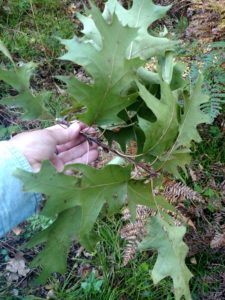
Oak leaf fold galls on red oak leaves. Photo: Mike Hillstrom

Oak leaf fold galls on red oak leaves. Photo: Mike Hillstrom

Ethan Lee, parks supervisor for the City of Janesville, recently reported symptoms of oak leaf fold galls on an oak tree on the University of Wisconsin – Rock County campus. Oak leaf fold galls, caused by fly larvae, are generally harmless to trees. However, new information links oak leaf galls with a recent invasive mite from Europe, Pyemotes herfsi, commonly called the oak leaf itch mite. Although no evidence of itch mite was found on the affected red oak tree, more than 50% of the tree’s leaves contained leaf fold galls. Continue reading “Oak leaf fold galls and itch mites”

Preparing for wildfire: what you can do in a weekend

It’s late August. The days are noticeably shorter, southerly bird migration has begun, and (gasp!) kids will be going back to school soon. You’re probably also noticing that your bounty of flowering plants is looking a bit ragged. To help shorten your list of fall clean-up chores, get a jump on things now! Your property will also be in better condition should a wildfire occur in your area.

Resident remove dead branches from around their home to reduce their risk should a wildfire occure in their area.

Removing dead trees, branches and shrubs from around you home can help reduce your wildfire risk should a wildfire occur in your area.

While we see most Wisconsin wildfire activity in the spring, fires can occur any time of the year when snow is not on the ground. We see spikes in occurrence in summer during dry spells and again in autumn when the leaves fall and the ground vegetation cures. All this dry matter can become fuel for a wildfire. Removing this debris is particularly important if you live or own property in a community at risk. In short, these are areas where sandy soils, oaks and pine trees are abundant.

What can you do? Start with the area immediately around your home and work outwards from there. Cut back the flowering plants that have faded and compost the debris. Remove any dead trees, branches or shrubs. If you have evergreens around your home, look at how close they are to one another. Evergreens are especially flammable; consider removing any trees necessary to keep at least 15 feet between the branches from tree to tree within 30 feet of buildings. Prune lower branches up and away from the ground. Check your town’s website for info on timing of curbside brush pick-up or brush collection site hours. These types of services are generally offered on a limited basis, so don’t miss out! For more info on ways to prepare your home for wildfire, check out our website!