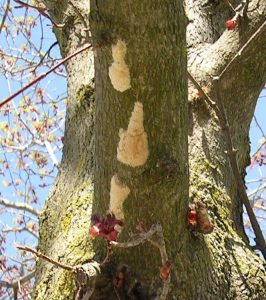
The Wisconsin DNR Urban Forestry grant system has been a valuable tool in the fight against the emerald ash borer (EAB). The Urban Forestry grant program is a reimbursable grant; the grantee must complete the project first, and then apply for reimbursement of up to 50% for eligible items, to a maximum of $25,000.
Celebrate National Forest Products Week
Since 1960, the seven-day period beginning on the third Sunday of October has been designated by Presidential proclamation as a time to recognize the many products that come from our forests in addition to the people who manage, harvest, and manufacture these products we depend on each and every day. Most Wisconsinites recognize that forests are an essential part of our state’s history, culture, and environment, but many do not realize the economic importance of our 17.1 million acres of forest land to the state and local economies.
Wisconsin’s forest products industry:
- Leads the US in paper production;
- Provides more than 64,000 jobs; and
- Contributes $ 24.7 billion of output to the state’s economy annually.
The forest products industry continues to provide a sustainable resource in response to an ever changing market. Despite the market changes over time, the diversity of Wisconsin’s forest products companies has been and will remain an important contributor to the economy in Wisconsin. Read more in this DNR news release.
Written by Sabina Dhungana, DNR Forest Products Specialist, (608) 261-0754, Sabina.dhungana@wisconsin.gov
Municipalities celebrate Tree City USA program

Tree City USA is a program sponsored by the Arbor Day Foundation in partnership with the U.S. Forest Service and the National Association of State Foresters, and implemented by DNR Forestry Division. It focuses on greening communities across the country. The Arbor Day Foundation describes Tree City USA as a great opportunity to celebrate the importance of an urban tree canopy and improve care of these vital city trees. The program gives recognition to communities committed to managing and augmenting their urban tree canopy. The beauty and abundance of trees provides the citizens of Tree City USA communities a general splendor unrivaled by anything else, as well as many other benefits.
Continue reading “Municipalities celebrate Tree City USA program”
Sustainable forestry in Wisconsin honored
Forest certification initiatives in Wisconsin received national honors from the Forest Stewardship Council with presentation of the 2016 FSC Leadership Award to the Wisconsin Department of Natural Resources. Read more in this DNR news release. For more information, contact DNR Forest Certification Coordinator Mark Heyde, Mark.Heyde@Wisconsin.gov, 608-267-0565.
Grants to strengthen fire suppression in 196 communities
Fire departments in 196 Wisconsin communities will receive a total of $645,487 in grants from the Wisconsin Department of Natural Resources Forest Fire Protection Grant Program in 2016. The funding can be used for equipment, prevention, and training to enhance forest fire protection and suppression ability. This grant program was established in 1997 to strengthen the capacity of local fire departments and county or area fire organizations to assist the DNR forestry staff in suppression of forest fires. Here’s a complete list of 2016 FFP grant recipients [PDF]. Read more in this news release or on the DNR website, keyword grants.
For more information, contact Chris Klahn (christopher.klahn@wisconsin.gov), DNR cooperative fire control specialist, 608- 297-2214.
BMPs found to protect water quality

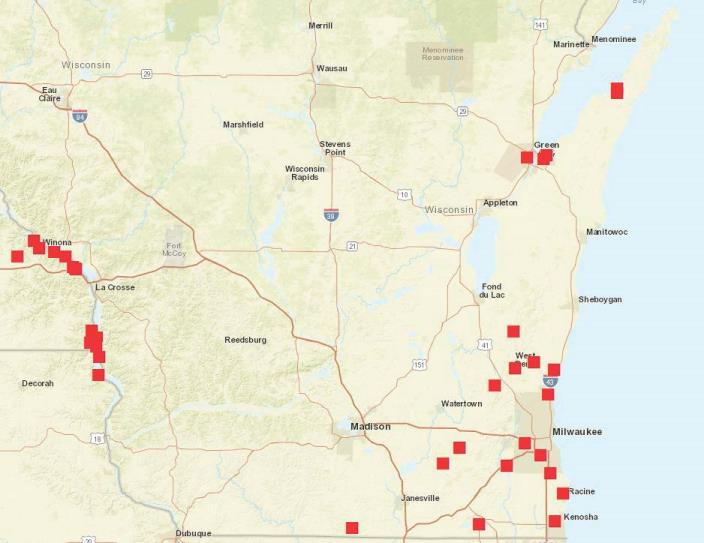
The Wisconsin forestland sites monitored by the 2015 BMP teams. Coniferous trees represent sites that were in the Managed Forest Law (MFL) program and deciduous trees represent sites not in the MFL program. Note: Some dots are close together making the total number of sites difficult to determine on this map.
Newly-released results from 2015 monitoring for the application and effectiveness of Wisconsin’s Forestry Best Management Practices (BMPs) for Water Quality show excellent results. The effectiveness of BMPs that were applied correctly was extremely high (99.6%) at protecting water quality, but when BMPs were applied incorrectly or not applied, BMP effectiveness rates woefully dropped (6.3% and 9.4% respectively). Even with the low water quality protection of BMPs that were applied incorrectly and not applied, no major impacts were reported on any of the monitored sites. Read more details about the results from the monitoring of 36 non-industrial private forestland (NIPF) sites (26 of the landowners are enrolled in the MFL program) in the 2015 BMP Monitoring Report.
For more information, contact Forest Hydrologist Dave Kafura, david.kafura@wisconsin.gov, (715) 416-4140
Collect seed for us; Buy seed from us
Are you looking for a fun activity for yourself or your family this fall? Why not spend a few hours crawling around picking acorns or walnuts. Need some seeds to plant?
Learn more here …
Managing seed orchards for tree improvement

White pine plantation near Lake Tomahawk
Soon after the beginning of the nurseries in Wisconsin, managers realized they had a special role to play in the development of trees, especially when it came to disease resistance, growth, and form. In conjunction with the UW system, USDA Forest Service scientists and researchers and our own tree geneticist, nursery staff established a number of seed orchards. Throughout the decades, we have explored and invested in new sites, creating a tree improvement program that is stocked with species in various stages of development and/or characteristic selection.
Continue reading “Managing seed orchards for tree improvement”
Reforestation monitoring update
2016 was the second season reforestation staff have use the revised protocol for monitoring reforestation sites. Due to ample rainfall and warm weather, the seedlings across the state are performing very well. This fall we are looking at sites that have gone through 3 and 7 years of growth and have visited 25 sites so far.
By Jeremiah Auer, jeremiah.auer@wisconsin.gov, (715) 424-3700
Transline® herbicide trial begins
In keeping with the Reforestation Program’s mission of providing pertinent information to forestry professionals, we began a new herbicide field trial with Transline® (clopyralid). Many foresters and landowners are interested in applying herbicides after a site has been planted to inhibit weed competition. However, in the case of Transline®, not all species are referenced on the label. In addition, the varying rates prescribed may impact species differently. All of this can create a challenge for a forester or landowner when managing competition within the planting. Continue reading “Transline® herbicide trial begins”