
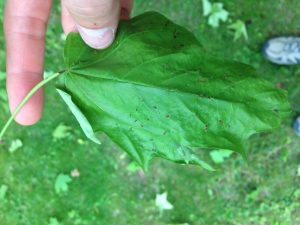
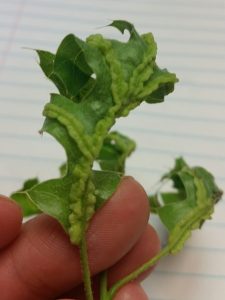
Maple petiole borer damage close up. Photo by Kyle Young.
Maple petiole borer has been active in the northwest. This exotic insect’s larvae cause tunneling damage to leaf petioles, leading to spring leaf drop in sugar maple.
Landowners have reported leaves falling from their sugar maple for no apparent reason. While a first glance of the problem might look similar to maple anthracnose, which is a foliar disease that can also cause premature leaf drop in spring, and has also been notably active this year (see this month’s article on maple anthracnose), a closer inspection of characteristics on fallen leaves points to maple petiole borer instead. Continue reading “Maple petiole borer causing leaf drop in northwest Wisconsin”
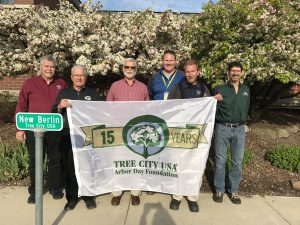 Breathe in… breathe out. The clear air that fills your lungs has been purified by trees. Clean air is one of the many ecological, economic and social benefits trees provide us. Trees also reduce crime rate, increase property values, reduce heating and cooling costs, increase tests scores, beautify communities, and provide lumber by-products. In late April, people around the world, both old and young, took time to celebrate these and other benefits by participating in Arbor Day celebrations.
 Green Tier, a voluntary program administered by the DNR, works with entities conducting their business beyond compliance requirements and looking for ways to improve. Currently there are 82 participants with 248 facilities in the program along with six Green Tier Charters, including the