WINTER FIRE SAFETY: Outdoor Brush Burning

Winter may seem like a perfectly safe time to burn, but it’s important to practice fire safety year-round to prevent wildfires. When the ground is entirely snow-covered, burning is permitted in DNR Protection Areas without a DNR burning permit for debris piles. As soon as the snow melts, DNR burning permits are required again. Always check with local fire officials before conducting any burning, especially in the spring.

Snow amounts vary across the landscape this time of year. The southern half of the state tends to have little to no snow, while the north looks like a winter wonderland. Just when you think winter is coming to an end, there’s that one lingering snowstorm to make everything white again. Suddenly, spring is finally here to stay, and it’s fire season!

Here are some tips for safe winter burning when the ground is snow-covered:

Winter Burning• Gather and pile brush in an open area away from over-hanging branches.
• If snow is in the forecast, place a tarp over the brush pile to keep it dry and time the burn, so the snow around the pile keeps the fire contained.
• When ready to burn, choose a calm day (less than 8 mph) with complete snow-cover on the ground.
• Snow must be next to the fire and stay there for the duration of the burn.
• Notify the local fire department and dispatch offices to avoid unnecessary fire response.
• Place small amounts of crumpled clean paper into the brush around the base of the pile.
• Light the paper all around the base of the pile. Do not use the fire to dispose of household garbage, rubber tires, oil or other accelerants.
• Using a rake or shovel, turn the debris into the flames to ensure all the materials are consumed.
• Avoid standing in direct contact or downwind of smoke and never leave the fire unattended.

Remember, spring is the peak of Wisconsin’s fire season. So, plan ahead and don’t wait until then to conduct debris burning. Better yet, consider alternatives to burning; compost, chip, leave brush for wildlife habitat or haul away to a transfer site. To obtain a free DNR burning permit or for more fire safety tips, visit this DNR website.

2022 Tree City USA Requirements: Arbor Day Celebration And Proclamation

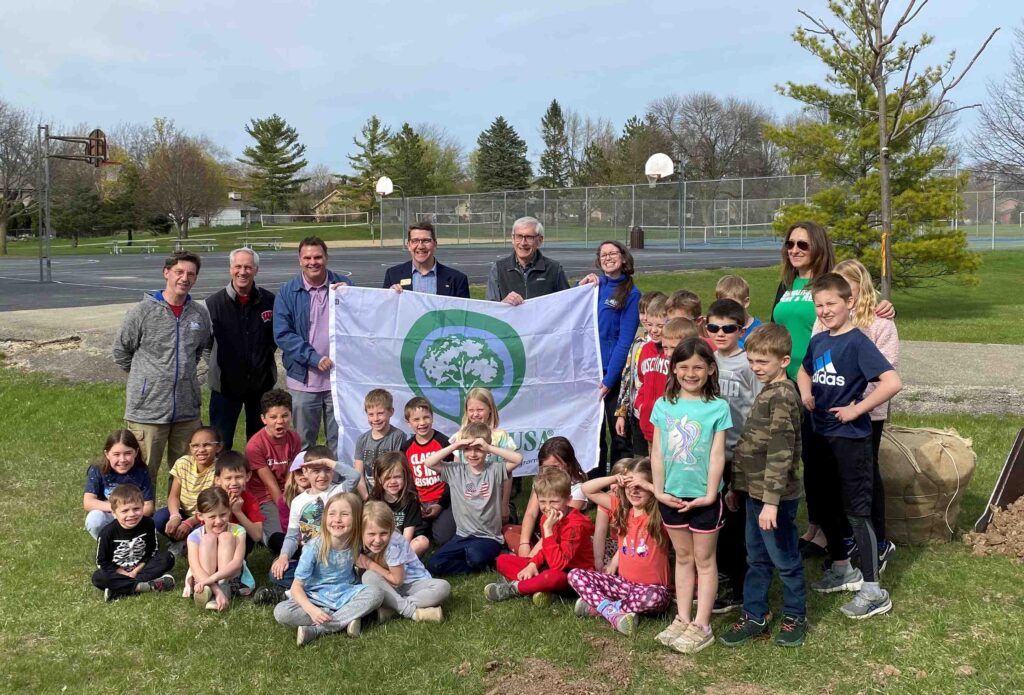
An Arbor Day celebration and proclamation will be required in 2022 to earn or maintain Tree City USA designation. An Arbor Day celebration will also be required to earn or maintain Tree Campus Higher Education and Tree Line USA recognition.

There are many ways a community/campus/utility might meet this standard, including:

  • An in-person gathering (e.g. community tree planting or festival)
  • A virtual event (e.g. webinar or live streamed tree planting)
  • A social media post or campaign

Continue reading “2022 Tree City USA Requirements: Arbor Day Celebration And Proclamation”

DNR Announces Additional Funding Now Available For Communities Impacted By Storm Damage

The Wisconsin Department of Natural Resources (DNR) announced that five communities impacted by severe weather last July will receive an additional $123,600 of aid from reserve funds.

On July 28, 2021, Marathon County and the cities of Omro, Ripon, Tomahawk and Watertown each experienced catastrophic storm damage following severe weather conditions.

Initially, the five grant applicants sought $228,435 from the DNR’s Urban Forestry Catastrophic Storm Grant program to lessen the burden of the impacted communities. However, the grant funds were limited to $104,920.

To assist with funding, the DNR submitted a request in November to the Joint Committee on Finance to transfer additional funds from the forestry emergency reserve. 

Continue reading “DNR Announces Additional Funding Now Available For Communities Impacted By Storm Damage”

90 New Municipal Detections Of Emerald Ash Borer In 2021

By Bill McNee, DNR Forest Health Specialist, Oshkosh, bill.mcnee@wisconsin.gov or 920-360-0942

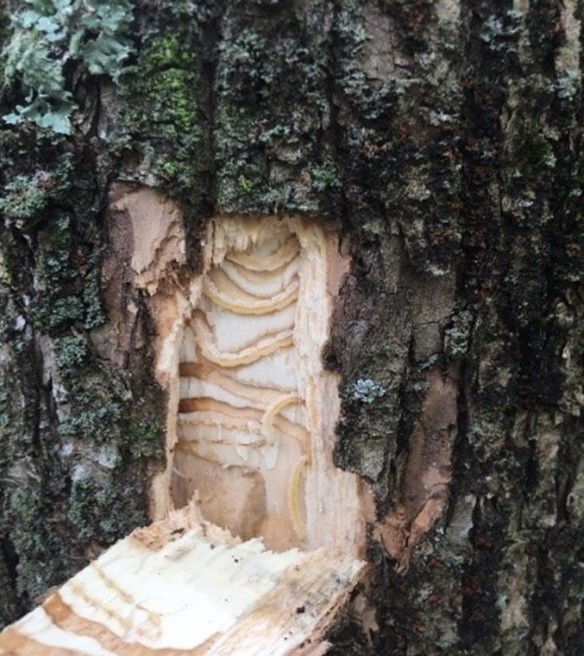
In 2021, emerald ash borer was found in 90 more communities in Wisconsin than in 2020, including 10 cities, 14 villages and 66 towns. This increased the total number of communities with a reported emerald ash borer detection 11% to 898 at the end of 2021.

Emerald ash borer was confirmed for the first time in Barron, Iron and Langlade counties during the year. It has now been found in 61 of Wisconsin’s 72 counties and confirmed on Oneida Nation land, and we believe additional unreported infestations are present.

Municipal emerald ash borer detections during 2021 are shown in orange. Older detections are shown in green or blue. Map courtesy of Wisconsin Department Agriculture, Trade and Consumer Protection.

Continue reading “90 New Municipal Detections Of Emerald Ash Borer In 2021”

Learn About Wisconsin’s Urban Forestry Council In New 2021 Biennial Report

By Shahla Werner, Urban Forestry Council Chair and Plant Protection Section Chief for the Wisconsin Department of Agriculture, Trade, and Consumer Protection (DATCP)

The purpose of the Wisconsin Urban Forestry Council is to advise the state forester, currently Heather Berklund, and the Wisconsin Department of Natural Resources (DNR) on the best ways to preserve, protect, expand and improve Wisconsin’s urban and community forest resources.

The 27 members, who serve after being approved by DNR Secretary Cole, hail from all over Wisconsin. They represent a wide array of stakeholders, including citizens; municipal and utility foresters; medical and higher education professionals; nursery staff; environmental groups; public works, planning and parks staff; landscape architects; the Wisconsin Arborist Association (WAA); the Urban Wood Network Wisconsin; the League of Wisconsin Municipalities; and partner agencies like the Wisconsin Department of Transportation and the Wisconsin Department of Agriculture, Trade and Consumer Protection. 

Continue reading “Learn About Wisconsin’s Urban Forestry Council In New 2021 Biennial Report”

Understanding The Extent Of Invasive Species And Other Urban Forest Challenges

By Dan Buckler, DNR Urban Forest Assessment Specialist, Madison, daniel.buckler@wisconsin.gov or 608-445-4578

How extensive are buckthorn and other invasive species in our communities? We don’t know yet, but Wisconsin’s Urban Forest Inventory And Analysis (UFIA) project will be able to answer that and many other questions.

Buckthorn beneath dead ash trees at Big Foot Beach State Park. Photo by Bill McNee.

Besides simple stem counts, we can learn about the type of land where buckthorn is found, species under which buckthorn is growing and trends in invasive species expansion or decline over time.

Continue reading “Understanding The Extent Of Invasive Species And Other Urban Forest Challenges”

Upcoming Webinars: EAB University And TREE Fund

The EAB University Spring 2022 Webinars are right around the corner. All webinars are free, and many count towards continuing education programs.

Can’t watch them live? No problem! All webinars are recorded and posted afterward.

Check out the EAB University Spring 2022 webinars and register for them here. All sessions begin at 10 a.m. CST.

  • Feb. 24: The Biology and Management of the Invasive Spotted Lanternfly. Holly Shugart, Ph.D. Postdoctoral Scholar, Pennsylvania State University
  • March 1: Firewood Rules, Certifications, and Recommendations across the USA.
    Leigh Greenwood, Forest Health Program Director, North America Region, The Nature Conservancy 
  • March 3: The Worst Kind of Snowbird: The Invasion of Asian Longhorned Beetle in South Carolina. David Coyle, Assistant Professor and State Extension Specialist, Clemson University 

Continue reading “Upcoming Webinars: EAB University And TREE Fund”

Garden Planning – Avoid Invasive Plants

By Jaqi Christopher, DNR Forest Invasive Plant Specialist, Rhinelander, Jacquelyn.Christopher@wisconsin.gov and Mary Bartkowiak, DNR Forest Invasive Plant Coordinator, Rhinelander, Mary.Bartkowiak@wisconsin.gov

With winter in full swing, many gardeners dream of spring and begin planning what plants to add to their gardens. Now is a great time to brush up on what not to plant to avoid invasive species that might be hiding in plain sight.

Woodlot in fall, most trees have lost their leaves which are covering the ground. Several burning bush shrubs still with their bright red leaves stick out against the brown backdrop.

Burning bush as a forest invasive.
Photo: Leslie J. Mehrhoff, University of Connecticut, Bugwood.org

Continue reading “Garden Planning – Avoid Invasive Plants”

Register Now for the Annual WAA/DNR Urban Forestry Conference!

Join the Wisconsin Department of Natural Resources (DNR) and the Wisconsin Arborist Association for the 2022 Wisconsin Annual Urban Forestry Conference. The conference will be held on Feb. 20 – 22 at the KI Convention Center in Green Bay with select sessions available for attendance virtually.

The in-person conference is limited to 462 attendees this year. This is approximately half of our usual attendance.

The early bird discount is available until Jan. 28. Prices will go up on Jan. 29.

To register for the in-person conference, go here.

The virtual conference will be available for viewing all of March. Register for the virtual conference here.

Continue reading “Register Now for the Annual WAA/DNR Urban Forestry Conference!”

Landscape and Grounds Maintenance Short Course

The virtual Landscape and Grounds Maintenance Short Course will once again be offered by the UW-Madison Division of Extension in Dane, Kenosha, Racine, Sheboygan and Waukesha counties. The course will be held from 1-3:30 p.m. every Wednesday in February; all are welcome to attend.

The cost of registration is $50 for all four weeks or $25 for a single session. The class will only be available during the live presentation on the specified date and time. It will NOT be available to view later.

The course offers up-to-date, science-based information to help landscape professionals increase the economic and environmental sustainability of the landscapes they care for and their businesses.

Continue reading “Landscape and Grounds Maintenance Short Course”