
By Paul Cigan, forest health specialist, Hayward, Paul.Cigan@wisconsin.gov, 715-416-4920
A particularly active winter weather season has left white pine and other conifer species along many of Wisconsin’s roadways with salt spray injury this spring. These salt deposits draw water out of the foliage, causing them to dry out and turn brown, often beginning at needle tips and progressing down to the needle base. Browning is most heavily concentrated on branches facing the road, lower portions of tree crowns and foliage that remained above the snowline.
Browning is likely to intensify as the weather continues to warm this spring, and heavily damaged needles may die and prematurely fall off. Successive years of damage can leave branches sparse of foliage and cause branch dieback.
Salt spray from de-icing salts applied to roadways may drift and settle onto vegetation within 150 feet of a roadway. Injury can be prevented or reduced by placing physical barriers such as snow fencing, plastic or burlap around conifers in fall. Salt residues can also be rinsed off with water during periods of warm weather prior to bud break. More information about salt damage to plants can be found in this UW–Madison Division of Extension publication.
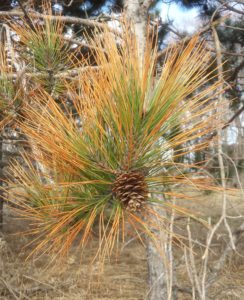
Red pine shoot with needle tip browning.
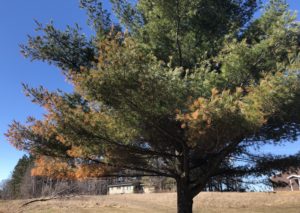
White pine tree with salt spray injury.
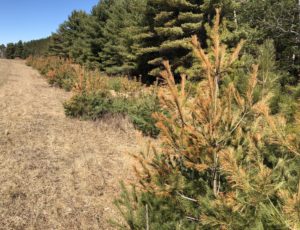
White pine seedlings with salt spray injury.