Month: February 2026

Wisconsin Sees First Recovery Of EAB Parasitoid Oobius Agrili

A plastic pan trap for wasps is hung from a tree branch.

A yellow pan trap used for trapping Oobius agrili wasps. / Photo Credit: United States Department of Agriculture Animal and Plant Health Inspection Service

By River Mathieu, DNR Forest Health Specialist
River.Mathieu@wisconsin.gov or 608-772-2758

One small adult wasp collected by United States Department of Agriculture Animal and Plant Health Inspection Service (USDA APHIS) staff at Riedel Redmond Nature Preserve in Mosinee (Marathon County) was recently identified as Oobius agrili.

USDA APHIS staff collected several wasp specimens in yellow pan traps and sent them to a U.S. Forest Service expert for identification. This marks the first recovery of O. agrili in Wisconsin.

Oobius agrili is an emerald ash borer (EAB) parasitoid that was first released in Wisconsin in 2011 and has been released annually since then. O. agrili parasitizes EAB eggs on the bark of ash trees, consuming the EAB larvae inside the egg. Continue reading “Wisconsin Sees First Recovery Of EAB Parasitoid Oobius Agrili”

Now Is Time To Seek Out Spongy Moth Egg Masses

Large spongy moth egg masses on a tree main stem.

Large egg masses are seen on a tree at the Kettle Moraine State Forest-Southern Unit in 2021. / Photo Credit: Wisconsin DNR

By Bill McNee, DNR Forest Health Specialist, Oshkosh
Bill.McNee@wisconsin.gov

It certainly has been chilly in recent weeks, but spring is coming. When the weather warms up, the annual return of spongy moth caterpillars will begin.

The overall spongy moth population is currently low in Wisconsin. However, egg mass numbers may remain high enough to cause nuisance problems and heavy tree defoliation on individual trees or in small areas.

There’s a way for property owners to help keep the population down: Get out now to locate and properly dispose of spongy moth egg masses, which were produced by adult moths last summer. Each spongy moth egg mass contains hundreds of eggs that will hatch into hungry, leaf-eating caterpillars in the spring.

Continue reading “Now Is Time To Seek Out Spongy Moth Egg Masses”

Thanksgiving Blizzard And Tree Damage

Ice and snow weigh down trees in a forest after a 2025 blizzard.

Trees bent from the weight of heavy snow following a Thanksgiving-week blizzard in northern Wisconsin. / Photo Credit: Wisconsin DNR

By Paul Cigan, DNR Forest Health Specialist
Paul.Cigan@wisconsin.gov or 715-416-4920

This year’s Thanksgiving holiday brought with it not only a hearty meal and a few good hunting stories to tell around the family table, but also a heavy fixing of blizzard-like conditions. The storm caused a real stretch to the proverbial beltline of many trees that were left heavily bent over in its wake.

On the evening of Tuesday, Nov. 25, a potent winter storm moved across northwestern Wisconsin, bringing with it freezing rain that transitioned to heavy, wet snow as temperatures dipped overnight.

Then, on Nov. 28-29, southern Wisconsin experienced its own potent dose of early winter snow when a second large snowstorm moved through, bringing heavy snowfall but with more limited damage.

Continue reading “Thanksgiving Blizzard And Tree Damage”

Heterobasidion Root Disease Resources Updated

Heterobasidion root disease fruiting bodies grow on base of tree

A tree shows fruiting bodies of Heterobasidion root disease at the base of its trunk. / Photo Credit: Wisconsin DNR

By Kyoko Scanlon, DNR Forest Pathologist
Kyoko.Scanlon@wisconsin.gov or 608-235-7532

In 2025, Heterobasidion root disease (HRD), a destructive fungal disease, continued to be found in Wisconsin counties where the disease had previously been detected. There were no new county finds in 2025.

Based on the findings in 2025, the maps in the HRD stump treatment guidelines and online viewer have been updated. The 6-mile and 25-mile buffer zone maps in the guidelines are updated annually and good through Dec. 31, 2026.

Continue reading “Heterobasidion Root Disease Resources Updated”

Make Plans For National Invasives Week

Workers spray water from a hose to clean the wheels of a tractor in a woodlot.

Workers follow the practice of pressure-washing the tires and frames of a tractor to rid the vehicle of possible invasive plants after a workday in the forest. / Photo Credit: Wisconsin DNR

By Art Kabelowsky, DNR Outreach and Communications
Arthur.Kabelowsky@wisconsin.gov or 608-335-0167

The North American Invasives Species Management Association (NAISMA) has organized a series of activities to take place as part of its National Invasive Species Awareness Week (NISAW), set for Feb. 23 through 27.

The Wisconsin Department of Natural Resources will participate by presenting a news release and daily social media posts in the days leading up to the start of NISAW’s 2026 activities.

Continue reading “Make Plans For National Invasives Week”

Correction On Plans For Discarding Holiday Decorations

A pile of discarded Christmas trees in a drop-off lot.

A stack of discarded Christmas trees awaits processing at a drop-off facility. / Photo Credit: Wisconsin DNR

By Wisconsin DNR

An article in the January edition of the Wisconsin Department of Natural Resources’ Forest Health News contained some incorrect information on the disposal of wreaths, trees, boughs and other holiday decorations.

The article focused on disposing holiday plant matter in ways that avoided the spread of invasive insects, seeds and spores that can spread to harm trees, plants and habitats.

Continue reading “Correction On Plans For Discarding Holiday Decorations”

Phomopsis, Black Knot Easily Found In Winter

Phomopsis galls are found on branches of a northern red oak.

This northern red oak has many large Phomopsis galls. / Photo Credit: Wisconsin DNR

By Linda Williams, DNR Forest Health Specialist
Linda.Williams@wisconsin.gov or 920-360-0665

Winter is a great time to admire the structure of trees. When they are without leaves, you can see how the branches are arranged, how large or small the branches are, and if they are fairly straight or contorted. You might also notice some swellings or growths on those branches.

Two types that can really make a statement are Phomopsis and black knot.

Continue reading “Phomopsis, Black Knot Easily Found In Winter”

Time To Consider A WMA-PFGP Grant Application

Volunteers working to remove invasive plants from a riverside forested area.

Volunteers at a garlic mustard-pulling event on the Montreal River in Iron County, part of a control project planned by a previous WMA-PFGP recipient. / Photo Credit: Ramona Shackleford, Northwoods Cooperative Weed Management Area

By Art Kabelowsky, DNR Outreach and Communications
Arthur.Kabelowsky@wisconsin.gov or 608-335-0167

With an April 1 deadline on the horizon, it’s time for eligible Weed Management Groups (WMGs) to consider applying for a Weed Management Area-Private Forest Grant Program (WMA-PFGP) grant to address invasive forest plants in 2026.

The WMA-PFGP helps eligible groups both by dealing directly with the invasives and by providing education, information and outreach to others. The grants are meant as reimbursements that cover up to 75% of eligible costs, with a 25% match required.

Continue reading “Time To Consider A WMA-PFGP Grant Application”

Forest Health Specialists Spread The News

By Art Kabelowsky, DNR Outreach and Communications
Arthur.Kabelowsky@wisconsin.gov or 608-335-0167

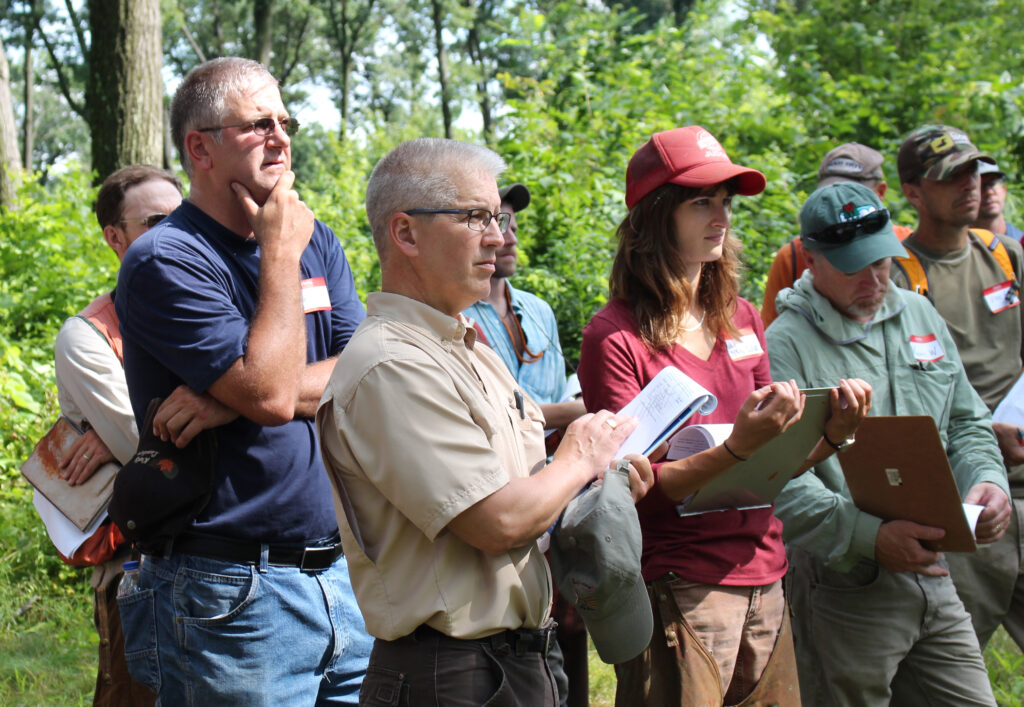
A DNR group in a forest discusses forest health issues .

Wisconsin DNR Forest Health specialist Bill McNee presents a hazard tree training talk to other DNR workers at Lizard Mound State Park in 2023. / Photo Credit: Wisconsin DNR

Did any of your trees explode during the recent cold snap? Likely not.

Social media — and some traditional news outlets — grabbed hits and headlines by warning folks that the January cold snap could spark a phenomenon they called “exploding trees.”

But Bill McNee, an Oshkosh-based Forest Health specialist for the Wisconsin Department of Natural Resources (DNR), was there to prune the branches of the fast-growing viral story.

Continue reading “Forest Health Specialists Spread The News”