
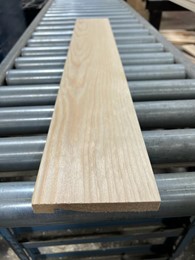
Lumber is produced at a mill. / Photo Credit: Twin Oaks Lumber
By Elle Soderberg, DNR Forest Products Specialist
The Wisconsin Department of Natural Resources Forest Products Services team would like to share some perspectives based on our conversations with forest products industry contacts and information sources. Our goal in sharing these informational updates is to provide material to help you understand how the state’s forest products industry is being impacted, not only by market/seasonal trends, but also by major announcements (e.g., mill closures, expansions, economic factors, etc.).
Logging
Weather conditions, workforce limitations, and shifting market demand continue to present significant challenges for Wisconsin’s logging industry. Changes in weather patterns, particularly the lack of consistently cold winter temperatures, have become one of the most significant barriers for loggers. Without reliable frozen ground, access to many timber sales is limited, reducing the amount of harvestable timber that can be economically and safely reached.
Workforce availability remains another long-standing concern. The logging workforce continues to age, and the industry is experiencing a growing shortage of operators as fewer younger workers enter the field. As a result, many multi-generation logging businesses are selling off equipment rather than transitioning operations to the next generation. In recent years, woodland owners have increasingly felt the effects of this trend. While there is no shortage of harvestable timber on the landscape, many landowners struggle to find loggers available to carry out timber harvests.
Market demand also plays a critical role in shaping logging activity. Weak pulp markets across the state, combined with a slowdown in housing construction – a primary driver of both hardwood and softwood demand – have directly impacted logging operations. Loggers have faced ongoing challenges finding mills willing to accept pulpwood, in part due to major mill closures in recent years. While hardwood markets have remained somewhat more stable, reduced housing demand has resulted in oversupplied conditions, further limiting market opportunities for loggers.
Pulp And Paper
As is typical for this time of year, pulp and paper markets are experiencing rapid fluctuations in wood purchasing driven by weather, year-end inventory targets, and variable mill consumption. Even a modest shift in deliveries or production can quickly move mills from being open for deliveries to placing tight quotas. This year is no exception.
Extended periods of favorable logging weather have resulted in many mills operating with wood yards that are very full heading into winter. One procurement forester noted that while the mills are actively trying to maintain enough open inventory space to sustain a reasonable flow of wood throughout the season, they are receiving higher-than-usual volumes as nearby competitor mills reach capacity. Despite this surge, overall logging production is still believed to be below true capacity; the recent uptick appears largely tied to exceptional weather conditions, reduced demand in seasonal markets linked to home construction, and continued weakness in hardwood log markets driven by broader housing sector challenges.
Fiber consumption has reportedly increased year over year for many mills, though production remains well below full capacity at roughly 80%. Looking ahead to 2026, one company reports that it is cautiously optimistic that improved sales, supported by new product development in packaging grades and growing market share tied to full EUDR compliance, will move operations closer to 85–90% capacity. Tariffs have had minimal direct impact on their operations, aside from contributing to inflationary pressures on equipment, parts and logging-related costs.
Hardwood Lumber
Hardwood prices across most of Wisconsin remain well below their pandemic-era highs. However, prices are generally higher than in 2024, though mills are operating with tighter profit margins. Lumber markets have shown modest strength, with slight increases in kiln-dried lumber prices and selective demand for species such as hard maple and red oak, while white oak and walnut prices have remained relatively steady. This price stability has been supported largely by low production levels, which have helped keep values stronger than in previous years.
Wisconsin’s sluggish lumber market continues to be driven by a national slowdown in housing construction, which has reduced demand for many wood products despite abundant timber availability. Declines in both single-family and multifamily housing starts, combined with higher home prices and elevated interest rates, have dampened demand for softwood construction lumber as well as hardwood products used in cabinetry, flooring, and furniture. While Wisconsin experienced a slight uptick in housing permits earlier this year, ongoing market uncertainty and homeowners’ reluctance to move have limited a broader recovery.
As in recent years, many mills have responded by emphasizing superior quality, color consistency, and customer service to maintain sales. Chip and sawdust residue markets have remained steady; however, bark and mulch markets have weakened following the pandemic-era DIY landscaping boom. Because residue sales often play a critical role in sawmill profitability, identifying new buyers or alternative uses for bark has become increasingly important.
Railroad Ties
The railroad tie industry has shown little change from the previous year. This is largely due to railroad capital expenditure remaining steady. However, going into 2026, there remains some uncertainty as changes in the political environment could drive a further impact on the industry. With U.S. economic uncertainty, a slight decline in railroad tie production is predicted this year. Promising news comes from the hopeful expansion of the U.S. coal industry and coal shipments, which would positively affect the tie industry.