Archives

UW-Madison Launches Website About Cicadas

By Krista Hamilton, Wisconsin Department of Agriculture, Trade and Consumer Protection;
Krista.Hamilton@wisconsin.gov

Photo of cicadas on a plant.

Hungry cicadas are expected to emerge from their 17-year dormancy this month to feed and mate. In past emergences, Brood XIII cicadas have been documented in 11 southern Wisconsin counties. / Photo Credit: Jim Occi, BugPics, Bugwood.org

In anticipation of the emergence of the Brood XIII periodical cicada this spring, the University of Wisconsin-Madison introduced a new Wisconsin Periodical Cicada website.

Information on the site covers the biology, ecology and distribution of these insects using photos, historical videos and other useful resources.

UW-Madison entomologist PJ Liesch sifted through 150 years of books, newspaper articles, university studies, government records and specimens in the Wisconsin Insect Research Collection to develop an updated map of Wisconsin periodical cicada reports.

Continue reading “UW-Madison Launches Website About Cicadas”

The Scourge Of Spurge, Both Cypress And Leafy

By Erika Segerson-Mueller, DNR invasive plant program specialist, Oshkosh;
Erika.SegersonMueller@wisconsin.gov or 715-492-0391

Photo showing the white milky sap of spurge plants, sometimes called “wolf’s milk.”

The white milky sap of spurge plants, sometimes called “wolf’s milk,” can be toxic to cattle and irritating to human skin. / Photo Credit: Norman E. Rees, USDA Agricultural Research Service Retired, Bugwood.org

Managing invasive plant species can really be a pain. When the plants you are targeting can potentially harm human health, that pain can become quite literal.

Leafy spurge (Euphorbia esula) and Cypress spurge (Euphorbia cyparissias) are restricted invasive plants under Wisconsin’s Invasive Species Rule NR40. Aside from their tendency to spread aggressively and displace native species, both plants contain a white milky sap that can cause skin irritation in some humans and is potentially toxic to cattle and horses. Continue reading “The Scourge Of Spurge, Both Cypress And Leafy”

Phomopsis Galls Found On Northern Red Oak

By Linda Williams, DNR forest health specialist, Woodruff;
Linda.Williams@wisconsin.gov or 920-360-0665

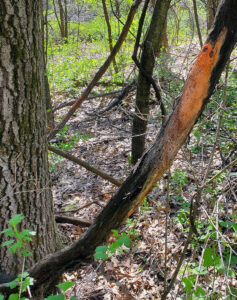
Photo showing large Phomopsis galls on a tree before it has leafed out in the spring.

It is often easier to spot large Phomopsis galls before leaves come out in the spring.

Phomopsis galls are large woody swellings on the branches or main stem caused by a fungus. Across Wisconsin, Phomopsis galls can grow on hickory, especially bitternut hickory. However, in some areas of Wisconsin, they can occur on northern red oak.

Northern red oaks sometimes have hundreds of Phomopsis galls on the branches, ranging from as small as a tennis ball to as large as a basketball. Continue reading “Phomopsis Galls Found On Northern Red Oak”

On The Outs With Goutweed

By Erika Segerson-Mueller, DNR Invasive Plant Program Specialist, Oshkosh Service Center;
Erika.SegersonMueller@wisconsin.gov or 715-492-0391

Photo of Bishop’s goutweed, a common garden ornamental that may be better known to home gardeners as “snow-on-the-mountain.”

A common garden ornamental, Bishop’s goutweed may be better known to home gardeners as “snow-on-the-mountain.” / Photo Credit: Leslie J. Mehrhoff, University of Connecticut, Bugwood.org

Introduced as an ornamental plant commonly planted in gardens, Bishop’s goutweed is a restricted invasive plant in Wisconsin under Invasive Species Rule NR40.

Also known by common names such as snow-on-the-mountain, bishop’s weed and goutwort, the variegated variety with white edges will probably look familiar to many gardening enthusiasts. Continue reading “On The Outs With Goutweed”

USDA Seeks Donated Ash Trees To Battle Emerald Ash Borer

By Caleb Burden, Acting Field Lead Technician, USDA APHIS PPQ;
Caleb.Burden@usda.gov or 734-732-0025

Photo of a green ash tree with a small piece of bark cut back shows emerald ash borer larvae feeding on the tree.

A green ash tree with a small piece of bark cut back shows emerald ash borer larvae feeding on the tree. / Photo Credit: USDA APHIS PPS

In the fight against emerald ash borer (EAB), the United States Department of Agriculture (USDA) again asks Wisconsin landowners to donate live, EAB-infested ash trees for use in a biological control program.

The emerald ash borer is an invasive insect from Asia first detected in the United States in 2002. Following its discovery, EAB has caused the death and decline of tens of millions of ash trees.

Continue reading “USDA Seeks Donated Ash Trees To Battle Emerald Ash Borer”

Forest Health News Subscribers Provide Input

By Art Kabelowsky, DNR Forest Health Outreach and Communications, Fitchburg;
Arthur.Kabelowsky@wisconsin.gov or 608-335-0167

Screenshot of a typical main page of the Wisconsin Department of Natural Resources' monthly Forest Health News.

A typical main page of the Wisconsin Department of Natural Resources’ monthly Forest Health News publication. / Graphic Credit: Wisconsin DNR

The readers have spoken … well, they’ve filled out their surveys. Now, we’re documenting what we learned.

The Wisconsin Department of Natural Resources (DNR) Forest Health team recently surveyed subscribers to its monthly Forest Health News, an internal and external newsletter sent out during the first week of every month.

Here are some general statistics about the newsletter: Continue reading “Forest Health News Subscribers Provide Input”

Forest Health Staff Plan Outreach Appearances

By Art Kabelowsky, DNR Forest Health Outreach and Communications, Fitchburg;
Arthur.Kabelowsky@wisconsin.gov or 608-335-0167

Photo of DNR forest invasive plants program specialist Erika Segerson-Mueller speaking at a 2023 gathering in Wausau.

Wisconsin Department of Natural Resources forest invasive plants program specialist Erika Segerson-Mueller speaks at a 2023 gathering in Wausau. / Photo Credit: Wisconsin DNR

Members of the Wisconsin Department of Natural Resources (DNR) Forest Health team have planned the following public outreach appearances for the month of April: Continue reading “Forest Health Staff Plan Outreach Appearances”

UW–Extension Ready To Handle Questions On Yard Trees

By Art Kabelowsky, DNR Forest Health Communications and Outreach, Fitchburg;
Arthur.Kabelowsky@wisconsin.gov or 608-335-0167

A screenshot of the University of Wisconsin-Madison Extension web page inviting viewers to ask a gardening question of its staff.

A screenshot of the University of Wisconsin-Madison Extension web page inviting viewers to ask a gardening question of its staff. / Graphic Credit: University of Wisconsin-Madison Extension

Now that spring has sprung, Wisconsin Department of Natural Resources (DNR) staffers can expect questions from the public about their yard trees.

However, the mission of DNR Foresters and Forest Health staff is geared toward focusing on larger, forested areas, not yard trees. Those questions fall under the purview of the University of Wisconsin-Madison Extension Horticulture Program.

Continue reading “UW–Extension Ready To Handle Questions On Yard Trees”

Dropping The Aphid Grenade On Garlic Mustard

By Erika Segerson-Mueller, DNR Invasive Plant Program Specialist, Oshkosh Service Center;
Erika.SegersonMueller@wisconsin.gov or 715-492-0391

Photo showing that leaves appear wrinkled and less healthy in garlic mustard plants affected by aphids.

Leaves appear wrinkled and less healthy in garlic mustard plants affected by aphids. / Photo Credit: Rebecah Troutman, Holden Forests and Gardens, Bugwood.org

The NR40-restricted invasive plant garlic mustard (Alliaria petiolata) is prevalent in many Wisconsin woodlands, but a new wave of hope is on the horizon.

The garlic mustard aphid, a tiny, dark, gray-to-green insect sometimes called the “grenade” aphid after the pattern of raised blotches on its back, was found in 2021 at the Holden Arboretum in Ohio. It could become a viable form of biocontrol for the garlic mustard plant.

Continue reading “Dropping The Aphid Grenade On Garlic Mustard”

2024 Spongy Moth Spray Plans Announced

By Art Kabelowsky, DNR Outreach and Communications, Fitchburg;
Arthur.Kabelowsky@wisconsin.gov or 608-335-0167

Photo of an airplane spraying insecticide on trees at Devil's Lake State Park in Sauk County.

An airplane sprays insecticide on trees at Devil’s Lake State Park in Sauk County. / Photo Credit: Wisconsin DNR

The Wisconsin Department of Natural Resources (DNR) has finalized aerial spraying plans for its 2024 Spongy Moth Suppression Program, with maps for the six selected treatment areas available online.

The treatment sites contain high-value trees at six state parks or forests in Columbia, Marinette, Sauk and Walworth counties. A total of 928 acres will be treated with an aerial spray of “Foray” bacterial insecticide containing Bacillus thuringiensis var. kurstaki.

Continue reading “2024 Spongy Moth Spray Plans Announced”