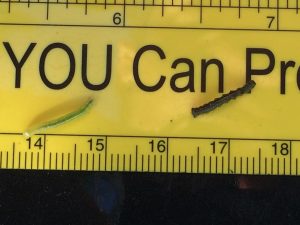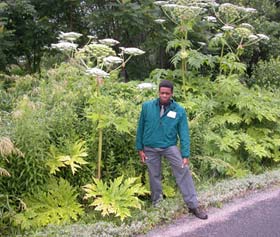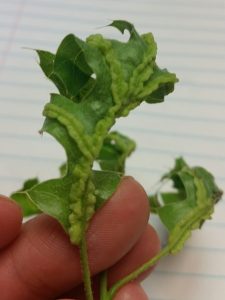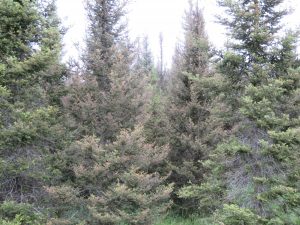
Amur cork tree (Phellodendron amurense) is a relatively new invasive plant found in at least four Wisconsin counties. It is classified as Prohibited under Wisconsin’s invasive species law, NR 40. The female cork tree cannot be possessed, transferred, transported or introduced in Wisconsin. We ask that you report this tree to DNR because it is invasive here and in other states and DNR is mounting control efforts before it becomes widespread. DNR works with property owners to achieve this by providing advice, tools and resource opportunities. Continue reading “Amur cork tree is an emerging threat to Wisconsin forests.”
Forest Health News
Wind and hail damage caused by the April 9, 2017 storm

The National Weather Service local storm reports map shows hail was most commonly reported, with some tree damage, and one tornado (west of Wausau).
During the night of April 9-10, 2017 a strong line of storms moved through Wisconsin. Reports ranged from pea sized to tennis ball sized hail, with most stating quarter sized hail. Immediately following the hail, winds picked up and straight line winds took down trees in a number of areas around Oneida and Vilas Counties. The National Weather Service reports that there was a tornado touch down west of Wausau, and reports of tree damage showed up in the National Weather Service’s local storm reporting page.
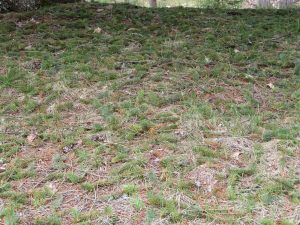
Damage to trees from hail was most noticeable on the conifers which had needles knocked off, creating a green carpet below the trees. Fine twigs on white pines were damaged by the hail and some fine branch mortality may occur if the twigs were damaged badly enough. Damaged red pine may be more prone to getting diplodia where the twigs were wounded.

April 9 hail wounds on white pine branches (yellow arrows) appear small but will dry, and the bark will crack further as spring progresses. Some branch dieback may occur.

April 9 hail wounds on young aspen and the fine branches of mature aspen appear as scuffed bark (yellow arrows). These will callus over relatively quickly.
Small wounds on young aspen should callus over.
Written by: Linda Williams, forest health specialist, Green Bay, (Linda.Williams@wisconsin.gov), 920-662-5172.
Herbicide damage to trees
Herbicide damage can resemble other tree problems such as branch dieback, foliage discoloration, and premature leaf or needle drop. Look for certain clues to help narrow down whether it is a weather related issue, insect or disease issue, or a potential herbicide issue.
Forest tent caterpillar egg mass surveys indicate low populations again

Newly hatched forest tent caterpillars with the egg mass they emerged from. Egg masses are laid in mid-summer and remain on the tree through the winter.
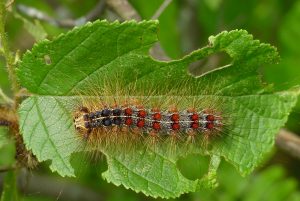
Low numbers of forest tent caterpillar egg masses were found recently during surveys in Vilas and Oneida Counties. Forest tent caterpillar is a native insect that has periodic outbreaks. Our last outbreak was from 1999-2002, and they typically have outbreaks every 10-15 years. Last year I noticed a few more caterpillars than the previous year, but there was no noticeable defoliation. So far egg mass surveys indicate another year of low populations, although there may be areas with locally higher populations. Forest tent caterpillar eggs will start hatching soon, timed to closely match the emergence of aspen leaves.

Eastern tent caterpillars hatch from eggs and immediately start to create a web nest. Young caterpillars are shown on a small nest.
Eastern tent caterpillars do not follow a typical outbreak pattern and tend to be present at some low level every year. They create web nests early in the spring, preferring black cherry trees, crabapple trees, or other stone fruits. When webs are small the caterpillars can be easily crushed or sprayed. As webs get bigger you may have to use a rake to pull them out of the tree. It is not necessary to prune the branch out of the tree. Doing so will actually cause more damage to the tree than the defoliation caused by the caterpillars, because trees can more easily send out additional leaves than grow a branch to replace one you prune out. Please do not burn nests out of the trees as this could start a wildfire.
Written by: Linda Williams, forest health specialist, Green Bay, (Linda.Williams@wisconsin.gov), 920-662-5172.
Emerald ash borer new locations in Wisconsin

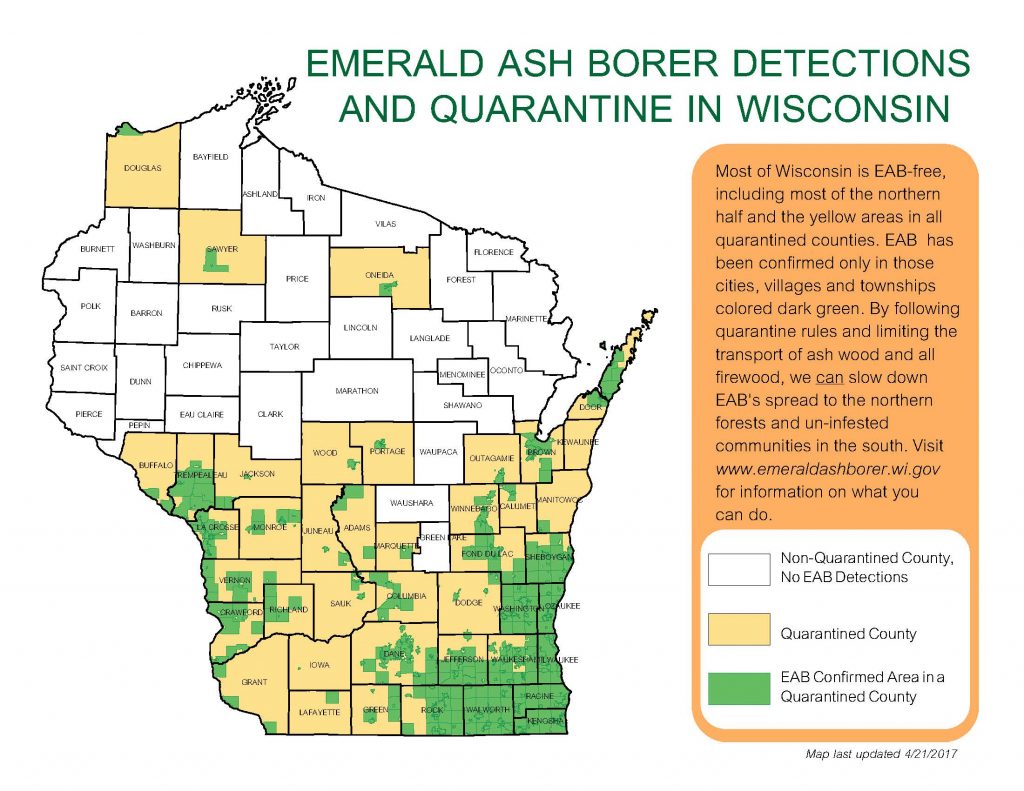
EAB quarantine and detections map. Counties shaded in tan are quarantined for EAB, green areas are townships and municipalities where EAB has actually been identified.
Emerald ash borer (Agrilus planipennis) continues to be found in new areas. Wisconsin continues to track EAB at the municipality or township level; quarantined counties are shown in tan and known infested areas are shown in green on the map.
If you know you have EAB, please contact us with that information so we can verify the infestation and update the maps. If your area:
- is not shaded in green on the map please contact DNR or
- is not shaded at all on the map please contact DATCP.
You can reach both agencies from the menu options when you call 1-800-462-2803.
New county quarantines
- none
New finds in counties already quarantined
- Adams/Columbia/Juneau/Sauk counties — city of Wisconsin Dells
- Brown County — village of Allouez
- Crawford County – town of Bridgeport
- Columbia County – town of Lowville
- Columbia/Dodge counties – village of Randolph
- Dane County – village of DeForest
- Green County – town of Monroe
- Jackson County — towns of Melrose and North Bend
- Jefferson County – towns of Aztalan, Farmington, Hebron, and Sumner
- La Crosse County – town of Shelby
- Monroe County – city of Sparta
- Rock County – towns of Clinton, Harmony, Johnstown, and Lima
- Sheboygan County – village of Kohler
- Trempealeau County — towns of Ettrick, Gale and Preston
Written by: Linda Williams, forest health specialist, Green Bay, (Linda.Williams@wisconsin.gov), 920-662-5172.
Emerald ash borer trapping in 2017
The Wisconsin DNR forest health team is planning to trap for emerald ash borer (EAB) at 20 locations in 2017.

EAB trap locations in northwest Wisconsin in 2017.

EAB trap locations in northeast Wisconsin in 2017.
Traps will mostly be placed on state properties. A couple traps will be placed on county land where state properties are not in the local area. Traps are deployed close to 400 growing degree days so they are ready when EAB adults start emerging at approximately 450 degree days. In 2016, southern Wisconsin hit 450 degrees days (modified base 50°F) in late May.
Written by: Mike Hillstrom, forest health specialist, Wisconsin Dells (Michael.Hillstrom@Wisconsin.gov), 715-459-1371.
Emerald ash borer trapping by a few northern county forestry departments
Douglas, Oneida, and Sawyer County Forestry Departments will be trapping emerald ash borer on select sites across their properties this year. As needed, the DNR Forest Health Program and the Department of Agriculture, Trade and Consumer Protection (DATCP) will provide guidance to county forest departments that are responsible for purchasing, installing and monitoring their EAB purple prism traps.
Any new EAB detections will be tracked at the state level and may be used by forest managers to prioritize stand management based on EAB proximity, and by communities to inform the timing of ash management in community forests.
The abundance of ash forest resources and limited known distribution of EAB in the state’s north spurred interest by these counties to continue trapping.
Written by Paul Cigan, forest health specialist, Hayward (Paul.Cigan@Wisconsin.gov), 715-416-4920.
Lesser celandine is an emerging threat to Wisconsin forests – be on the lookout.

Spherical bulbils of lesser celandine form during the spring growing season. Later they drop off and sprout to form new plants.
Lesser celandine (Ranunculus ficaria), also known as fig buttercup, is a ground layer plant and an aggressive invader of forests in North America. So far, it is relatively unknown in Wisconsin but has been found in the southeastern part of the state, especially in moist (mesic and wet-mesic) forests and along river banks.
Lesser celandine is a spring ephemeral that emerges in early spring, develops flowers, dies back by early summer, and remains dormant in underground tubers. During the short growing period the plant produces bulbils which sprout and give rise to new plants. After the round bulbils drop off they are spread by gravity, water, small animals, and like the tubers, transported when soil is moved. Continue reading “Lesser celandine is an emerging threat to Wisconsin forests – be on the lookout.”
Welcome to the new Forest Health News
The DNR Forest Health Program has transitioned to a new online newsletter format. You will no longer receive Pest Updates and Regional Forest Health Newsletters directly from DNR Forest Health Specialists. Instead, if you are subscribed to Forest Health News you will receive an email, typically once per month, when new information is posted by the Forest Health Program on this new Wisconsin DNR Forestry News site. You can also access the articles directly anytime.
If you haven’t already, consider subscribing and please take a moment now to include widnr@service.govdelivery.com in your email address book, so the emails avoid your spam box.
Monthly emails will have Forest Health articles organized by:
- Information that is relevant statewide and
- Information specific to certain parts of the state.
The Forest Health News zones have changed too, so check out which counties each zone covers.
New zones for Forest Health News updates
The map shows which counties are included in each Forest Health News zone for purposes of monthly news updates, as of March 2017. Subscribers to Forest Health News emails and visitors to this site who are interested in forest health articles for specific parts of the state can refer to the map to check out which forest health zone or region they’d like to read news updates from on this site. If you use tags from the menu bar on the right side of this page to sort articles remember: Forest Health News with statewide relevance is shown with a “Statewide Forest Health” tag and is not included in each zone’s tag.

For more information: Colleen Robinson, forest health educator (Colleen.Robinson@Wisconsin.gov), 608-266-2172.