Urban Forestry News

Go Outside Funds Available

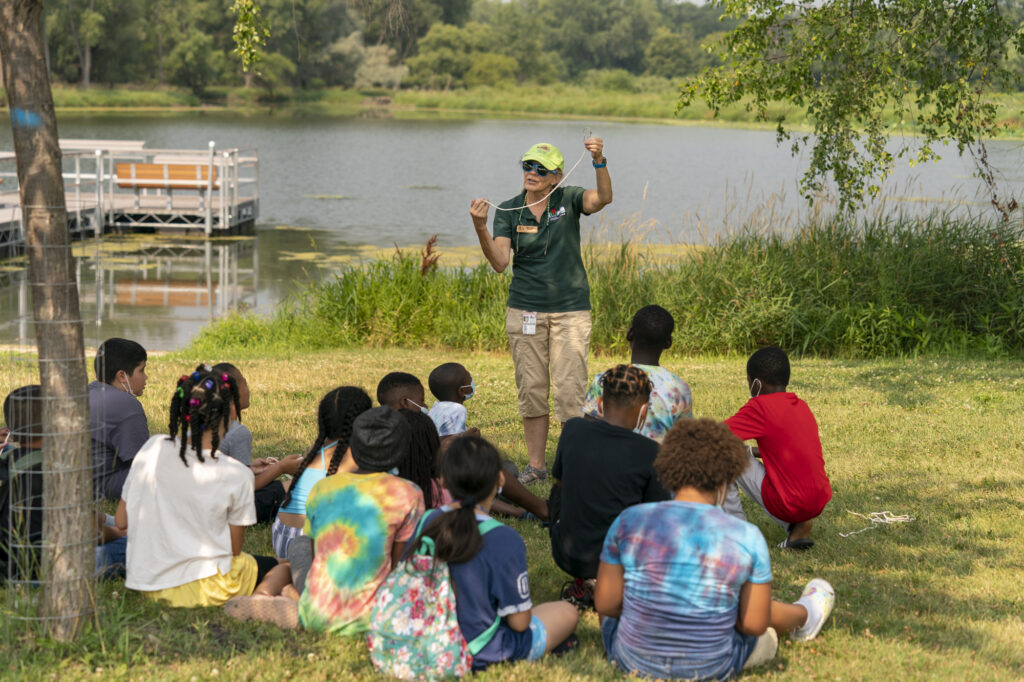
children learning outdoors

Photo Credit: Wisconsin DNR

The Go Outside Fund provides funding that helps connect youth to outdoor, nature-based learning experiences. Teachers or partner organizations may apply for funding to cover costs that facilitate getting kids outside and hands-on with nature, such as purchasing field supplies or paying for transportation and educator costs. Grants between $100 and $1,500 are available. Educators, as well as eligible organizations, are welcome to apply, with the next deadlines for applications being Sept. 1 and March 1, 2026. Continue reading “Go Outside Funds Available” →
When Can I Prune That Elm Tree?

By Elton Rogers, DNR Urban Forestry Coordinator
Elton.Rogers@wisconsin.gov or 414-294-8675

Most urban foresters and arborists are aware of the historical significance of Dutch elm disease (DED). Introduced to the United States in the 1930s, this deadly fungus wreaked havoc on urban and rural forests throughout the United States. In many ways, DED was the impetus for many of the best practices of urban forestry we see today, such as species diversification and modern plant health care practices.

Likewise, most urban forest practitioners understand DED is still very much prevalent today, and if they are managing any lingering American elms, they know they can help decrease their susceptibility to the disease by not actively pruning or wounding them during the growing season. Pruning these elms during the growing season attracts bark beetles, which can carry thousands of DED fungal spores on their bodies. But elm is a complex genus; there are over 30 different species of elm and hundreds (if not thousands) of hybrids and cultivars in the landscape. So, which of these species and cultivars can you prune during the growing season, and which shall you not? Continue reading “When Can I Prune That Elm Tree?” →

Upcoming Training & Events

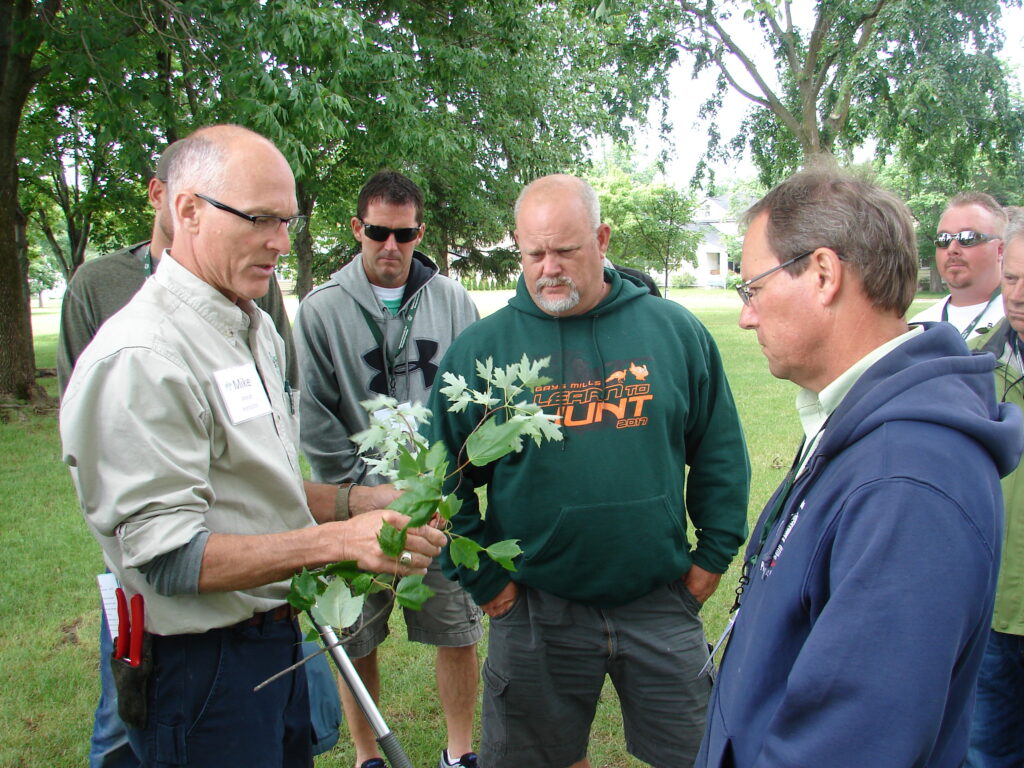
group of adult learning to identify trees

Photo Credit: Wisconsin DNR

* These training opportunities are provided as an information service only and do not constitute endorsement by the Wisconsin Department of Natural Resources (DNR).

See below for information on training topics and events, including biopesticides, invasives, urban trees and fire, tree diseases, ecological restoration, safety and woodland trees and management. Continue reading “Upcoming Training & Events” →

Public Hearing On Invasive Species Regulations Set

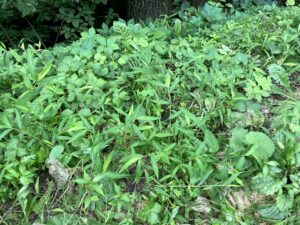
A wide-angle photo of an infestation of Japanese stilt grass in a forest.

A field at the Coulee Experimental Forest near La Crosse is infested by Japanese stilt grass. / Photo Credit: Wisconsin DNR

By Jenn Janness, DNR Urban Forestry Communications

The Wisconsin Department of Natural Resources will hold a virtual public hearing on a permanent rule to revise Ch. NR 40, relating to changes to invasive species regulations.

Meeting details:

  • Date: Aug. 5, 2026
  • Time: 5 p.m.
  • Online: Join via Microsoft Teams
  • Phone: Join by calling 608-571-2209 and entering phone conference ID 496 793 478#

Continue reading “Public Hearing On Invasive Species Regulations Set” →

Forest Health Team Debuts Two New Fact Sheets

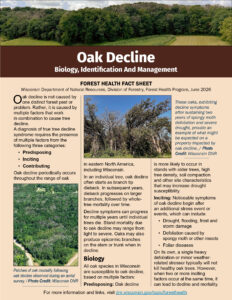
An image of the front page of a DNR fact sheet.

The front page of the Wisconsin DNR’s new Forest Health Fact Sheet on oak decline. / Graphic Credit: Wisconsin DNR

By Art Kabelowsky, DNR Outreach and Communications, Fitchburg
Arthur.Kabelowsky@wisconsin.gov or 608-335-0167

The Wisconsin Department of Natural Resources Forest Health team has published two new fact sheets, bringing the total count of its fact sheet offerings to 26.

The new fact sheets:

  • Fall Webworm: DNR Publication FR-622u discusses basic information on the biology of the insect (Hyphantria cunea), its life cycle, potential lookalike caterpillars and management options.
  • Oak Decline: DNR Publication FR-622v covers the tricky topic of oak decline, which is not caused by one distinct forest pest or problem but instead is the result of multiple factors — some predisposing, some inciting and some contributing — that work in combination to cause decline.

The fact sheets are designed in full color, with photos, and are meant to be printed out for reference or to carry into the field. They can also be viewed online. They can be printed on standard letter-sized paper. Most fact sheets are two pages, meant for two-sided printing; a few are four-page documents.

A complete directory of links to all DNR Forest Health fact sheets is available online.

Cooperative Enlists Public To Make Tree Health A Snap

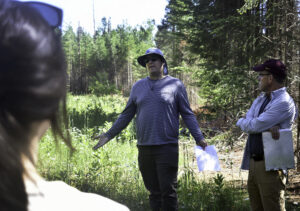
A worker speaks with colleagues in a forested area.

Dr. Scott O’Donnell, center, a forest geneticist with the Wisconsin Department of Natural Resources Forest Economics and Ecology section, updates members of the DNR Forest Health team on upcoming genetic projects at an orchard near Lake Tomahawk in Hazelhurst during the Forest Health team’s summer meeting on May 25, 2024. / Photo Credit: Wisconsin DNR

By Art Kabelowsky, DNR Outreach and Communications, Fitchburg
Arthur.Kabelowsky@wisconsin.gov or 608-335-0167

It takes more than a village to foster healthy forests. More than a township, a city and a county, too. Sometimes, even more than a state.

That’s why the Great Lakes Basin Forest Health Cooperative (GLB FHC) was formed five years ago by Holden Arboretum in Ohio and the U.S. Department of Agriculture Forest Service.

Geographically, the group’s region encompasses an area from New Jersey to Wisconsin. The Wisconsin Department of Natural Resources (DNR) is an active member.

Continue reading “Cooperative Enlists Public To Make Tree Health A Snap” →

2027 Urban Forestry Grants Announced

By Nicolle Spafford, DNR Urban Forestry Grant Manager
Nicolle.Spafford@wisconsin.gov or 715-896-7099

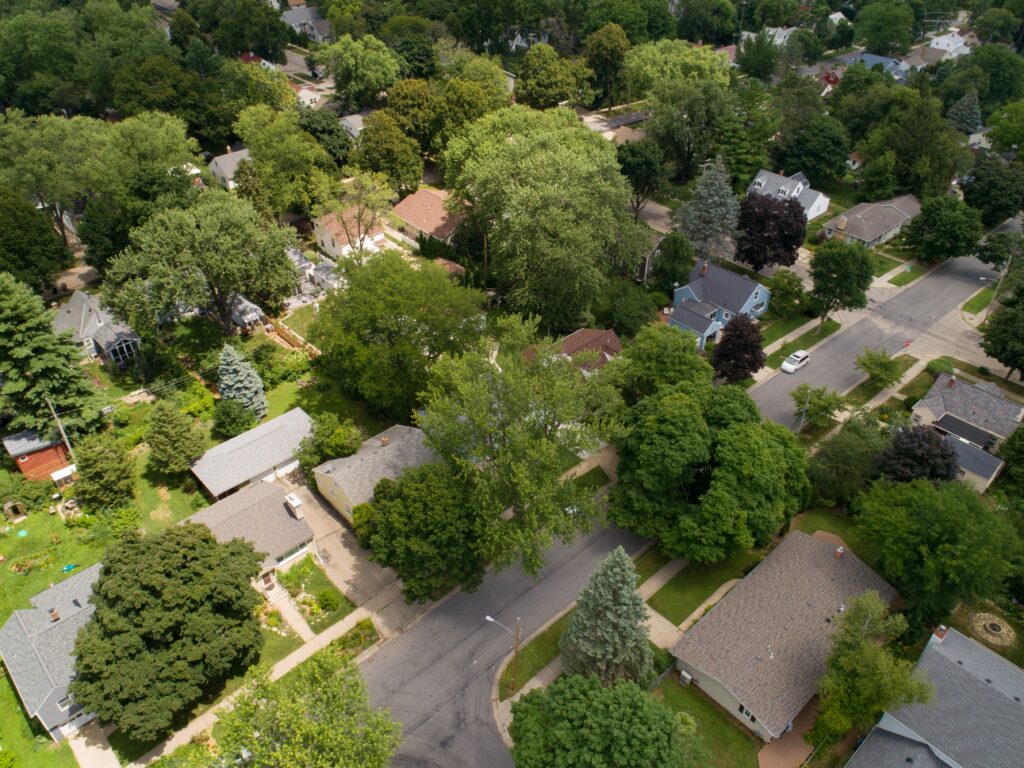
aerial view of neighborhoodBeginning July 1, 2026, cities, villages, towns, counties, tribes and 501(c)(3) nonprofit organizations conducting projects in Wisconsin can apply for a regular or startup 2027 Wisconsin Department of Natural Resources (DNR) Urban Forestry grant. Continue reading “2027 Urban Forestry Grants Announced” →
The Urban Forestry Staff Springs Into Action For Arbor Day

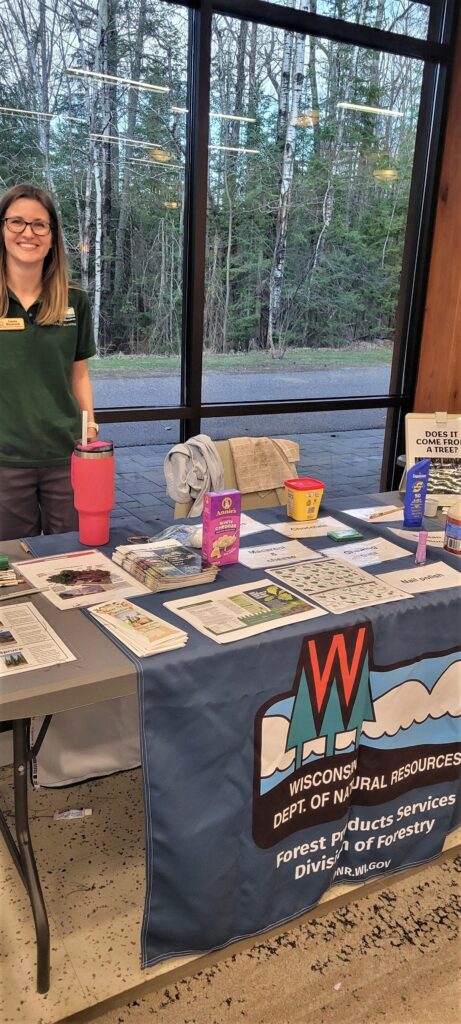
Laura Buntrock hosted an urban forestry booth at Rhinelander’s Earth Day Sustainability Fair, where she educated the public on the benefits of urban trees, provided resources and answered questions.

April and May might just be the busiest months of the year for the Urban Forestry staff. This small but mighty team participates in as many Arbor Day, Earth Day and Forest Appreciation Week events as they can fit into their schedules. Municipalities, schools and nonprofits tend to spread out their events over a couple months rather than scheduling them all on Arbor Day, which allows the staff to get to more events.

The Urban Forestry team’s involvement in these events varies and can include tree planting, seedling distribution, education and tree-related activities, such as competing for the loudest Arbor Day cheer. If you have an event you would like an Urban Forestry staff member to attend at any time of the year, get your request in early!

Here are just a few of the events that Urban Forestry staff attended. Continue reading “The Urban Forestry Staff Springs Into Action For Arbor Day” →

Urban Forestry Welcomes Summer Interns

The Urban Forestry team is excited to have two interns this summer through the State of Wisconsin Student Development Internship Program (SWSDIP). They will be working out of the Milwaukee DNR office but will also have opportunities to get involved in projects in other parts of the state. The Urban Forestry interns always hit the ground running, squeezing an impressive number of activities into their time with the program. Watch for an article later in the year summarizing their experience with the Urban Forestry program. Continue reading “Urban Forestry Welcomes Summer Interns” →

What’s In A Name? An Intro To Reading Scientific Names

By Abby Krause, DNR Urban Forestry Coordinator
Abigail.Krause@wisconsin.gov or 608-556-5690

What’s in a name? That which we call a tree by any other name would stand as tall. Okay, maybe that’s not exactly how the Shakespeare quote goes, but in the urban forestry world, what we call a tree does play into our management decisions.

As communities work to recover from the devastation inflicted by invasives pests and build resilience against future challenges, species diversity rules have become the guide for planting projects. Planning out care of trees once they’re in the ground also revolves around knowing which species are present. How are we tallying our progress toward diversity goals, relaying the specific species we want to order from the nursery or narrowing down what’s ailing that tree in the park? Continue reading “What’s In A Name? An Intro To Reading Scientific Names” →