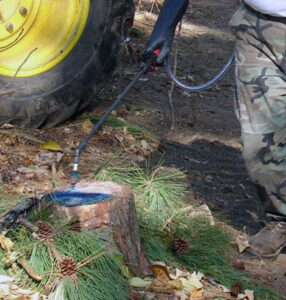
A worker manually applies fungicide, imbued with blue dye, to a freshly cut tree stump to fight the spread of fungal diseases such as Heterobasidion root disease. / Photo Credit: Wisconsin DNR
By Kyoko Scanlon, DNR Forest Pathologist, Fitchburg
Kyoko.Scanlon@wisconsin.gov
The manufacturer, Lallemand Plant Care, recently decided to remove Rotstop® C fungicide from the North American market.
As a result, the product is no longer available for purchase in North America. If you already have the product and have stored it in an appropriate space, you may still use it as a preventative treatment for Heterobasidion root disease (HRD) as long as the expiration date has not arrived.
Continue reading “Rotstop® C No Longer Available In North America”


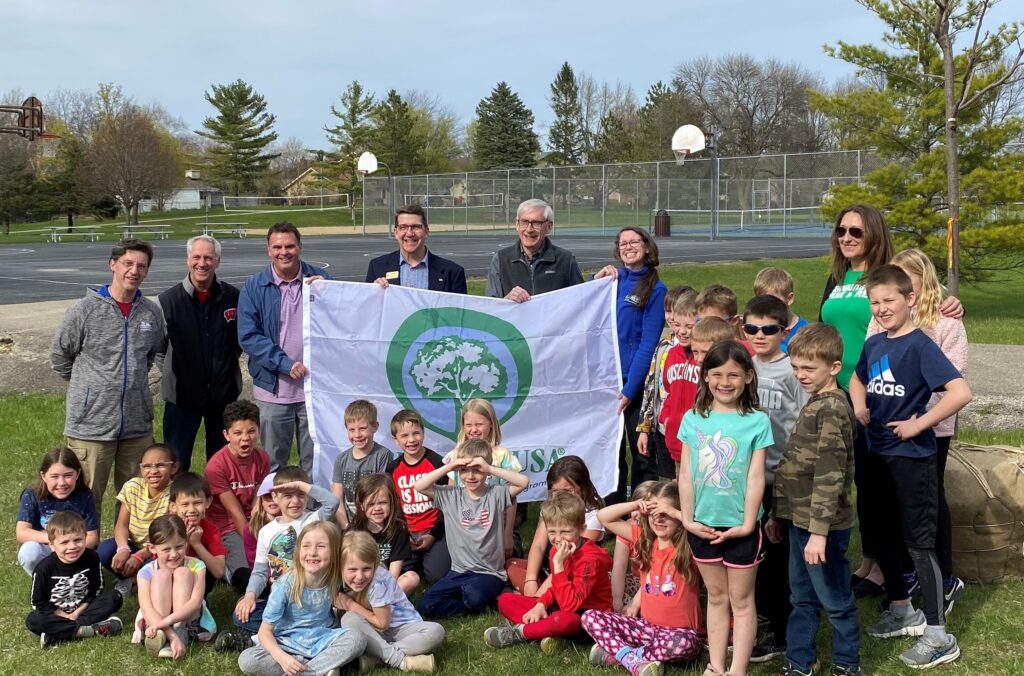 Arbor Day’s roots began in the late 1800s in Nebraska where, according to the Arbor Day Foundation, residents of Nebraska City felt a lack of trees in their community. The secretary of the Nebraska Territory at the time, J. Sterling Morton, proposed a statewide tree-planting holiday, and on April 10, 1872, the first Arbor Day was celebrated.