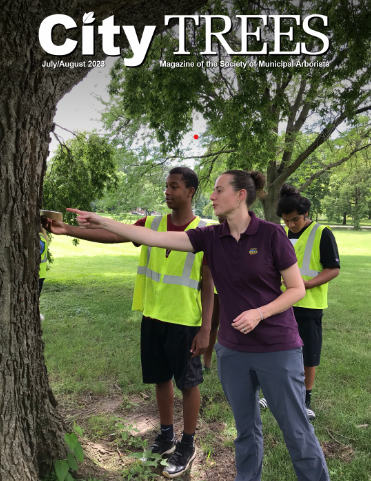
 City Trees, an international, bimonthly online magazine published by the Society of Municipal Arborists and about all things urban forestry, is now free and available to anyone. Subscribe here.
Basswood Thrips Causing Crumpled Leaves, Thin Crowns
By Linda Williams, DNR Forest Health Specialist, Woodruff; Linda.Williams@wisconsin.gov or 920-360-0665
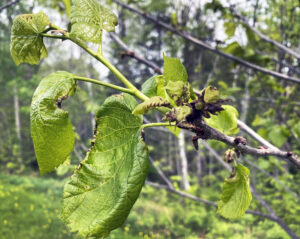
Basswood leaves show damage after feeding of introduced basswood thrips. / Photo Credit: Wisconsin DNR.
For the second consecutive year, damage from introduced basswood thrips (Thrips calcaratus) is significant in some northeastern Wisconsin counties. Introduced basswood thrips are tiny, invasive insects that feed inside tree buds in early spring. Leaves are then deformed when they expand and can look like frost or wind has damaged them.
Continue reading “Basswood Thrips Causing Crumpled Leaves, Thin Crowns”
Maple Petiole Borer Causes Leaves To Drop
By Linda Williams, DNR Forest Health Specialist, Woodruff; Linda.Williams@wisconsin.gov or 920-360-0665
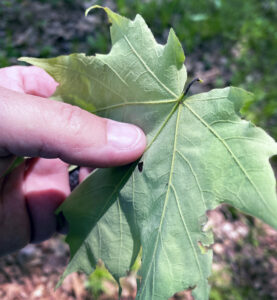
A green maple leaf found on the ground with a broken petiole (leafstalk) due to damage by the maple petiole borer. / Photo Credit: Wisconsin DNR.
Some sugar maple trees in the northern half of Wisconsin experienced leaves dropping to the ground this spring.
These leaves were green and had no apparent areas of damage, but they covered the ground under some trees. A closer look showed these leaves had short petioles (leafstalks) that had been broken off when they fell, which indicates a tiny sawfly larva called maple petiole borer was to blame.
Continue reading “Maple Petiole Borer Causes Leaves To Drop”
Watch For Brown Spot Needle Blight
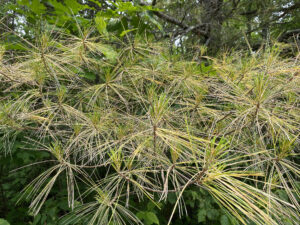
White pine with yellowing needles; new growth is not affected. / Photo Credit: Wisconsin DNR.
By Linda Williams, DNR Forest Health Specialist, Woodruff; Linda.Williams@wisconsin.gov or 920-360-0665
White pine in north central Wisconsin, as well as scattered areas elsewhere in the state, have many needles that are bright yellow. Brown spot needle blight (Lecanosticta acicula, previously known as Mycosphaerella dearnessii) is the primary suspect, although samples have been sent to the Wisconsin Department of Natural Resources (DNR) Forest Health laboratory to determine if other fungal species are present.
Lecanium Scale Creating A Sticky Situation
By Linda Williams, DNR Forest Health Specialist, Woodruff; Linda.Williams@wisconsin.gov or 920-360-0665
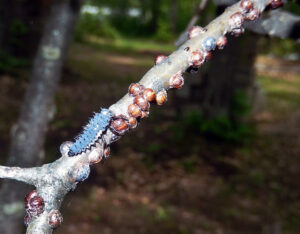
A ladybug larva feeds on lecanium scale domes on an oak twig. / Photo Credit: Wisconsin DNR.
Lecanium scale is infesting oak forests across Marinette, Oneida and Vilas counties. These scale insects insert their mouthparts into twigs and suck the tree sap. They release honeydew, which ants can collect, or coat leaves and anything located under infested trees (i.e., yard furniture or vehicles). Sooty mold can grow on that sticky material and turn things black, so homeowners may want to rinse off the honeydew from outdoor items regularly.
Continue reading “Lecanium Scale Creating A Sticky Situation”
Acorn Pip Galls, Woolly Catkin Galls All The Same
By Linda Williams, DNR Forest Health Specialist, Woodruff; Linda.Williams@wisconsin.gov or 920-360-0665
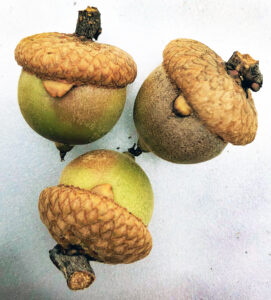
Pip galls are small, tongue-like protrusions emerging from under the caps of acorns. / Photo Credit: Linda Williams, Wisconsin DNR.
Gall wasp life cycles can be complex. Did you know that acorn pip galls, which I’ve written about several times, have another part of their life cycle that is entirely different? This stage is called the woolly catkin gall.
Both woolly catkin galls and acorn pip galls are caused by Callirhytis quercusoperator, a species of cynipid gall wasp. This gall wasp takes two years to complete development by going through the two parts of its life cycle. Both parts of the life cycle are completed on northern red oak in our area.
Continue reading “Acorn Pip Galls, Woolly Catkin Galls All The Same”
Severe Spruce Budworm Defoliation Hits In Northwest
By Linda Williams, DNR Forest Health Specialist, Woodruff; Linda.Williams@wisconsin.gov or 920-360-0665
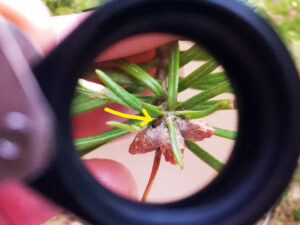
Spruce budworm overwinters as tiny caterpillars (yellow arrow) that migrate to the buds before they start to swell in the spring. A magnifying lens is needed to see them at this stage. / Photo Credit: Linda Williams, Wisconsin DNR.
For the 11th consecutive year in Wisconsin, spruce budworm has caused significant defoliation on spruce, balsam fir and tamarack in some areas of the state.
This year, areas with widespread severe defoliation include Oneida and Vilas counties, with Forest, Iron, and Langlade counties also showing significant defoliation.
Continue reading “Severe Spruce Budworm Defoliation Hits In Northwest”
High Beech Scale Moving Beyond Door County
By Bill McNee, DNR Forest Health Specialist, Oshkosh; bill.mcnee@wisconsin.gov or 920-360-0942;
and Linda Williams, DNR Forest Health Specialist, Woodruff; linda.williams@wisconsin.gov or 920-360-0665
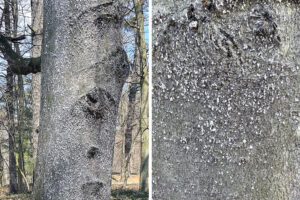
Examples of white “wool” coating on trees heavily infested with beech scale at Kohler-Andrae State Park (left) and in the Town of Beecher in Marinette County (right). / Photo Credit: Bill McNee (left) and Linda Williams (right), Wisconsin DNR.
Fourteen years after first detecting beech scale (Cryptococcus fagisuga, a non-native insect) in Door County, sites with high populations of beech scale have been found in additional counties. Beech scale is believed to have spread through the range of American beech in Wisconsin’s eastern counties, but until now has only been seen at low levels outside of Door County.
Continue reading “High Beech Scale Moving Beyond Door County”
Applications For Urban Forestry Grants Are Now Open
Cities, villages, towns, counties, tribes and 501(c)(3) nonprofit organizations in or conducting their project in Wisconsin can apply for a regular or startup 2024 Wisconsin Department of Natural Resources Urban Forestry Grant.
The grants range from $1,000 to $25,000, and grant recipients must match each grant dollar for dollar. A startup grant of up to $5,000 is available for communities that want to start or restart a community forestry program. Grants are awarded to projects that align with state and national goals for increasing the urban forest canopy and its benefits. Also available this grant cycle is an additional $145,000 in federal funding to be used for emerald ash borer treatment and ash tree removals and replacements.
The application deadline is Oct. 2, 2023. For more information, visit the Urban Forestry Grants webpage.
If you have questions regarding the application process and eligible projects, contact your DNR Urban Forestry Coordinator.
Please note: The DNR was recently allocated $4.875 million in Inflation Reduction Act (IRA) funding. We expect to competitively sub-award most of this allocation to local governments, tribal governments and 501(c)(3) nonprofit organizations through our grant program to fund projects that support equitable access to trees and the benefits they provide in disadvantaged communities across Wisconsin. We will be sharing more information about the IRA funding soon.
The Power Of Progeny: White Oak Initiative
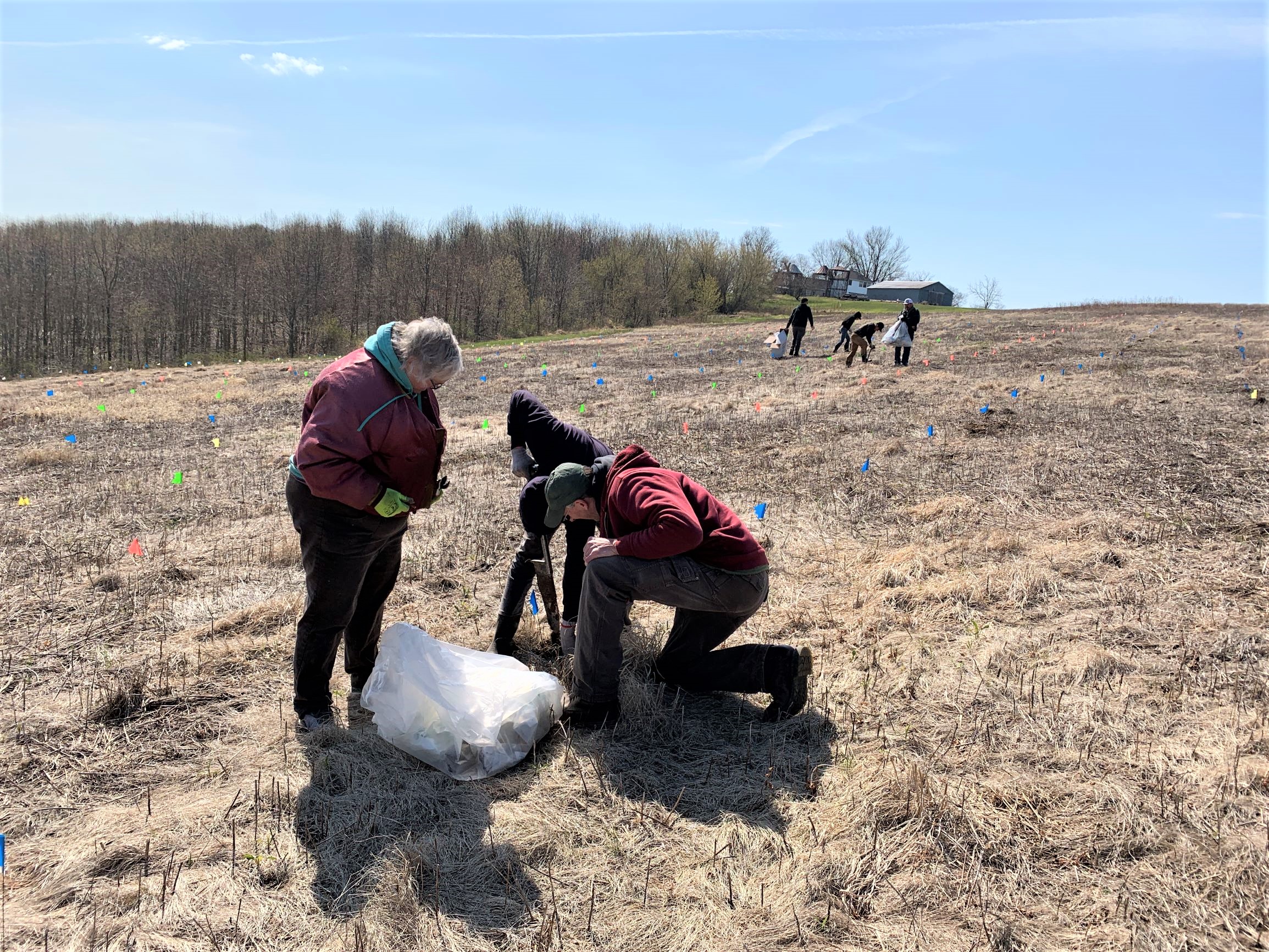
DNR reforestation team leader Joe Vande Hey assists his crew with planting white oak seedlings on a plot in Prairie du Chien.
In the fall of 2021, the Wisconsin Department of Natural Resources (DNR) reforestation team, along with their forestry peers and seasoned seed collectors, were tasked with collecting acorns from the best white oaks across the state as part of the ongoing efforts of the White Oak Initiative, a coalition working on the long-term sustainability of white oak for habitat, recreational activities and industries using oak for forest products.
In total, 39 half-gallon samples of white oak acorns were collected in Wisconsin and part of Iowa. The acorns were processed at Wisconsin state nurseries in late 2021, then shipped to the White Oak Genetics and Tree Improvement Program (WOGTIP) at the University of Kentucky in partnership with the White Oak Initiative.
Prime white oak acorns were collected from a total of 17 states participating in a white oak progeny test implemented by WOGTIP. This research aims to create genetically improved white oak seed orchards across the eastern U.S., including Wisconsin. These high-performing seed orchards will provide a reliable, known source of superior white oak seed for use in forest products industries, such as whiskey distilleries.
Continue reading “The Power Of Progeny: White Oak Initiative”